


Your toddler stacks two cups, tries to balance a third on top, and watches it all topple over. That’s your child sizing things up (is it too tall, will it fit?) and that kind of trial and error is what math for kids looks like at this age. It’s the same with the everyday brain games you already do together—the finger plays, matching and sorting, and memory games. These small moments are where your child starts understanding numbers.
What Counts as Early Math for Kids
Early math for kids isn’t about racing to count to 10. It’s something your child already practices every day, even if you haven’t thought of it as math yet. When your toddler lines up toy cars by size or points at the moon and says “big,” that’s early math. Shapes for kids, comparing amounts, sorting objects, noticing patterns, even measuring how tall a block tower gets—all of it counts.
You’ll sometimes hear this ability called number sense. Erikson Institute’s Early Math Collaborative defines it simply as understanding a group of things and knowing the number that goes with it, like glancing at three mangoes and knowing it’s three without counting one by one.
A foundational study from Duke University found that a baby’s number sense at 6 months old predicted their math scores three years later, a good reminder that this skill starts building long before your child can talk.
Why Play Teaches Math Better Than Worksheets
Flashcards and repetitive drills can wait. Hands-on, playful exploration is what builds a strong foundation for math at this age. Pushing drills on a toddler or preschooler often creates frustration instead of understanding, since your child learns best through touch, movement, and real objects, not abstract symbols on a page.
A study from Temple University and the University of Delaware put this to the test with preschoolers learning shapes. The kids who learned through guided play (hands-on exploration with just a little steering from an adult) understood the shapes better than the kids taught through direct instruction, and they still remembered it a week later. You don’t need a strict lesson plan to make this work for your child. A little guidance during playtime is often what play-based math needs to click.
Everyday Ways to Turn Playtime into Math for Kids
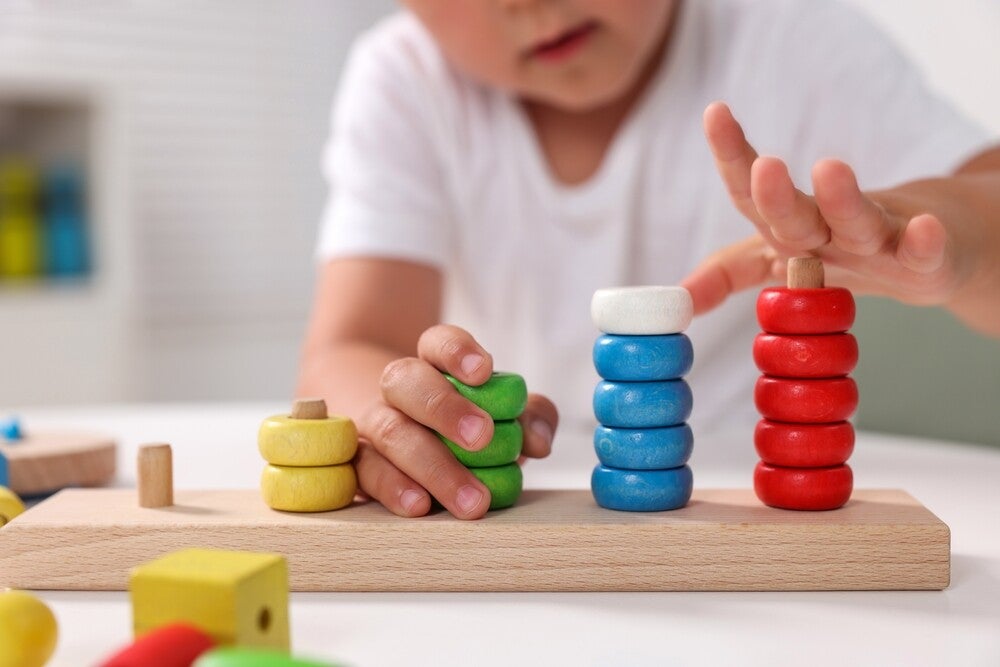
Sorting socks, blocks, or rings by color and shape builds the same thinking skills used in later math.
Ready to help your child fall in love with numbers? Most of these math activities for kids use things you already have at home.
1. Count during daily routines.
Build counting activities for kids into your daily routine. Count the steps as you climb them, the plates as you set the table, the mangoes as you drop them into a bag at the palengke, or all the jeeps you spot going home. The more your child hears you count out loud, the more natural numbers start to feel, no lesson required.
2. Compare portions and amounts.
Ask your child whose shoes are bigger, yours or theirs, or which pile of toy cars has more. Comparing numbers for kids this way builds a feel for “more” and “less” long before they learn to actually count.
3. Sort and match toys.
Give your child a pile of socks, blocks, or plastic containers and ask them to group similar ones together. Matching activities for toddlers and sorting activities for kids like this teach your child to gather things into groups. It’s the same idea they’ll use later when they learn that combining two small groups makes one bigger one, building the foundation for addition and subtraction.
For more ideas, check out these Montessori toys that build problem-solving skills.
4. Spot shapes and patterns around the house.
Point out shapes for kids wherever you go: a round plate, a square window, a triangular roof. Try simple pattern activities for preschoolers, too, like alternating red and blue blocks and asking your child what comes next. This is the same skill they’ll use much later to count by twos or spot what number comes next in a sequence (2, 4, 6, 8…), just dressed up as a block game for now.
5. Measure and cook together.
Let your child help you measure rice, pour water, or count spoonfuls of sugar while you cook. Measurement for kids doesn’t need a ruler at this age, just cups, spoons, and your child’s curiosity, plus a few extra minutes in your time together.
6. Sing counting songs and read picture books.
Make learning numbers for kids fun for your child. Sing counting songs during bath time or bedtime, and choose picture books with numbers, shapes, or repeating patterns. Numbers stick best when they’re wrapped up in something your child already loves, so a song or story does double duty.
You can also use DIY Montessori toys for this exact type of learning, like making a coin drop or tissue pull, and counting how many coins go in and how many tissues come out.
Simple Ways to Talk About Numbers with Your Child
The words you use matter just as much as the activities themselves.
Use “more” and “less” in everyday chats.
Research from the University of Chicago followed toddlers from 14 to 30 months old and tracked how often their parents used number words like “two” or “more.” The children who heard more of this number talk went on to have a stronger grasp of what numbers actually mean.
Basically, the more often your child hears words like “more,” “less,” and “some,” the sooner those words start to click for them. You don’t need to sound like a teacher. You just narrate what you’re already doing: “You have two spoons, I have one. You have more, but don’t worry, I’ll get one too.”
Ask instead of tell.
When you’re counting something together, pause and ask, “How many pandesals do you see?” instead of counting it for them. Even if they guess wrong, that pause gives them a chance to practice thinking it through, not just hearing the answer.
Age-by-Age Math Activities for Toddlers and Preschoolers
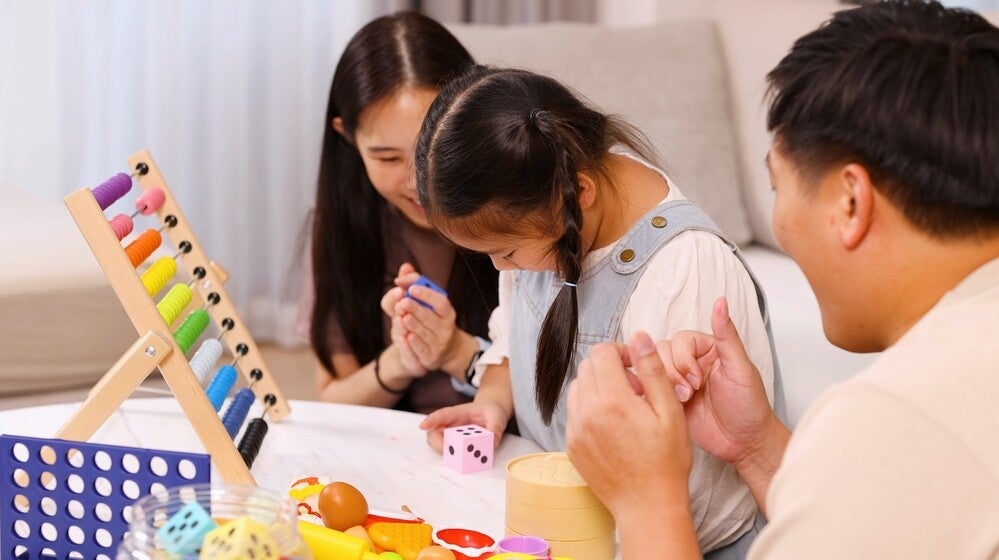
Simple games like dice or hopscotch help preschoolers practice counting while learning to take turns.
What your child can do with numbers shifts quickly between the toddler and preschool years.
Toddlers, 1 to 3 years old
At this stage, toddler math activities work best when they’re physical, since your child is still learning mostly through touch and movement, not words yet. Around 15 months, most toddlers start stacking small objects, so stacking cups or blocks fits right into a skill they’re already practicing.
Sort laundry by color or count fingers and toes during a diaper change, too. It’s just a few extra seconds of connection folded into things you’re already doing daily.
Preschoolers, 3 to 5 years old
Preschoolers can handle a bit more challenge. They can follow simple rules now, which opens the door to real games. By age 5, most children can count to 10 and are starting to recognize numbers when they see them.
Try counting games for preschoolers like hopscotch or piko, simple board games with dice, or asking your child to set the table for the right number of family members to make that skill real and practical.
Games like these sneak in patience and taking turns right alongside the counting practice. For more on what to expect at this stage, see this guide to child development from birth to 5 years.
Keeping Math for Kids Playful, Not a Lesson
The goal isn’t to raise a math prodigy. It’s to help your child feel curious and confident around numbers.
- If your child keeps asking to play the game again, or brings you objects to count on their own, that’s a good sign they’re engaged, not overwhelmed.
- Some days your child might want to count everything in sight. Other days they won’t care about numbers at all, and that’s fine, too. Let their interest guide how much math you bring into play, not the other way around.
Make Math for Kids Fun
The whole point of math for kids is that it can be present in the things you’re already doing. Whether you’re stacking, sorting, counting steps, or just narrating “more” and “less” out loud, your child is picking up the same instincts they’ll use later in school.
What matters more than any single activity is the pace: follow your child’s interest, keep it playful, and let the numbers show up naturally. Try sorting socks on laundry day or counting fruits at the grocery store this week to help build your child’s number sense.
Every family finds their own version of math for kids. Yours might turn out to be grocery bags, tricycle rides, or a bag of pandesal. Head over to the ParenTeam Moms and Dads Facebook group and share what’s worked for you or borrow an idea from another parent.
References
Erikson Institute's Early Math Collaborative. "Big Ideas of Number Sense." Accessed September 1, 2026. https://www.erikson.edu/early-math-collaborative/big-ideas/number-sense/
Fisher, Kelly R., Kathy Hirsh-Pasek, Nora Newcombe, and Roberta M. Golinkoff. "Taking Shape: Supporting Preschoolers' Acquisition of Geometric Knowledge through Guided Play." Child Development 84, no. 6 (2013): 1872–1878. Accessed September 1, 2026. https://pubmed.ncbi.nlm.nih.gov/23534446/
Levine, Susan C., Linda Whealton Suriyakham, Meredith L. Rowe, Janellen Huttenlocher, and Elizabeth A. Gunderson. "What Counts in the Development of Young Children's Number Knowledge?" Developmental Psychology 46, no. 5 (2010): 1309–1319. Accessed September 1, 2026. https://pmc.ncbi.nlm.nih.gov/articles/PMC2998540/
Starr, Ariel, Melissa E. Libertus, and Elizabeth M. Brannon. "Number Sense in Infancy Predicts Mathematical Abilities in Childhood." Proceedings of the National Academy of Sciences 110, no. 45 (2013): 18116–18120. Accessed September 1, 2026. https://pmc.ncbi.nlm.nih.gov/articles/PMC3831472/
Zubler, Jennifer M., Lisa D. Wiggins, and Michelle M. Macias, et al. "Evidence-Informed Milestones for Developmental Surveillance Tools." Pediatrics 149, no. 3 (2022): e2021052138. Accessed September 1, 2026. https://publications.aap.org/pediatrics/article/149/3/e2021052138/184748/Evidence-Informed-Milestones-for-Developmental
Related articles

25 Filipino Nursery Rhymes and Lullabies to Sing to Your Child
Explore this list of 25 Filipino nursery rhymes and lullabies. You can sing these songs to help your child learn, grow, and have fun!
9 mins to read

GROWING TOGETHER: The Importance of Tracking Developmental Milestones in the First 2000 days. -2nd
The first 2,000 days are critical in shaping a child’s future—discover why every developmental milestone matters in these early years of growth and learning.
2 mins to read
GROWING TOGETHER: The Importance of Tracking Developmental Milestones in the First 2000 days.
The first 2,000 days are critical in shaping a child’s future—discover why every developmental milestone matters in these early years of growth and learning.
2 mins to read

How to Survive Toddler Haircuts Without the Tears
Say goodbye to the struggles of toddler haircuts. Here are practical ways to make salon visits fun, tear-free, and comfortable for your child.
6 mins to read

15 Brain Games to Help Your Babies and Toddlers Learn!
No pricey toys required. These brain games need just one important thing: Mom or Dad. Get ready to have fun with your little one!
8 mins to read

How to Discipline a Child Without Hitting or Yelling
Disciplining your child without yelling or hitting? It’s possible with these effective tips that build better behavior.
4 mins to read

7 Teacher-Recommended Reading Strategies to Use at Home
Get your little one to build their reading skills with these expert tips and strategies from a teacher.
4 mins to read

How to Control Emotions: 9 Ways to Help Toddlers Who Feel Too Much
Toddlers feel big emotions but are still learning to manage them. Discover science-backed, mom-approved tips to guide meltdowns into calm without losing your cool.
6 mins to read

10 Fun Activities to Keep Toddlers Entertained in the Heat
You can keep your toddler cool and engaged even on the hottest days while making the most of play-based learning!
6 mins to read

How to Handle Short-Tempered Kids (Is It More Than a Phase?)
When your toddler becomes short-tempered, they can throw a fit like there's no tomorrow. Here's how to calm things down.
6 mins to read

Gentle Parenting Through Toddler Tantrums: What Works (and What Doesn’t)
The latest research shows gentle parenting isn't always easy. But it may be worth it, especially when dealing with toddler tantrums. Here's what it takes.
6 mins to read

Age-Appropriate Household Chores for Kids to Teach Life Skills
Getting kids to help doesn’t have to be a battle. Learn the best age-appropriate household chores for kids to build confidence, independence, and real-life skills.
6 mins to read

How a Daily Routine Can Support Your Child’s Emotional Health
Did you know that a simple daily routine can do wonders for easing tension at home? Learn how to start one now!
7 mins to read

Taming Tantrums: How to Teach Your Toddler Emotional Regulation
Struggling with meltdowns? Emotional regulation is the key to calm. Discover how to teach your toddler to manage big feelings with love.
6 mins to read

Real Moms Share What Works When Setting Boundaries With Lolos and Lolas
Setting boundaries with family takes patience, practice, and teamwork with your spouse. Here are seven ways to approach it with calm.
6 mins to read

How to Use the 5 Kinds of Love Language to Connect with Your Toddler
Knowing the different kinds of love language allows you to parent better! Here's how to talk to your toddler to meet their emotional needs.
5 mins to read

Sharing Is Caring: How to Teach Toddlers to Share Toys
The idea of "sharing is caring" works better when you begin with realistic expectations. Here's a realistic guide to raising a cooperative child.
6 mins to read

3 Ways Dads Build Self-Confidence in Kids
Want to build self-confidence in kids? Find out why Dad's kulitan and harutan are actually good for their future success.
4 mins to read

Toys for a 1-Year-Old to Help Motor, Brain, and Language Development
With toys for a 1 year old, think less about quantity and more about how they can support your child's developmental milestones.
7 mins to read


