


Fetal Development by Month: Your Baby Size Visualizer
Fetal development happens fast. See exactly how big your baby gets each month with ParenTeam’s Baby Size Visualizer.
Tracking fetal development is one of the most exciting parts of expecting a baby. You start with a cluster of cells, and little by little, that cluster becomes fingers, a heartbeat, and eventually a whole tiny person ready to meet you. ParenTeam’s Baby Size Visualizer lets you see exactly how big your baby is every month of your pregnancy, using augmented reality to place a 3D model right next to any object near you.


Want to have a closer, week-specific look at what’s happening in your body and your baby’s? Check out the ParenTeam Pregnancy Weekly Calendar and read about each week in detail.
How to Use the Baby Size Visualizer
If you often wonder, ‘how big is my baby,’ use this tool to get an idea of your baby’s development in the womb. Here’s how to get started.
- Scan the QR code with your camera.
- Open the link to the Augmented Reality (AR) page.
- Choose your current month of pregnancy from the list, from month one through month nine, then allow camera access when prompted.
- Point your phone at a nearby object, like a fruit or vegetable, and place the 3D model. You’ll see your baby’s size compared to that object in real life, along with a simple countdown showing how many months you have left until your due date.
- Slide through the months to watch how much bigger your baby gets throughout your pregnancy timeline.
The visualizer is meant to give you a general sense of fetal size, not an exact measurement, since fetal growth varies a little from pregnancy to pregnancy. Its size comparisons are based on the World Health Organization’s (WHO) Fetal Growth Charts, a global standard built from data across ten countries.
What You’ll See with the Baby Size Visualizer
Beyond the size comparison, you’ll find a “Learn More” button that links to a related pregnancy week article. So, if you want more detail on what’s happening at that specific week, you can read further right from the tool.
The visualizer’s nine months also line up with pregnancy’s three trimesters. If you want a fuller picture of fetal development by month and how your body and your baby are changing as your pregnancy progresses, read this guide to the stages of pregnancy.
Fetal Development Milestones You Can Look Forward To
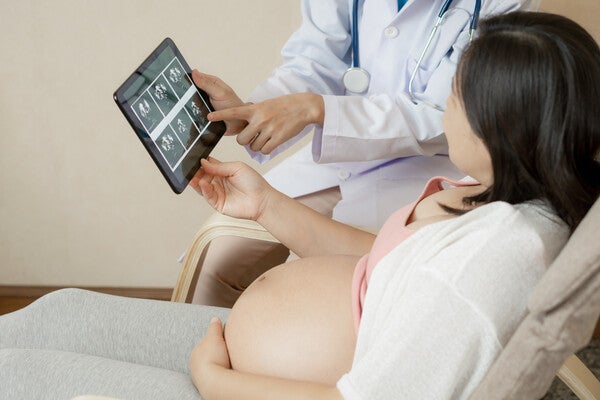
From a fertilized egg at Week 12 to full-term at Week 39, fetal development hits real milestones each month.
While you’re checking your baby’s size, it helps to know what’s happening inside the womb along the way.
First trimester: the early groundwork
During the first trimester, your baby goes from a fertilized egg to a fetus with the beginnings of human features. According to Mayo Clinic, the first trimester covers the first 12 weeks of pregnancy. Put plainly, this is when the foundation for your baby’s whole body gets laid down. Your baby is also officially called a fetus (instead of an embryo) by Week 11.
By the end of Week 12, your baby is about 5.1 cm (2 in) long and weighs about 14 g (half an ounce), but nearly everything they’ll need is already in place. Browse ParenTeam’s week-by-week first trimester articles to learn more.
Second trimester: what changes around week 20
The second trimester runs from Week 13 to 26. By Week 20, you’ve hit the halfway mark of your pregnancy, and there’s a lot to celebrate. Your baby is about the size of a banana, and their five senses are starting to develop as brain cells grow. In short, this is when your baby starts processing the world around them, even before birth.
You might start feeling their movements around now, though for many parents, those first flutters, often called quickening, don’t become noticeable until closer to Week 25. Check out these second trimester articles for more on your baby’s development in the womb.
Third trimester: getting ready for birth
The third trimester runs from Week 27 to birth, when your baby spends the final stretch gaining weight and finishing up the organ maturity they’ll need to breathe, feed, and regulate their own body temperature after birth.
By Week 32, your baby measures about 43 cm (17 in) long and weighs around 1.8 kg, roughly the size of a large papaya or pineapple. Most of their organs are formed by now, though the lungs are still maturing, and that fine body hair called lanugo is starting to fall off.
By Week 36, around 15% of your baby’s body weight comes from fat, which helps keep them warm once they’re born. By Week 39, your baby is considered full-term. They’ve lost their lanugo but now have hair on their head. Their bones are hardening except around the skull, and they’ve likely already dropped into your pelvis to get ready for birth.
Every pregnancy moves at its own pace, so treat these milestones as a general guide rather than a strict timeline, and bring any specific questions to your ob-gyn. Read more about what happens across your third trimester to feel more confident before birth.
Why Tracking Your Baby’s Growth Matters

Every kick and change you notice is a small way to feel closer to the baby you’ll soon meet.
Once you know what’s typically happening at each stage, tracking your baby’s growth becomes even more meaningful.
Following your baby’s development gives you more than just fun facts. It helps you understand your pregnancy stages and feel connected to your baby, especially on days when nothing outwardly seems to be changing. Watching your baby’s growth can also help you notice if something feels different, so you know when to give your ob-gyn a call.
At the end of the day, tracking your pregnancy month-by-month is one small way to feel closer to the little one you haven't met yet, and that’s something to celebrate.
Every Stage Brings You Closer to Your Baby
Fetal development moves through distinct stages, even though you can’t watch it happen with your own eyes. The Baby Size Visualizer gives you the next best thing: a way to picture your baby going from a few cells to a fully formed newborn, one month at a time. The next time you’re curious about how big your baby’s gotten or what’s changing inside the womb, open the tool and take a look for yourself.
Pregnancy comes with a lot of waiting, but seeing fetal development, even through an AR model, gives you something concrete to hold onto between checkups. If you want to hear how other Filipino parents are going through the same stages, join the ParenTeam Moms and Dads Facebook group.
References
Cleveland Clinic. "Fetal Development: Week-by-Week Stages of Pregnancy." Last updated March 19, 2024. Accessed September 9, 2026. https://my.clevelandclinic.org/health/articles/7247-fetal-development-stages-of-growth
Kiserud, Torvid, Gilda Piaggio, Guillermo Carroli, Mariana Widmer, José Carvalho, Lisa Neerup Jensen, Daniel Giordano, et al. "The World Health Organization Fetal Growth Charts: A Multinational Longitudinal Study of Ultrasound Biometric Measurements and Estimated Fetal Weight." PLOS Medicine 14, no. 1 (2017): e1002220. Accessed September 9, 2026. https://journals.plos.org/plosmedicine/article?id=10.1371/journal.pmed.1002220
Mayo Clinic Staff. "Fetal Development: The First Trimester." Mayo Clinic. Last updated March 18, 2025. Accessed September 9, 2026. https://www.mayoclinic.org/healthy-lifestyle/pregnancy-week-by-week/in-depth/prenatal-care/art-20045302


