


A Doctor Explains Baby Poop Color: What’s Typical and What’s Not
As a parent, every detail of your baby’s life becomes a point of interest, even the contents of their diapers! That’s just how life with a newborn goes. One day it’s mustard yellow, the next it’s green, and you’re left wondering if any of it means something’s wrong. Baby poop color changes constantly in the first year, and most of it is completely harmless, but a few shades may need a check in with your doctor.
Monitoring your baby’s stool is one way to check their health and digestion. Knowing what’s typical can give you peace of mind or help you seek timely care. Here’s what board-certified pediatrician Dr. Sandra Sharlene Lim Uy wants every parent to know.
Quick Answer: What Baby Poop Colors Should You Expect?
Short on time, Mommy? Here’s the quick version, straight from Dr. Lim Uy. In a baby’s first days, expect very dark green, almost black stool. That’s meconium, and it simply means your baby is clearing out what he ingested in the womb.
After that, a breastfed baby’s poop typically turns more yellow and seedy, while a formula-fed baby’s poop settles into a light brown. Once your baby starts solids, you might see green stool from certain foods. Any color outside that range is worth a call to your pediatrician.
If you want a better understanding of your baby’s digestion overall, this guide to baby poop walks you through the basics.
Baby Poop Color Chart: What Each Color May Mean
Here’s every color Dr. Lim Uy mentions, in one handy chart you can bookmark for later.
| Baby Poop Color | What It May Mean | Typically Expected? | When to Call the Doctor |
| Dark green to black, sticky | Meconium, from what baby ingested in the womb | Yes, for the first few days | If it doesn’t appear at all, or turns black again later |
| Mustard yellow, seedy | Typical for a purely breastfed baby | Yes | If paired with fever, vomiting, or poor feeding |
| Light brown | Typical for a formula-fed baby | Yes | If very watery, bloody, or foul-smelling |
| Green | Often food-related once solids start | Usually | If paired with fever, vomiting, blood, or poor weight gain |
| White, pale, or chalky | May point to a liver or gallbladder issue | No | Call right away |
| Red or bloody | May signal bleeding, irritation, or allergy | Needs caution | Call your doctor, especially if it’s not clearly food-related |
| Black, after the newborn stage | May suggest bleeding higher in the digestive tract | No | Call right away |
Typical Baby Poop Colors
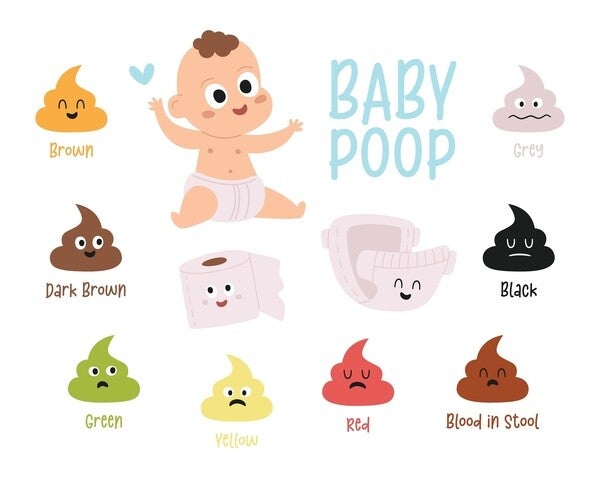
From mustard yellow to earthy brown, typical baby poop comes in many shades and forms.
Here’s some good news, Mommy: most of what you’ll see in those early diapers falls into a pattern you can learn to recognize, so you can skip the late-night worry spiral.
Mustard yellow or seedy baby poop
As mentioned earlier, once the newborn stage passes, breastfed baby poop “can turn more yellow, sometimes looking seedy,” which is a healthy color and consistency for a purely breastfed baby, explains Dr. Lim Uy. Those small, grainy flecks are just undigested milk fat—nothing to worry about.
One thing you should know, though: your own diet can influence their poop color too, since what you eat changes your breast milk composition. So, don’t be alarmed if it’s a bit more golden one day and more olive the next, as long as it’s soft and your baby’s feeding well.
Light brown baby poop
“Light brown stools are the usual for a healthy formula-fed baby,” notes Dr. Lim Uy. According to the Cleveland Clinic, it’s usually thicker than breastfed stool, closer to the consistency of peanut butter, with a slightly stronger smell—and the shade itself can lean more tan, yellow, or even greenish rather than one fixed color.
So, don’t be surprised if shades shift too, since switching formulas can change the color, texture, and frequency of your baby’s poop.
Green baby poop after starting solids
Surprised to see green poop after a stretch of yellow or brown diapers? Once your baby starts eating solid food, green stool can simply reflect what they had that day, whether it’s spinach, peas, or anything else with a natural green pigment.
Black or dark green newborn poop (meconium)
In the very first days of life, expect very dark green, almost black stool. Dr. Lim Uy explains this is meconium, and it’s expected while your baby is still clearing out everything they swallowed in the womb.
Baby Poop Colors That May Need Medical Attention
Now here’s where you’ll want to pay closer attention. These colors may require a second set of eyes—particularly from your doctor.
White, pale, or chalky baby poop
Dr. Lim Uy explains that “white or chalky stools, sometimes a very pale yellow, are what we call acholic stool, suggesting problems in the liver or gall bladder, like biliary atresia, which may warrant surgical intervention or, in severe cases, liver transplant.” This is the color she flags most urgently, since it can signal a liver or gallbladder issue that needs prompt medical evaluation.
Red or bloody baby poop
A small red streak can simply mean a tear from straining during constipation, but a larger amount is a different story.
Dr. Lim Uy clarifies: “Red stools or bloody stools may be a sign of bleeding, infection, or allergies to the milk proteins that the baby is taking in. A large volume of red stools could be indicative of a more serious problem, like a problem with the intestines.” When in doubt, call your pediatrician instead of waiting it out.
Black baby poop after the newborn stage
Meconium only sticks around for the first few days. Once your baby’s stool has moved to typical yellow or brown, seeing black again is a different story. “Black stools, or what doctors call ‘melena,’ after having had typical stools past the meconium phase, are also not typical. It may also indicate bleeding, but most likely higher up in the GI tract.”
Again, anything that doesn’t look or feel right should constitute a trip to your doctor’s office.
Colors That Look Alarming but Are Usually Harmless
You already know green can show up once solids start—but sometimes it (and a few other shades) can look more alarming than it is. Have you ever spotted blue-tinged, green, or even bright orange poop in your baby’s diaper? Before you panic, take a breath. Unusual colors like these are usually tied to whatever your baby or child just ate.
Dr. Lim Uy notes that green or orange poop is usually food-related, and there have even been cases of blue-tinged or teal poop from certain food dyes. Still, her advice stands: if you’re ever worried, call your doctor to check if there’s a real cause for concern.
How Feeding Affects Baby Poop
You’ve already got a handle on what color to expect from breastfed versus formula-fed babies, Mommy, but feeding type shapes more than color. It also affects how often you’ll be reaching for that diaper bag.
Breastfed baby
Now that you know what breastfed baby poop color looks like, here’s the frequency side of things: breastfed babies tend to poop more often than formula-fed babies overall, according to the American Academy of Pediatrics (AAP).
A 2024 study published in the European Journal of Pediatrics found frequency actually peaks around 3 weeks of age, at about four times a day on average, before gradually settling down.
Formula-fed baby
Your formula-fed baby’s poop color isn’t the only difference. Formula-fed babies also tend to poop a bit less often than breastfed babies. So don’t fret if you’re changing diapers less often.
Poop color after starting solids
You already know stool color gets more varied once solids enter the picture (hello, orange stool after carrots!)—here’s what happens to frequency. As your baby gets older, poop frequency naturally slows down too, whether they’re breastfed or formula-fed.
Baby Poop Texture: Why Color Is Only One Clue
Color isn’t the only clue in that diaper, Mommy—texture tells you just as much, if not more. If you’re ever unsure what you’re looking at, stool charts can help you make sense of it.
Watery baby poop
Loose is typical for a lot of baby poop, but if it turns extra watery and shows up more often than usual, that’s your cue to pay closer attention, especially if you’re also seeing fever or signs your baby’s getting dehydrated, says the AAP.
If you’re noticing this pattern, this breakdown of baby diarrhea can help you spot the signs early and know when to call your pediatrician.
Hard or pellet-like baby poop
On the flip side, if your baby’s stool looks like small, hard pellets and seems difficult or painful to pass, that’s usually a sign of constipation, according to the Cleveland Clinic. If your child is having a hard time pooping, check out this guide from a pediatric gastroenterologist.
Mucus in baby poop
A little mucus here and there usually isn’t anything to worry about. But Mayo Clinic notes that if your baby’s stool is full of mucus, especially alongside blood or diarrhea, you should consult your baby’s pediatrician.
When Should You Call the Doctor About Baby Poop Color?

A same-day call to your pediatrician is the safest next step for red or black stool.
So how do you know when it’s time to actually pick up the phone? Here’s what Dr. Lim Uy had to say.
When you spot a red-flag color, don’t wait it out at home. You can call your doctor or head straight to the ER, where “competent pediatricians on duty” can assess your baby right away. Some cases may need immediate surgical intervention, while others just need further evaluation before deciding on next steps. And for certain cases, like a milk protein allergy, you’ll really need to consult your doctor.
Not sure what to expect once you’re on the phone or in the exam room? Your pediatrician will likely ask about the color, how much and how often, and whether your baby's had fever, vomiting, or seemed off in any other way, so it helps to have those details ready before you call.
In short: don’t wait it out on your own if you feel there’s something wrong. Whether it’s a call to your pediatrician or a trip to the ER, getting your baby assessed quickly is always the safer choice.
FAQs About Baby Poop Color
What does yellow baby poop mean?
Mustard-yellow, seedy stool is typical for breastfed babies past the newborn stage, according to Dr. Lim Uy.
Is green baby poop a concern?
Not usually. Green stool is often food-related once your baby starts solids, and Dr. Lim Uy notes it’s rarely cause for alarm on its own. Still, you should always call your doctor if you’re unsure.
Is black baby poop a concern?
Black stool right after birth is meconium and is expected. But black stool that shows up later, after your baby’s first few days, is a different story and needs a doctor’s attention.
When should you call the pediatrician about baby poop color?
Call right away for white, pale, or chalky stool, a large amount of red or bloody stool, or black stool after the newborn stage. These are the colors Dr. Lim Uy flags most urgently.
The Bottom Line on Baby Poop Color
You don’t need to memorize every shade in that chart, Mommy—you just need to trust your gut (and your baby’s) when something feels off. Color, texture, and frequency all work together to tell you how your baby’s digestion is doing.
One habit worth doing: snap a quick photo of anything unusual before you toss the diaper. It gives your pediatrician something concrete to look at, which is a lot more useful than trying to describe a color from memory. Every diaper tells you a little more about your baby, and by understanding baby poop color, you’ll know exactly when to relax and when to make that call.
Still got questions on baby poop color? Swap notes with other parents in the ParenTeam Moms and Dads Facebook group. Chances are, someone’s diaper bag has seen it all too.
About Dr. Sandra Sharlene Lim Uy
Dr. Sandra Sharlene Lim Uy is a board-certified pediatrician with a deep commitment to newborn and premature infant care. For the past five to six years, she has served as a dedicated pediatrician in the Neonatal Intensive Care Unit (NICU) at Taguig Pateros District Hospital, guiding countless families through the critical early days of their premature babies' lives.
References
American Academy of Pediatrics. “Diarrhea (0-12 Months).” HealthyChildren.org. Accessed May 6, 2025. https://www.healthychildren.org/English/tips-tools/symptom-checker/Pages/symptomviewer.aspx?symptom=Diarrhea+(0-12+Months)
Cleveland Clinic. “Baby Poop Colors: What Do They Mean?” Cleveland Clinic Health Essentials. Accessed July 9, 2026. https://health.clevelandclinic.org/the-color-of-baby-poop-and-what-it-means-infographic
Cleveland Clinic. “Bristol Stool Chart.” Accessed July 9, 2026. https://my.clevelandclinic.org/health/articles/bristol-stool-chart
Children’s Hospital Colorado. “Baby Poop Guide: What’s Normal, What’s Not?” May 12, 2026. Accessed July 9, 2026. https://www.childrenscolorado.org/just-ask-childrens/articles/baby-poop-guide/
Jana, Laura, and Jennifer Shu. “The Many Colors of Baby Poop.” HealthyChildren.org. American Academy of Pediatrics. Accessed July 9, 2026. https://www.healthychildren.org/English/ages-stages/baby/Pages/The-Many-Colors-of-Poop.aspx
Jana, Laura, and Jennifer Shu. “Pooping By the Numbers: What's Normal for Infants?” HealthyChildren.org. American Academy of Pediatrics. Accessed July 9, 2026. https://www.healthychildren.org/English/ages-stages/baby/Pages/Pooping-By-the-Numbers.aspx
Mayo Clinic. “Baby Poop: What to Expect.” Accessed July 9, 2026. https://www.mayoclinic.org/healthy-lifestyle/infant-and-toddler-health/expert-answers/baby-poop/faq-20057971
Northwestern Medicine. “The Ultimate Baby Poop Guide: What’s Normal and What’s Not” Updated November 2025. Accessed July 9, 2026. https://www.nm.org/healthbeat/healthy-tips/quick-dose-when-your-babys-poops-are-a-problem
Pediatric Education. “Are These Stools Acholic?” Accessed July 9, 2026. https://pediatriceducation.org/2022/05/23/are-these-stools-acholic/
Solasaari, T., K. Korpela, S. Lommi, S. Hyvönen, S. Gardemeister, L. Merras-Salmio, A. Salonen, W. M. de Vos, and K. L. Kolho. “Bowel Function in a Prospective Cohort of 1052 Healthy Term Infants up to 4 Months of Age.” European Journal of Pediatrics 183, no. 8 (2024): 3557–65. Accessed July 9, 2026. https://pmc.ncbi.nlm.nih.gov/articles/PMC11263225/
Related articles

28 Weeks Pregnant: Baby Development, Symptoms, and Tips for Mommies
Your guide to being 28 weeks pregnant is here! Learn about key baby development milestones, how to manage new symptoms, and what you can do to stay comfortable.
6 mins to read

The Stages of Pregnancy: What to Expect for You and Baby
Get to know the stages of pregnancy! Learn about each trimester, track your baby's growth, and embrace your body’s changes.
5 mins to read

How to Track Ovulation Symptoms If You Have Irregular Periods
Tracking ovulation symptoms is key when your cycle changes. Learn how to read your body’s signs and spot your fertile window even with irregular periods.
10 mins to read

Ginger Tea in Pregnancy: Is It Safe for Morning Sickness?
Ginger tea in pregnancy can help ease morning sickness, but safe doesn’t mean unlimited. Here’s what your ob-gyn wants you to know about salabat and dosage.
7 mins to read

Does Milk Help You Sleep? How a Glass Before Bedtime Helps Kids Unwind
Does milk help you sleep? A pediatric nutrition specialist breaks down what’s true, what’s myth, and how bedtime milk fits your child’s routine.
6 mins to read

A Doctor Explains Cramps During Pregnancy and Other Discomforts
Experiencing cramps during pregnancy? A doctor explains what causes it, how to ease it, and when it’s worth a call to your OB to help bring you peace of mind.
7 mins to read

How a Pregnancy App Can Help You Track Your Baby’s Development
A pregnancy app can help you see how your baby grows each week. It’s a simple way to feel confident and ready for every new change.
7 mins to read

Your Complete Guide to the Types of Milk in the Grocery Aisle
Confused by the types of milk lining the grocery shelf? Here’s a clear way to compare full cream, fresh, fortified, and plant-based options for your family.
7 mins to read

Best Milk for Pregnant Women: What Nutrients to Look For
Not all milk for pregnant women is the same. Know the six nutrients that actually matter—and what to look for in nutrition labels for the best buy.
9 mins to read

A Derma’s Guide to Pregnancy Skin Care: What’s Safe and What to Avoid
Building a safe pregnancy skin care routine starts with checking the label. Discover the best ingredients for your skin and the chemicals you need to avoid right now.
8 mins to read

Early Pregnancy Pain Areas: A Dad’s Guide to Comforting His Partner
Learn how to help your partner manage early pregnancy pain areas. Small comforts like checking in, prepping light meals, and doing her chores make a huge difference.
6 mins to read

How to Deal with Pregnancy Hormones and Mood Swings
Pregnancy hormones can intensify your emotions. Learn simple ways you and your partner can handle those mood swings and get the support you need.
8 mins to read

Doctor-Approved Ways to Ease Acid Reflux in Pregnancy
Dealing with acid reflux in pregnancy is uncomfortable. Discover simple food tweaks, better sleep habits, and other doctor-approved tips to ease that sour burn today.
5 mins to read

A Doctor Explains Pregnancy Spotting Colors and Flow
Understanding your pregnancy spotting color and flow can help you spot warning signs early. Discover what to expect and when to call your doctor.
6 mins to read

Updated! 5 PhilHealth Benefits for You and Baby
Your PhilHealth benefits cover more than just delivery day. Here's everything you can claim under the 2026 expanded maternity benefits.
8 mins to read

5 Ways to Manage a Pregnancy Rash in the Hot Months
Treat a pregnancy rash by adjusting your daily hygiene habits. Discover how cool midday baths, gentle soaps, and loose clothing can soothe your skin now.
6 mins to read

1 Month Pregnant? A Guide to Symptoms, Baby Development, and Nutrition
Understand exactly what happens when you're 1 month pregnant! Explore common symptoms, how your baby starts growing, and vital nutrition tips for this crucial stage.
6 mins to read

Pregnancy Discharge? Your Guide to Staying Fresh and Comfortable
An increase in pregnancy discharge means your body is protecting your baby, but the extra moisture may feel uncomfortable. Learn how to stay fresh with simple habits.
5 mins to read

8 Examples of Light Exercises for Your 3rd Trimester
Discover safe and effective examples of light exercises for your third trimester. From walking to stretches, here's how to ease discomfort, and prepare for labor.
6 mins to read


