


Is Screen Time Really Bad for Language Development in Children?
Your preschooler just watched a YouTube show about dinosaurs, and now they’re teaching you the difference between a T. rex and a triceratops over merienda. Moments like this show how quickly your kid soaks up new words, Mommy, and you want to help them build on every milestone. So, you might wonder: is screen time really as bad as you’ve heard? But Mom, studies on language development in children show that screens aren’t automatically good or bad for your kid’s words. How much and how your kid watches both matter.
With the right habits, a favorite show can become a chance to stretch your kid’s vocabulary and thinking. Read on to see what the evidence says, with insights from Dr. Kaye Napalinga, a developmental and behavioral pediatrician and Wyeth Nutrition medical advisor. Then try a few simple ways to make every show count.
What Is Language Development in Children?
Language development in children is how your kid learns to understand words, use them to share thoughts and feelings, and hold a real conversation with you. Dr. Napalinga explains that it has three parts. Speech is how your kid pronounces words, language is how they understand them, and communication is how they use words, which is related to social skills. These skills build on each other. The more your kid understands, the more they can say, and the more they can say, the more they can connect with the people around them.
You’ll see this growth every day: your kid telling you what’s wrong in words, asking “why” for the tenth time, or retelling their favorite episode at dinner. Between ages 3 and 5, your kid moves from short phrases to full stories.
All that growth needs practice, and practice needs someone to talk with. A screen can’t answer back or ask your kid what they think, but you can.
What Experts and Studies Say About Screen Time and Language
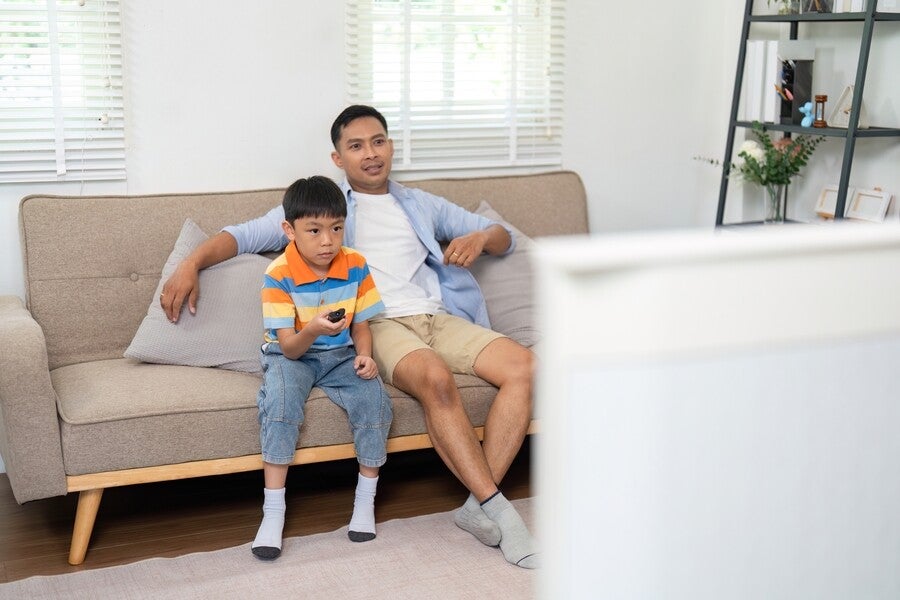
Studies link co-viewing with stronger language skills, so pause the show and ask your kid what they think will happen next.
If you’ve ever wondered whether screens help or hold back your kid’s words, researchers have asked the same question. Their findings can help you make the most of every show.
Why watching alone falls short
A 2020 review on the associations between screen use and child language skills found a pattern. In the studies it covered, kids were about 3 years old on average, and the more hours they spent on screens, the weaker their language skills tended to be. The same was true for background TV, the kind that stays on while no one is really watching.
Keep this in perspective, Mom: the links were small, and the researchers stress that screens are just one of many things that shape your kid’s language. Your daily chats, stories, and attention count, too.
So why would screen time matter at all? Two studies that recorded kids’ days at home offer a clue. The first, a 2009 study led by researchers at Seattle Children’s Research Institute and the University of Washington, looked only at audible TV. Kids wore small recorders at home one day each month, for up to two years. Each extra hour of audible TV was linked to about 770 fewer words a child heard from an adult that day.
A 2024 Australian study went further and looked at all screens. Researchers followed 220 families from when their kids were 1 to 3 years old. More screen time was linked to kids hearing fewer words from adults, making fewer sounds themselves, and having fewer back-and-forth exchanges, with the strongest link at age 3. Researchers call this “technoference,” short for technology-based interference.
Dr. Napalinga explains that technoference takes away the time your kid spends interacting with you. “It’s the lack of that reciprocal interaction which leads to the language delays,” she says. Interacting with your kid during screen time, at the right age, can help. What the recommendations emphasize, she says, is simple: “Wag mo lang sila iwan mag-isa.” She also advises setting time limits.
The Australian researchers don’t expect families to give up screens, either. They suggest turning screen time into a chance to connect with your kid instead. And remember that background TV finding: switch off the TV when no one’s watching.
How talking together changes the picture
Here’s the good news, Mommy: the 2020 review also found that kids who watched educational shows or co-viewed with a caregiver tended to have stronger language skills. Researchers think the benefit may come from what you do while watching, like naming what’s on screen, asking questions, and picking shows made for your kid’s age. They add that shows may be especially helpful when they name objects, talk directly to your kid, and pause for answers.
A 2024 review of 100 studies on kids from birth to almost 6 years old points the same way. Kids who used screens with someone else, like a parent or older sibling, tended to have better thinking and learning skills, which include language. Another helpful detail? Researchers say the benefit likely depends on how much you talk about the show together. Asking “why” and “what if,” explaining what’s happening, and linking the story to your kid’s own life may all help your kid think and learn.
Closer to home, a study of 419 Filipino kids aged 2 to 3 found that those who usually watched alone tended to score lower in understanding and using words than kids who watched with an adult, no matter how many hours they spent on screens. Kids who watched alone also had much higher odds of going over an hour of screen time a day. For you, that means watching together does double duty: it turns shows into chances to talk, and it’s linked to keeping screen time within healthy limits.
What about screen time and language delay?
If language delay worries you, keep in mind that these studies show links, not proof that screens themselves cause delays. Your kid’s language grows from many things, and your daily conversations play a big part.
Gentle limits are still a good idea. The World Health Organization (WHO) recommends no more than one hour of sedentary screen time a day for kids aged 3 to 4, and says less is better. Sedentary screen time means sitting and passively watching, like shows or videos. When your kid is sitting still, the WHO encourages reading and storytelling with you instead.
The US Centers for Disease Control and Prevention (CDC) adds that the hour should go to a children’s program, with an adult present. If ending screen time often leads to tears, these tips on easing gadget habits can help you set limits that stick.
Trust your instincts, Momma. If you feel your kid isn’t reaching milestones or loses words they once used, talk to your pediatrician early and ask about developmental screening.
Screen Time Across the Stages of Language Development
Your kid’s language grows fast between ages 3 and 5, and the way you talk during screen time can grow right along with it. The CDC’s developmental milestones show what at least 75% of kids can do by each age. Think of them as a guide, not a test.
At age 3: Back-and-forth chats begin
Most 3-year-olds can hold a short back-and-forth chat and name actions, like “running.” During a show, ask, “What’s he doing?” When your kid answers, ask for one more detail, since the CDC notes that each follow-up gives your kid another turn to talk.
At age 4: Stories take shape
By 4, most kids use sentences of four or more words and can tell what comes next in a story they know well. After an episode, ask, “What happened first? Then what?” Questions like these help your kid understand the order of events.
At age 5: Little storytellers and thinkers
Most 5-year-olds can tell a story with at least two events and keep a conversation going. Stretch their thinking with open-ended questions like, “Why do you think she did that?” The CDC notes that asking “why” and “how” helps your kid give fuller answers.
How Screen Time Affects Vocabulary Development
Your kid may pick up new words from a favorite show, like “volcano” or “astronaut.” But researchers in the 2020 review note that young kids can find it hard to use what they see on screen in real life. That’s where you come in, Mom. When you talk about the show together, you help those new words make the jump from the screen to your kid’s everyday conversations.
Try serve and return during shows
Harvard’s Center on the Developing Child calls these moments “serve and return.” Your kid “serves” by pointing, asking, or making a sound, and you “return” it with attention and words. Here’s how it can look during screen time:
- Notice the serve: Your kid points at a dinosaur on screen.
- Return it and give it a name: “Oo, ‘yan ay T. rex! It’s so big.”
- Take turns and wait: Ask, “What sound do you think it makes?” Then give your kid time to answer.
According to the center, naming what your kid sees, does, or feels helps build language connections in the brain. Waiting matters, too, since it gives your kid time to form their own reply. The same idea works off-screen. Simply narrating your day, like “Now we’re washing the plates,” gives your kid more words to learn. (Here’s more on how talking to your kid supports brain development.)
When your kid is watching a show, Dr. Napalinga suggests joining them and looking at what they’re looking at. Then build on the words they already know. “If the child already knows the word ‘cat,’ then you can add on to it by expanding it. For example, ‘Oh, the cat is jumping.’ So then that exposes the child to more words than just ‘cat,’” she says.
Talk in the language that feels natural
Many Filipino homes switch between English, Filipino, and regional languages, and that’s okay. Communication experts say hearing more than one won’t confuse your kid or cause speech or language delays. So if your kid mixes words from both in one sentence, that’s simply part of the process. The experts also encourage you to talk with your kid in whichever one feels most comfortable to you.
Kids who grow up in a household with more than one language hear different words, Dr. Napalinga explains, and they cling to what means more to them and what’s easier for their brain to understand. “For example, you learn Korean words by watching K-drama? And you learn it, you really learn it, because it’s in that context. Nakikita mo talaga ’yung eksena, so nami-memorize mo,” she says. “Gano’n din gusto mong mangyari sa kids.”
So even if a show is in English, you can chat about it in Filipino. If you’d like your kid to grow fluent in more than one language, these tips on raising a kid who speaks English, Filipino, and more can help.
Turn Screen Time into Language Time with the 3Cs

After a show, ask your kid to retell their favorite part. Retelling builds comprehension, sentence skills, and confidence.
You don’t need a script or special apps to make screen time count, Momma. Three simple habits—Comprehend, Converse, and Connect—can turn almost any show into a chance to build your kid’s language. They mirror the kind of talk researchers link to watching together.
- Comprehend: Help your kid understand the story. After the episode, ask your kid to tell Lola or Papa what it was about. Retelling helps your kid make sense of what they saw and put it into their own words.
- Converse: Keep the chat going. Ask open questions with no single right answer, like “Which part made you laugh?” Then share your own favorite part and ask another question. Each back-and-forth gives your kid practice in listening, taking turns, and finding the right words.
- Connect: Link the show to real life. Try “They went to the beach. Remember nung nag-swimming tayo sa Batangas?” Links like these can help new words move from the screen into your kid’s everyday world.
Start with whichever C feels easiest, then add the others as talking about shows becomes a habit.
How Nutrition and Conversation Work Together
Every chat you have about a show gives your kid practice with words, and good nutrition helps support that growth from the inside. According to the US National Institutes of Health (NIH), your kid’s brain and nervous system need choline to help regulate memory, mood, and muscle control. DHA, a type of omega-3 fat, is found in especially high levels in the brain and eyes, where it helps make up the walls of cells.
PROMIL Gold brings these brain-supporting nutrients together in its NUTRIGIFT ADVANCE™ formula. Aside from choline and DHA, it also has α-lipids, which contain five phospholipids, including sphingomyelin. These support myelination, which helps brain connections work faster. As the Global No. 1 in Brain Research, PROMIL Gold is clinically proven to advance 47% more of the brain for advanced language development.
Together, PROMIL Gold’s nutrition and your everyday 3C conversations work to support your kid’s advanced brain and language development. Give PROMIL Gold 3+, a powdered milk drink for kids over 3 years old, together with a varied, balanced diet and a healthy lifestyle.
Frequently Asked Questions
Here are quick answers to common questions about screen time and language development in kids 3 and up.
Does screen time cause language delay in kids?
Research shows a link between more screen time and weaker language skills, but no proof that screen time causes language delay. If your kid isn’t reaching milestones or loses words they once used, talk to your pediatrician early.
How can screen time help language development?
It depends on what and how your kid watches. Studies link educational shows and watching with a caregiver to stronger language skills, and researchers think talking about the show together makes the difference.
What are the stages of language development?
According to the CDC, most 3-year-olds can hold a short back-and-forth conversation, and most 4-year-olds use sentences of four or more words. By 5, most kids can tell a simple story with at least two events.
How can I support my child’s vocabulary development during screen time?
Watch together, name what catches your kid’s eye, ask a question, and wait for their answer. After the show, use the 3Cs to keep the conversation going in English, Filipino, or both.
Make Every Screen Moment Count
So, is screen time bad for your kid’s words? Not on its own. What matters is how your kid watches, not just how long. Gentle limits keep screens in their place, and watching together turns them into chances to talk. What your kid needs most is you: your questions, your stories, and your patience as they find the right words.
Start small tonight, Mom. After your kid’s next episode, ask one question about it, like “What was your favorite part?” Then wait, listen, and ask one more. Small moments like these are what the research on language development in children keeps pointing to: real conversations with you.
Turn screen time moments into a 3C movement. Advance language with PROMIL Gold.
REFERENCES
Brushe, Mary E., Dandara G. Haag, Edward C. Melhuish, Sheena Reilly, and Tess Gregory. “Screen Time and Parent-Child Talk When Children Are Aged 12 to 36 Months.” JAMA Pediatrics 178, no. 4 (2024): 369–75. Accessed October 23, 2026. https://jamanetwork.com/journals/jamapediatrics/fullarticle/2815514
Center on the Developing Child at Harvard University. “5 Steps for Brain-Building Serve and Return.” Accessed October 23, 2026. https://developingchild.harvard.edu/resources/5-steps-for-brain-building-serve-and-return/
Centers for Disease Control and Prevention. “CDC’s Developmental Milestones.” Learn the Signs. Act Early. Last updated February 16, 2026. Accessed October 23, 2026. https://www.cdc.gov/act-early/milestones/index.html
Centers for Disease Control and Prevention. “Concerned About Your Child’s Development?” Learn the Signs. Act Early. Accessed October 23, 2026. https://www.cdc.gov/act-early/families/concerned.html
Centers for Disease Control and Prevention. “Milestones by 3 Years.” Learn the Signs. Act Early. Last updated May 16, 2026. Accessed October 23, 2026. https://www.cdc.gov/act-early/milestones/3-years.html
Centers for Disease Control and Prevention. “Milestones by 4 Years.” Learn the Signs. Act Early. Last updated May 16, 2026. Accessed October 23, 2026. https://www.cdc.gov/act-early/milestones/4-years.html
Centers for Disease Control and Prevention. “Milestones by 5 Years.” Learn the Signs. Act Early. Last updated May 16, 2026. Accessed October 23, 2026. https://www.cdc.gov/act-early/milestones/5-years.html
Christakis, Dimitri A., Jill Gilkerson, Jeffrey A. Richards, Frederick J. Zimmerman, Michelle M. Garrison, Dongxin Xu, Sharmistha Gray, and Umit Yapanel. “Audible Television and Decreased Adult Words, Infant Vocalizations, and Conversational Turns: A Population-Based Study.” Archives of Pediatrics & Adolescent Medicine 163, no. 6 (2009): 554–58. Accessed October 28, 2026. https://jamanetwork.com/journals/jamapediatrics/fullarticle/381618
Communication Health Support Association. “Learning More Than One Language.” Last reviewed May 1, 2026. Accessed October 23, 2026. https://helpingyoucommunicate.org/article/learning-more-than-one-language
Dy, Angel Belle C., Alane Blythe C. Dy, and Samantha Katrina Santos. “Measuring Effects of Screen Time on the Development of Children in the Philippines: A Cross-Sectional Study.” BMC Public Health 23 (2023): 1261. Accessed October 23, 2026. https://pmc.ncbi.nlm.nih.gov/articles/PMC10308687/
Madigan, Sheri, Brae Anne McArthur, Ciana Anhorn, Rachel Eirich, and Dimitri A. Christakis. “Associations Between Screen Use and Child Language Skills: A Systematic Review and Meta-analysis.” JAMA Pediatrics 174, no. 7 (2020): 665–75. Accessed October 23, 2026. https://pmc.ncbi.nlm.nih.gov/articles/PMC7091394/
Mallawaarachchi, Sumudu, Jade Burley, Myrto Mavilidi, et al. “Early Childhood Screen Use Contexts and Cognitive and Psychosocial Outcomes: A Systematic Review and Meta-analysis.” JAMA Pediatrics 178, no. 10 (2024): 1017–26. Accessed October 23, 2026. https://jamanetwork.com/journals/jamapediatrics/fullarticle/2821940
National Institutes of Health, Office of Dietary Supplements. “Choline: Fact Sheet for Consumers.” Last updated June 2, 2022. Accessed October 23, 2026. https://ods.od.nih.gov/factsheets/Choline-Consumer/
National Institutes of Health, Office of Dietary Supplements. “Omega-3 Fatty Acids: Fact Sheet for Consumers.” Last updated July 18, 2022. Accessed October 23, 2026. https://ods.od.nih.gov/factsheets/Omega3FattyAcids-Consumer/
Penn State. “‘Disconnected’ Study Suggests Technology Interferes with Couple Relationships.” Penn State News, December 10, 2014. Accessed October 28, 2026. https://www.psu.edu/news/research/story/disconnected-study-suggests-technology-interferes-couple-relationships
World Health Organization. Guidelines on Physical Activity, Sedentary Behaviour and Sleep for Children Under 5 Years of Age. Geneva: World Health Organization, 2019. Accessed October 23, 2026. https://www.who.int/publications/i/item/9789241550536
Related articles

27 Conversation Starters for Kids That Turn Screen Time into Talk Time
Try these conversation starters for kids during and after screen time. Ask a question, share a thought, and watch your kid’s words grow.
10 mins to read

9 Water Safety Rules Every Filipino Parent Should Teach Their Kids
Water safety starts before your child dips a toe in the water. Teach these easy rules your child can follow, plus skills to build by age and what to do in an emergency.
11 mins to read

Exploring the Philippines with Kids: 6 Travel Safety Tips You Should Know
Good travel safety habits keep your family trip fun from start to finish. Stay close at the beach, beat the heat, eat safely, and stick together in crowds.
10 mins to read

10 Bible Stories for Kids That Teach Values They Can Live By
Teaching big values to preschoolers isn’t easy. These Bible stories for kids bring concepts like patience and kindness in a way little minds can get.
13 mins to read

7 ₱500 Budget Ulam Ideas to Feed Your Family
Use these budget ulam ideas to cook hearty yet wallet-friendly meals for your family.
6 mins to read

Bored Preschooler? 10 Fun Activities for Kids at Home
Keep your preschooler entertained with these activities for kids at home. Use pillows, paper, and kitchen scraps for hours of active, creative play.
8 mins to read

15 Gifts for Kids Who Have Too Many Toys
Running out of space for toys? Try these thoughtful gifts for kids that focus on fun, learning, and family time without the clutter.
5 mins to read

Is It Shyness or Social Anxiety? Signs Your Child May Need Extra Support
Social anxiety in kids isn’t just being quiet. Learn the signs a psychologist watches for, from school refusal to withdrawal, and how to help your child cope.
8 mins to read

Does Your Child Learn Better with Pictures? 4 Visual Learning Tips to Try
Visual learning turns flashcards, drawings, and picture charts into real study tools. Here’s how to spot it and try it with your child.
7 mins to read

How to Feed a Picky Eater: A Nutritionist’s Guide for Preschoolers
Raising a picky eater doesn’t mean giving up on healthy meals. Get practical, nutritionist-backed ideas to make mealtimes easier and more satisfying.
12 mins to read

10 Signs na Hiyang Ang Anak Sa Kinakain Niya
Makikita mo sa kilos, sa energy, at kahit sa pagtulog ng anak mo na hiyang ang anak mo sa kinakain nya!
7 mins to read

Sterilized Milk Benefits for Growing Kids: What Parents Should Know
Sterilized milk benefits your whole household, from safety to shelf life. Here’s what it offers your family and your growing kids.
5 mins to read

Does Your Preschooler Need Fresh Milk or Growing-Up Milk?
Fresh milk gives your preschooler a strong start—but does it cover everything they need? Here’s how to know if growing-up milk can help your child.
7 mins to read

6 Budget-Friendly Milk Products for Your Preschooler’s Baon
Milk products don’t have to strain your budget. Here are six affordable picks that fit your preschooler’s baon and their growing needs.
7 mins to read

6 Benefits of Protein in Milk for Preschoolers
Protein in milk gives your preschooler the fuel to play hard, grow strong, and fight germs—here’s exactly how it works and how much they need.
7 mins to read

Powdered Milk or Fortified Milk: What’s the Difference for Your Preschooler?
Powdered milk and fortified milk might seem similar, but they serve different purposes. Learn how they differ and which one your preschooler might need.
6 mins to read

Your 6 Ways to a Good Night’s Sleep
Have some problems with sleeping? Try these 6 tips for well-rested sleep.
3 mins to read

How to Build Your Child’s Attention Span
Nurture your child’s ability to concentrate from an early age—and give him the mental discipline to succeed in school and life
6 mins to read

Eat Healthy for a Good Immune System
Food is very important for a healthy immune system to fight all types of infections. What are the nutrients needed to keep us nourished?
3 mins to read


