

Does Your Child Learn Better with Pictures? 4 Visual Learning Tips to Try
You’re helping your preschooler with their homework and explaining the steps to them three times, but they can’t seem to get it. You finally explain it using a picture, and suddenly they understand. If that sounds familiar, your child might genuinely learn better with pictures than words—that’s visual learning, and it means they take in and remember information best through what they see.
Once you spot this, you can use it to your advantage: pictures, colors, and diagrams can help lessons click faster and stick longer. This guide walks you through the signs to watch for and practical, easy ways to use visual learning at home.
For more on how kids process information differently, check out this guide on learning styles and homework.
What Visual Learning Really Means
Visual learning simply means your child picks up new ideas faster when they can see them, whether that’s through pictures, colors, or diagrams, instead of just hearing them explained.
It’s about seeing information, not just hearing it.
A foundational study on learning found that this kind of preference is real, and it shows up consistently when kids are asked how they like to learn. So, if your child keeps reaching for pictures over explanations, that’s a genuine pattern you can work with.
It’s a preference, not a fixed learning style.
Here’s the part that helps you as a parent: a visual learning style is a tendency and not a label to lock your child into. It doesn’t mean your child needs every lesson delivered through pictures to learn well.
The same study found that preferring pictures and needing pictures are two different things, and only the first one is backed by solid evidence. So, what does this mean for you? You can lean into visual tools when they help, without worrying that skipping them will hold your child back.
Signs Your Child Might Be a Visual Learner
So, what is a visual learner? Here are some patterns you might notice at home if your child leans toward visual learning.
They remember pictures better than spoken instructions.
Researchers call this the picture superiority effect: in a 2019 study, kids remembered picture pairs better than word pairs, and the effect held just as strongly for children as it did for adults. So, if a picture sticks with your child longer than an explanation does, use that: show before you tell.
They’d rather watch than listen.
If your child asks you to show them how to do something instead of just telling them, that fits. Watching your hands fold paper or tie a shoelace can stick better for them than a verbal walkthrough.
Visual Learning Activities You Can Try at Home
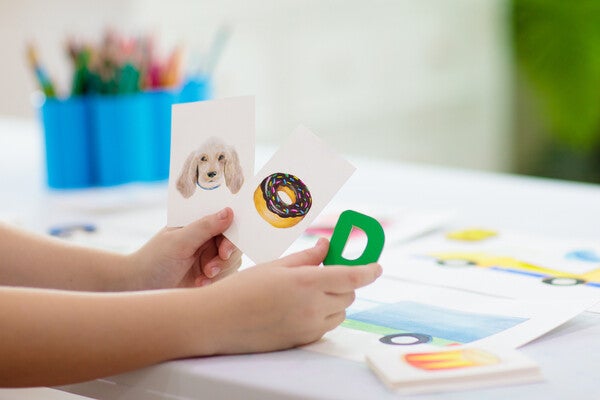
Try this visual learning strategy: Flashcards with one picture and one word. It helps many kids retain new vocabulary faster.
Once you notice these patterns, try building a few of these into your day. Simple visual aids for children can make both learning and daily routines easier for both of you.
1. Flashcards for kids
Flashcards give you a shortcut. Instead of repeating a word five times, you hold up a card and let the picture do the explaining. They work well for new vocabulary, numbers, or Filipino and English word pairs. Keep them simple: one picture, one word, nothing cluttered.
2. Drawing to learn new ideas
Drawing to learn isn’t about artistic skill. Scribbles and stick figures count. Ask your child to draw what happened in a story or what they learned in school today, and you’ll get an honest read on what actually stuck; no quiz required.
3. Story maps and mind maps for kids
Story maps for kids break a book into a simple sequence: pictures for the beginning, middle, and end, so your child can retell the story without you prompting every line. Mind maps for kids do something similar for bigger topics: one central picture (say, “animals”) connects out to smaller ones, a cat, a dog, a bird. Basically, both turn something abstract into something your child can see and point to.
For more hands-on ways to build these skills, try these teacher-recommended problem-solving activities, such as arts and crafts and role-play.
4. Picture cards and color-coded routines
Flashcards are great for teaching a new word or idea, but picture cards for kids do a different job: they walk your child through a routine step by step, like brushing teeth, putting on shoes, and packing your bag.
Early childhood programs use this same kind of visual support to give children a predictable routine they can follow. Color-coding subjects or chores adds another visual cue that helps your child remember what goes where.
Why Your Child Still Needs More Than Pictures
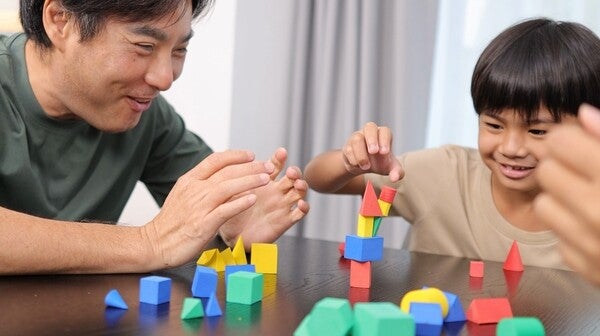
Block-building and hands-on play build problem-solving skills that visual tools like flashcards can’t teach alone.
As helpful as visual tools are, don’t stop there. Kids build different skills through different channels: seeing, hearing, talking, and doing. Reading stories aloud still builds your child’s vocabulary and listening skills in ways pictures alone can’t. Hands-on play, like building blocks or acting out a story, strengthens problem-solving and coordination.
According to the National Association for the Education of Young Children (NAEYC), all areas of a child’s development—physical, cognitive, social, emotional, and language—are connected and support one another. So, if your child loves flashcards, keep using them. Just build in time for storytelling, movement, and conversation too, so they’re getting the full range, not just the part that comes easiest.
What Research Says About Learning Styles
You may have heard that kids learn best when you match lessons exactly to their “type,” visual, auditory, or hands-on. Here’s what the research actually shows.
Treating it as a fixed label can work against your child.
Research published by the American Psychological Association (APA) found that people who believe that children are born with a specific learning style (and that this determines how well they’ll do in school) hold onto that belief even when shown evidence against it. The researchers found this rigid thinking shows up even more often among educators who work with young children.
This matters because kids taught this way can end up boxed into one method instead of getting the mix of approaches that helps them learn. In short, the visual tools aren’t the problem. The problem lies in treating your child as only one type of learner, rather than someone who takes things in a few different ways.
Drawing supports memory, even if it’s not a fixed “style”.
Research on children’s memory found that kids who draw what they remember include less detail overall than kids who just tell you verbally. But what they do include tends to stay consistent, even months later, while verbal accounts are more likely to shift and change over repeated retellings. Their drawings also contained noticeably fewer mistakes than their spoken accounts.
Simply put, drawing helped kids remember what happened more accurately, though the study focused on recalling past events, not classroom learning. So drawing isn’t about getting more out of your child. It’s about getting something steadier and more accurate, a reason to keep it as one tool among several, not the whole approach.
Putting Visual Learning into Practice
So does your child learn better with pictures? If they remember what they see more than what they hear, the answer’s probably yes, at least some of the time. Visual learning isn’t a box to check off. It’s simply one more way to notice how your child takes in the world, alongside the stories you read aloud, the conversations you have, and the hands-on play that fills the rest of their day. Pick one thing from this guide, a set of flashcards, a story map, a color-coded routine, and try it this week. See what clicks, then build from there.
Curious about what’s worked for other families? Other parents may be testing these same visual learning tools in the ParenTeam Moms and Dads Facebook group. Drop by and compare notes.
References
American Psychological Association. "Belief in Learning Styles Myth May Be Detrimental." Press release. May 29, 2019. Accessed September 2, 2026. https://www.apa.org/news/press/releases/2019/05/learning-styles-myth
Baadte, Christiane, and Bettina Meinhardt-Injac. "The Picture Superiority Effect in Associative Memory: A Developmental Study." British Journal of Developmental Psychology 37 (2019): 382–395. Accessed September 2, 2026. https://bpspsychub.onlinelibrary.wiley.com/doi/abs/10.1111/bjdp.12280
"The Importance of Schedules and Routines." HeadStart.gov. U.S. Administration for Children and Families. Last updated February 3, 2025. Accessed September 2, 2026. https://headstart.gov/about-us/article/importance-schedules-routines
Iordanou, Christiana, Melissa L. Allen, and Lara Warmelink. "Drawing and Memory: What Is the Content of Children's Drawings and How Does It Differ from Their Verbal Reports?" Empirical Studies of the Arts 40, no. 2 (2022): 245–258. Accessed September 2, 2026. https://journals.sagepub.com/doi/10.1177/02762374211047971
National Association for the Education of Young Children (NAEYC). Developmentally Appropriate Practice. Position statement. Adopted by the NAEYC National Governing Board, April 2020. Washington, DC: NAEYC, 2020. Accessed September 2, 2026. https://www.naeyc.org/resources/position-statements/dap/contents
Pashler, Harold, Mark McDaniel, Doug Rohrer, and Robert Bjork. "Learning Styles: Concepts and Evidence." Psychological Science in the Public Interest 9, no. 3 (2008): 105–119. Accessed September 2, 2026. https://journals.sagepub.com/doi/full/10.1111/j.1539-6053.2009.01038.x
Related articles

10 Signs na Hiyang Ang Anak Sa Kinakain Niya
Makikita mo sa kilos, sa energy, at kahit sa pagtulog ng anak mo na hiyang ang anak mo sa kinakain nya!
7 mins to read

Back-to-School Prep: 8 Ways to Help Your Child Get Ready for Classes
Back-to-school blues, begone! These practical tips take the stress out of planning to help your child feel confident, prepared, and ready for the new school year.
6 mins to read

How Much Parental Pressure is Healthy for a Kindergartener?
Starting kindergarten is a big step for both kids and parents. Here’s how to strike a healthy balance between encouragement and setting expectations.
5 mins to read

7 Ways Family Love Boosts Your Child's Success
Family love gives your child confidence, resilience, and emotional safety. Learn how a nurturing home shapes success from early childhood onward.
5 mins to read

Why Letting Kids Play Is Essential in Parenting
Wondering what sort of activities you should plan for your children? Let your kids play instead!
9 mins to read

12 Filipino Children’s Books That Help You Teach the Big Lessons
Discuss kindness, courage, and family changes with Filipino children's books for every age. These stories give you the right words for life's important conversations.
6 mins to read

Kaya Ko ‘To, Mommy: Para sa Independent na Pagpapalaki
Mommy, napakalaki ng role mo sa pagpapalaki kay baby para siya ay maging independent. At kaya mo siyang i-train para maging independent kahit bata pa.
3 mins to read

How to Feed a Picky Eater: A Nutritionist’s Guide for Preschoolers
Raising a picky eater doesn’t mean giving up on healthy meals. Get practical, nutritionist-backed ideas to make mealtimes easier and more satisfying.
12 mins to read

10 Bible Stories for Kids That Teach Values They Can Live By
Teaching big values to preschoolers isn’t easy. These Bible stories for kids bring concepts like patience and kindness in a way little minds can get.
13 mins to read

Sterilized Milk Benefits for Growing Kids: What Parents Should Know
Sterilized milk benefits your whole household, from safety to shelf life. Here’s what it offers your family and your growing kids.
5 mins to read

7 ₱500 Budget Ulam Ideas to Feed Your Family
Use these budget ulam ideas to cook hearty yet wallet-friendly meals for your family.
6 mins to read

Does Your Preschooler Need Fresh Milk or Growing-Up Milk?
Fresh milk gives your preschooler a strong start—but does it cover everything they need? Here’s how to know if growing-up milk can help your child.
7 mins to read

6 Budget-Friendly Milk Products for Your Preschooler’s Baon
Milk products don’t have to strain your budget. Here are six affordable picks that fit your preschooler’s baon and their growing needs.
7 mins to read

6 Benefits of Protein in Milk for Preschoolers
Protein in milk gives your preschooler the fuel to play hard, grow strong, and fight germs—here’s exactly how it works and how much they need.
7 mins to read

Powdered Milk or Fortified Milk: What’s the Difference for Your Preschooler?
Powdered milk and fortified milk might seem similar, but they serve different purposes. Learn how they differ and which one your preschooler might need.
6 mins to read

Your 6 Ways to a Good Night’s Sleep
Have some problems with sleeping? Try these 6 tips for well-rested sleep.
3 mins to read

How to Build Your Child’s Attention Span
Nurture your child’s ability to concentrate from an early age—and give him the mental discipline to succeed in school and life
6 mins to read

Eat Healthy for a Good Immune System
Food is very important for a healthy immune system to fight all types of infections. What are the nutrients needed to keep us nourished?
3 mins to read

Why You Shouldn’t Force Picky Eaters – And What Works Better
Does your child refuse to a large variety of food? Learn the real issue behind picky eating, and how to get your child to warm up to healthier and more nutritious options.
4 mins to read


