


9 Water Safety Rules Every Filipino Parent Should Teach Their Kids
Heading to the pool this weekend, Mommy? It could be the one at your kumare’s condo, a truck pool rented for a neighbor’s party, or the resort pool on a family trip out of town. Swimming feels so ordinary, it’s easy to let your guard down, especially when your preschooler is in the kiddie pools or shallow areas. And when the titos and titas are around, you might assume someone else is watching your child. Whether you’re at the pool or beach, teaching your child water safety rules helps keep them protected.
Children are curious and quick, and they can’t always tell when water is dangerous. This list gives you nine simple rules your child can remember and follow, plus the swim skills to build at each age and what to do if your child gets into trouble in the water.
Why Water Safety Matters for Filipino Families
Your child will likely end up near water sooner or later. A classmate’s tarp pool, a school field trip by a lake, or a weekend at the beach can all bring your preschooler close to the edge.
Knowing how to swim helps, but it’s only one part of water safety. Young children can drown in as little as an inch of two inches of water, the American Academy of Pediatrics (AAP) notes, so even a shallow kiddie pool needs your eyes on it. Good swimmers need watching, too. The American Red Cross advises keeping a close eye on kids no matter how well they swim. This is especially important in the sea, which can have strong currents and waves.
And young children need the most protection. Drowning is the fourth leading cause of death for children aged 1 to 4 worldwide, the World Health Organization (WHO) reports. That’s why the rules and skills below matter so much.
Closer to home, researchers behind a 2021 study found drowning to be a leading cause of child death in the Philippines. For a bit more optimistic news: their data show that drowning rates among Filipino kids under 5 went down between 2008 and 2017.
The same researchers list the risks that earlier studies have linked to child drowning: no adult watching, easy access to water, being too young to spot danger, and not knowing how to swim. The rules below help with most of them.
9 Water Safety Rules to Teach Your Kids
Teach these safety rules to your child at home, then go over them again right before you get in the water, so they stay fresh in your child’s mind.
Rule 1: Always ask a grown-up before you go near the water.
You’ve probably called out "Anak, 'wag kang lalayo!" more than once at a crowded resort. When your child asks you first, you can walk them to the water and stay close from the very first splash. The Red Cross says you should never leave a young child alone near water, and you should always teach them to ask permission first.
Rule 2: Only swim when a grown-up is watching you.
Once your child is in the water, someone needs to keep their eyes on them the whole time, so help is always seconds away. Drowning is fast and quiet. UNICEF says young children can drown silently in as little as 25 seconds. In other words, you might not hear a thing, especially if you stepped away to grab a towel or you’re on your phone.
Pick one water watcher, or bantay, for every swim. The US Centers for Disease Control and Prevention (CDC) advises whoever’s watching to stay off the phone and skip the alcohol. Leave the earphones off, too, so you can hear right away if your child needs help. Keep towels, water, and snacks within reach, so your bantay never has to walk away.
Mommy, you don't have to be the bantay the whole time. At big family gatherings, take turns so whoever’s on duty stays alert.
Rule 3: Stay close enough for Mommy or Daddy to touch you.
When your child stays within arm’s reach, you can grab them the moment they slip or go under. The AAP calls this “touch supervision,” and it recommends getting in the water with younger kids and those still learning to swim. Instead of watching from a lounge chair, swim right beside your preschooler.
The same goes for breaks out of the water. Whether you’re eating by the pool or resting on the sand, keep your child within arm’s reach whenever water is nearby.
Rule 4: Always swim with a buddy.
A swim buddy gives your child a partner in the water, someone right there to shout for help if something goes wrong. Pair your preschooler with an older cousin, ate, or kuya they love playing with. Just remember that while a buddy adds a layer of safety, they never replace the adult keeping watch. As the Red Cross puts it: don’t trust a child’s life to another child.
Rule 5: Wear your life jacket at the beach and on every bangka ride.
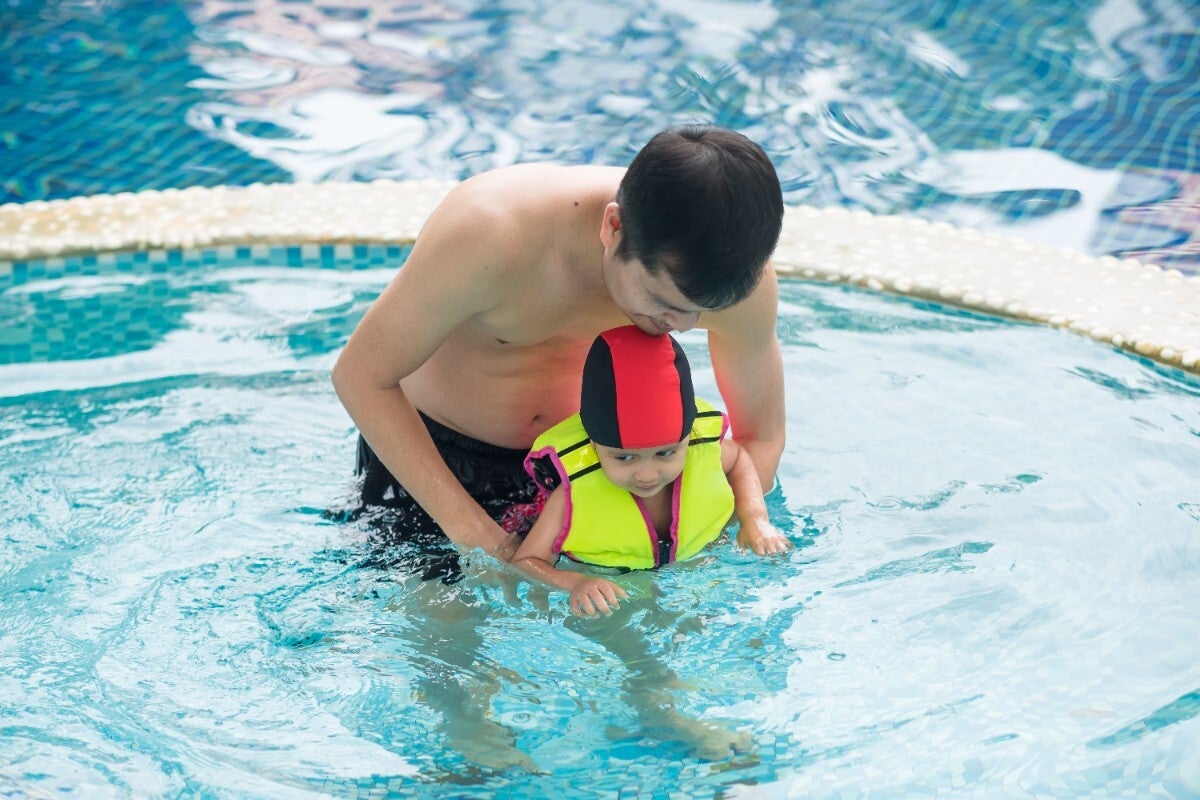
Here’s an important water safety tip: Ensure your child wears a snug life jacket at the pool, beach, or on any boat ride.
The CDC recommends life jackets for children in and around natural water, like the sea. It also notes that life jackets lower the risk of drowning on boats for people of all ages. If your child can’t swim yet, the AAP suggests one for the pool, too.
Before an island-hopping trip, ask the boat operator if they have a life jacket in your child’s size. If they don’t, bring your own. Right before your child gets in the water, check that it fits snugly.
Rule 6: Don’t count on floaties to keep you safe.
Salbabidas and arm floaties make pool time more fun, but they can’t replace watching your child. The Red Cross warns against relying on swim rings, water wings, and inflatable toys instead of adult supervision.
If your child can’t swim yet and needs help floating, choose a life jacket. Even then, stay close, since the Red Cross also advises against relying on life jackets alone.
Rule 7: Swim where the lifeguard can see you.
A lifeguard gives your child an extra pair of trained eyes on the water. The Red Cross recommends swimming in areas where lifeguards can see you, so when you arrive at a resort or beach, make sure to set up near them. Stay alert even then, however shallow the water looks. And if there’s no lifeguard at all, that job is yours.
If you’re at the beach, look for warning signs or colored flags before anyone gets in the water. Some local governments use flags to show sea conditions. In Pangasinan, for example, green means calm water, yellow means caution because of strong currents or waves, and red means swimming isn’t recommended, the Philippine Information Agency reports. The same advisory reminds beachgoers to watch out for rip currents. If you see a red flag or the waves look rough, keep your child on the sand. If there are no flags or signs, ask the lifeguard or resort staff how the water is that day.
Rule 8: Never play in floodwater.
After a heavy downpour, a flooded street can look like one giant puddle to splash in. But floodwater can carry sewage, chemicals, and bacteria that cause illnesses like leptospirosis. (You can learn more in this typhoon safety guide.)
WHO also notes that drowning causes most deaths in flood disasters. During the rainy season, keep your child indoors or on dry ground until the water goes down.
Rule 9: Shout for a grown-up if a friend needs help.
Your child’s first instinct may be to jump in and help a friend, but that can put two kids in danger. Teach them to stay on dry land and shout for a grown-up right away. If no adult hears them, they can run to get one. Make it a game at home: have your child spot a “swimmer” in trouble on the sofa and practice shouting for help.
Water Safety Skills to Teach Your Child by Age
Rules help keep your child away from danger, and swim skills give them another layer of protection once they’re in the water. What your child can learn depends on their age.
Ages 3 to 4: parent-and-child swim classes
At this age, swim class is a chance to have fun in the water together. The AAP says many kids can start lessons as early as age 1, so your preschooler isn’t too young.
For kids under 4, the AAP recommends an adult stay within arm’s reach even during class, so choose a course that lets you join your child in the pool. You’ll see exactly what they’re learning and know what to practice together on your next family swim.
Ages 4 to 5: lessons that build water skills
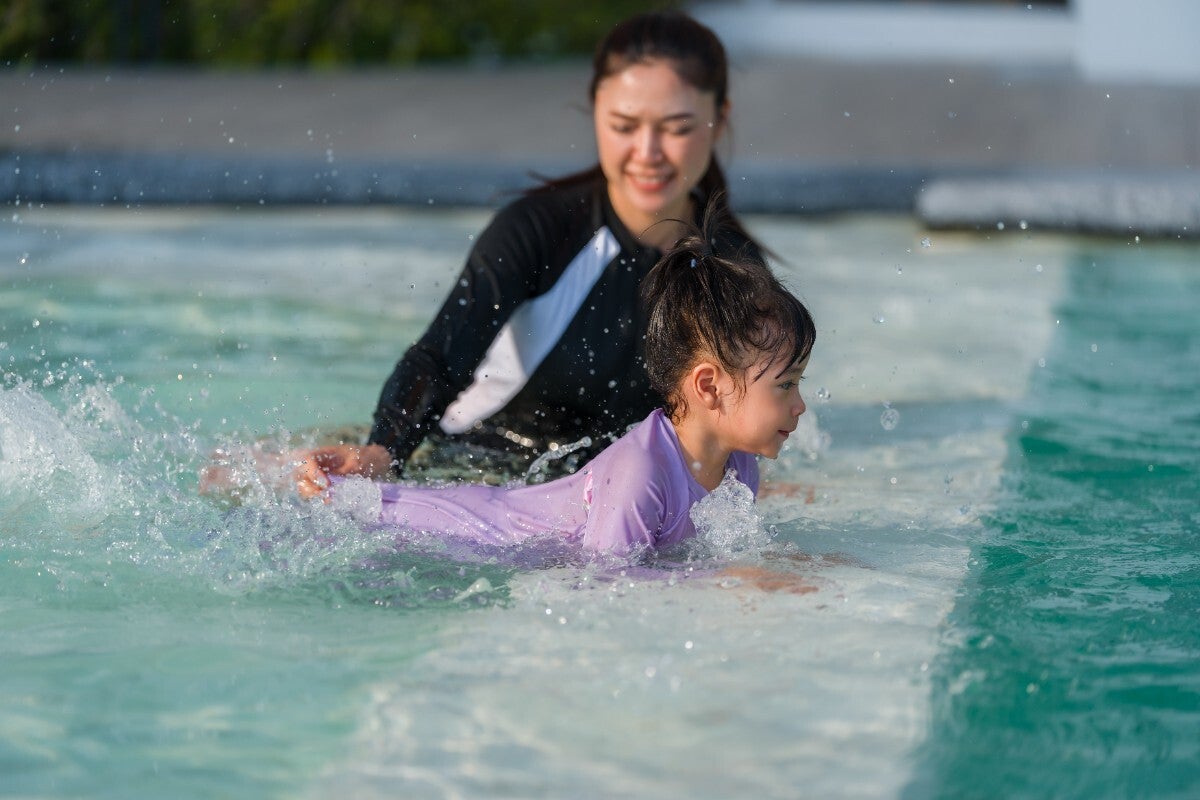
Most kids are ready for swim lessons by age 4. Lessons teach them to come up, move forward, and climb out of the pool safely.
By age 4, most kids are ready for swim lessons, according to the AAP. Good lessons teach your child to come back up after going underwater, move through the water, and climb out on their own. Put plainly, these are the skills that help your child get from the water back to the edge of the pool or to the shore.
As your child’s skills grow, keep watching just as closely. The CDC reminds parents that kids who’ve had swim lessons still need close and constant supervision.
Ages 6 and up: formal swimming and water safety training
Once your child turns 6, WHO recommends basic swimming and water safety training, so they learn to swim and how to stay safe around water. It’s a good time to sign them up for a proper course. In the Philippines, groups like your local Philippine Red Cross chapter offer water safety programs.
What to Do If Your Child Gets Into Trouble in the Water
Even with rules in place, you need a plan for emergencies. First aid and water safety go hand in hand, so keep these steps in mind before your trip.
Check the water first if your child goes missing.
In a crowd, it’s natural to assume your child wandered off with a tita or is playing by the rental cottages. But if you can’t find them, look in the water before anywhere else.
The Red Cross stresses that seconds count, and checking the pool or shoreline first gives you the best chance of reaching your child in time. Share this rule with the other adults in your group so everyone knows where to look first.
Reach or throw before you go in.
If your child is in water too deep for you to stand in, try to help from the edge first. Hold out a pole, towel, or anything long for them to grab, or throw something that floats, like a life jacket, as UNICEF suggests. This keeps you safe too, so you don’t end up needing rescue yourself.
Have someone call 911 or the local government unit’s (LGU) hotline right away. Before any trip, save the local emergency number for where you’re staying in your phone. That way, you already have it when you need it.
Learn CPR before you need it.
Knowing CPR means you can act right away instead of only waiting for help. In fact, CPR skills could save a life in the time it takes for paramedics to arrive, the CDC notes. The Philippine Red Cross offers first aid courses with CPR training, the same kind of training this choking first aid guide recommends.
If your child ever goes under and you pull them out of the water, UNICEF advises checking their airway and breathing while someone else calls for help. That’s when your training helps you stay calm and act fast.
Make Water Safety Part of Every Family Trip
Water safety comes down to three things: clear rules your child can follow, swim skills that grow with them, and a plan you’re ready to use if something goes wrong. Before your next dip, do a quick three-step check, Mommy. Name your bantay, pack a life jacket in your child’s size, and go over the rules with your preschooler one more time.
Got your own water safety tips from past family outings? Share them in the ParenTeam Moms and Dads Facebook group and help more kids enjoy every splash safely.
References
American Red Cross. "Swimming Safety." n.d. Accessed September 25, 2026. https://www.redcross.org/get-help/how-to-prepare-for-emergencies/types-of-emergencies/water-safety/swim-safety.html
Centers for Disease Control and Prevention. "Preventing Drowning." Last modified September 29, 2025. Accessed September 25, 2026. https://www.cdc.gov/drowning/prevention/index.html
Guevarra, Jonathan P., Amy E. Peden, Lita L. Orbillo, et al. "Preventing Child Drowning in the Philippines: The Need to Address the Determinants of Health." Children 8, no. 1 (2021): 29. Accessed September 25, 2026. https://www.mdpi.com/2227-9067/8/1/29
McCallin, Tracy, and Rohit P. Shenoi. "Swim Lessons for Children: When to Start & What to Consider." HealthyChildren.org. Last modified May 18, 2026. Accessed September 25, 2026. https://www.healthychildren.org/English/safety-prevention/at-play/Pages/Swim-Lessons.aspx
Philippine Information Agency. "Pangasinan Beachgoers Urged to Learn, Heed Flag Warnings." April 10, 2025. Accessed September 29, 2026. https://pia.gov.ph/news/pangasinan-beachgoers-urged-to-learn-heed-flag-warnings/
UNICEF. "Drowning Prevention Tips." UNICEF Parenting. n.d. Accessed September 25, 2026. https://www.unicef.org/parenting/safety/drowning-prevention-tips
World Health Organization. "Drowning." Fact sheet. May 1, 2026. Accessed September 25, 2026. https://www.who.int/news-room/fact-sheets/detail/drowning
World Health Organization. WHO Guideline on the Prevention of Drowning through Provision of Day-Care and Basic Swimming and Water Safety Skills. Geneva: World Health Organization, 2021. Accessed September 25, 2026. https://www.who.int/publications/i/item/9789240030008
Related articles

Exploring the Philippines with Kids: 6 Travel Safety Tips You Should Know
Good travel safety habits keep your family trip fun from start to finish. Stay close at the beach, beat the heat, eat safely, and stick together in crowds.
10 mins to read

10 Bible Stories for Kids That Teach Values They Can Live By
Teaching big values to preschoolers isn’t easy. These Bible stories for kids bring concepts like patience and kindness in a way little minds can get.
13 mins to read

7 ₱500 Budget Ulam Ideas to Feed Your Family
Use these budget ulam ideas to cook hearty yet wallet-friendly meals for your family.
6 mins to read

Bored Preschooler? 10 Fun Activities for Kids at Home
Keep your preschooler entertained with these activities for kids at home. Use pillows, paper, and kitchen scraps for hours of active, creative play.
8 mins to read

15 Gifts for Kids Who Have Too Many Toys
Running out of space for toys? Try these thoughtful gifts for kids that focus on fun, learning, and family time without the clutter.
5 mins to read

Is It Shyness or Social Anxiety? Signs Your Child May Need Extra Support
Social anxiety in kids isn’t just being quiet. Learn the signs a psychologist watches for, from school refusal to withdrawal, and how to help your child cope.
8 mins to read

Does Your Child Learn Better with Pictures? 4 Visual Learning Tips to Try
Visual learning turns flashcards, drawings, and picture charts into real study tools. Here’s how to spot it and try it with your child.
7 mins to read

How to Feed a Picky Eater: A Nutritionist’s Guide for Preschoolers
Raising a picky eater doesn’t mean giving up on healthy meals. Get practical, nutritionist-backed ideas to make mealtimes easier and more satisfying.
12 mins to read

10 Signs na Hiyang Ang Anak Sa Kinakain Niya
Makikita mo sa kilos, sa energy, at kahit sa pagtulog ng anak mo na hiyang ang anak mo sa kinakain nya!
7 mins to read

Sterilized Milk Benefits for Growing Kids: What Parents Should Know
Sterilized milk benefits your whole household, from safety to shelf life. Here’s what it offers your family and your growing kids.
5 mins to read

Does Your Preschooler Need Fresh Milk or Growing-Up Milk?
Fresh milk gives your preschooler a strong start—but does it cover everything they need? Here’s how to know if growing-up milk can help your child.
7 mins to read

6 Budget-Friendly Milk Products for Your Preschooler’s Baon
Milk products don’t have to strain your budget. Here are six affordable picks that fit your preschooler’s baon and their growing needs.
7 mins to read

6 Benefits of Protein in Milk for Preschoolers
Protein in milk gives your preschooler the fuel to play hard, grow strong, and fight germs—here’s exactly how it works and how much they need.
7 mins to read

Powdered Milk or Fortified Milk: What’s the Difference for Your Preschooler?
Powdered milk and fortified milk might seem similar, but they serve different purposes. Learn how they differ and which one your preschooler might need.
6 mins to read

Your 6 Ways to a Good Night’s Sleep
Have some problems with sleeping? Try these 6 tips for well-rested sleep.
3 mins to read

How to Build Your Child’s Attention Span
Nurture your child’s ability to concentrate from an early age—and give him the mental discipline to succeed in school and life
6 mins to read

Eat Healthy for a Good Immune System
Food is very important for a healthy immune system to fight all types of infections. What are the nutrients needed to keep us nourished?
3 mins to read

Why You Shouldn’t Force Picky Eaters – And What Works Better
Does your child refuse to a large variety of food? Learn the real issue behind picky eating, and how to get your child to warm up to healthier and more nutritious options.
4 mins to read

Why Play is Essential For Your Kid in Stressful Times
Check out this research-backed listicle of ways that play can ease tension and promote a more positive outlook for kids, particularly as the “post new normal” has upended their more carefree way of
6 mins to read


