


Traveling with a Baby in the Philippines: Packing, Safety, and Prep Guide
Now that your baby’s old enough to leave the house, you’re probably thinking about your first real trip together, and it can feel overwhelming fast. Between diaper changes, feeding schedules, naps, and keeping your little one calm, there’s a lot more to plan for than your usual pack-and-go.
The good news: it gets easier with practice, and it’s worth building the habit early. Family travel comes with real benefits as your child grows, so the trips you’re taking now pays off for years to come.
Whether you’re driving, taking a ferry, or catching a flight, this guide covers what to pack and prepare, no matter how you’re getting there.
Quick Answer: What to Pack When Traveling with a Baby
When traveling with a baby, pack a diaper bag you can reach quickly. This should contain all the things you might need in transit for your little one, including any travel documents. The rest of the necessities can go in your main luggage. Beyond packing, prepare based on how you’re getting there: install a car seat for road trips, check life jacket availability for ferry trips, or confirm your airline’s infant policy for flights.
Here’s your baby travel checklist at a glance.
| Category | What to Pack or Prepare |
|---|---|
| Diapering | Diapers, wipes, changing mat, diaper cream, disposal bags |
| Clothing | Extra outfits, socks, a light jacket, sleepwear for overnight trips |
| Feeding & snacks | Nursing cover, bibs, water for yourself |
| Comfort | Favorite toy, small blanket, pacifier, or another familiar comfort item |
| Hygiene | Tissues, hand sanitizer, baby wipes, a burp cloth or small towel |
| Health | Basic first aid kit, prescribed medicine, a thermometer |
| Documents | Birth certificate copy, valid ID, HMO or health card, booking confirmations |
| Carrying | Baby carrier, stroller, or both, depending on your trip |
| Safety | Car seat for road trips, life jacket check for ferry trips |
What to Keep in Your Diaper Bag vs. Main Luggage
Once you know what to pack, split it smartly. Keep what you’ll need quickly within arm’s reach, and leave the rest in your luggage so you’re not digging through your whole suitcase at a diaper change.
| Keep in Your Diaper Bag | Keep in Your Main Luggage |
|---|---|
| 2 to 3 diapers, or enough for your travel time | Main diaper supply |
| Wipes and a small changing mat | Extra wipes |
| 1 to 2 extra outfits | Bulk of the clothes |
| Feeding essentials like a nursing cover | Any other feeding items |
| Comfort toy or pacifier | Extra toys or books |
| Small first aid basics | Larger medicine kit |
| Travel documents | Backup copies |
| Plastic bags for soiled items | Laundry bag |
Not sure whether to bring a stroller, a carrier, or both? This stroller buying guide and carrier guide can help you decide based on your baby’s age and where you’re headed.
Using a carrier regularly may work in your favor beyond convenience, too. A 2024 study in the Infant Mental Health Journal found that parents who frequently wore their baby in a sling, wrap, or carrier reported feeling less frustrated when their baby cried, compared to parents who rarely did.
So what does this mean for you? Those extra minutes you spend with your baby strapped close to you aren’t just freeing up your hands. They may also be helping you stay calmer when your baby fusses, on the road or at home.
Car Travel with Baby: What You Need to Know
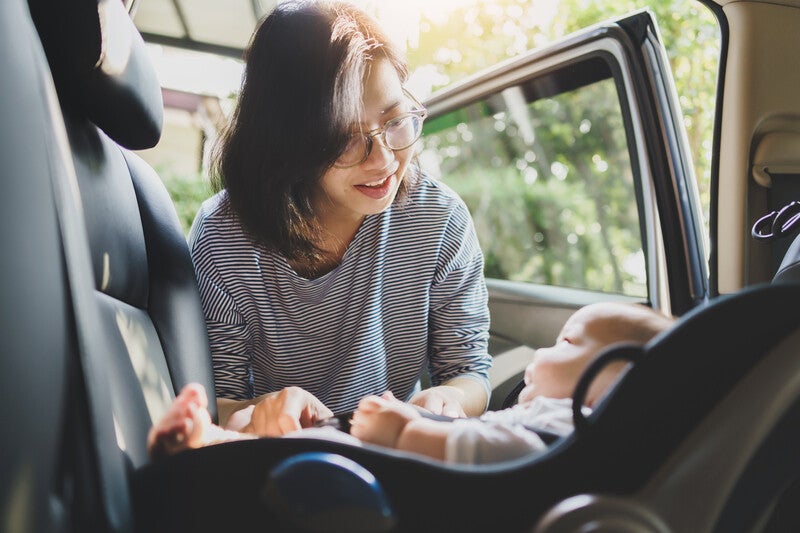
RA 11229 requires a child restraint system for kids 12 and under, or under 150 cm, in private vehicles.
Got a road trip planned? Car travel with a baby means planning for safety first, then comfort. If you’re driving anywhere in the Philippines, your baby needs to ride in a proper child car seat.
Republic Act No. 11229, or the Child Safety in Motor Vehicles Act, requires children 12 years old and below, or under 150 cm in height, to use an age- and size-appropriate child restraint system (CRS), and they can’t sit in the front seat. This isn’t just about avoiding a fine. According to the Centers for Disease Control and Prevention (CDC), car seat use reduces the risk of injury in a crash by 71 to 82 percent for children, compared to seat belt use alone.
Beyond the car seat, a few habits go a long way:
- Plan regular stops so you can feed, change, and let your baby stretch.
- Keep water, snacks, and a light blanket within arm’s reach.
- Avoid parking in direct sun for too long, since car interiors heat up fast.
Want to double-check if you’re following the law correctly? Take this quick car seat law quiz.
Boat or Ferry Travel with Baby: Staying Safe at Sea
Headed to the province by sea? Ferry travel with baby takes a bit more prep than a car ride, since delays, tight spaces, and long waits are part of the territory.
Before you leave:
- Check the weather and your ferry’s schedule, since delays and rescheduled trips happen often during rainy season.
- Confirm the ferry has infant-sized life jackets on board. Under MARINA Circular No. 2009-25, passenger ships must carry infant life jackets equal to at least 5 percent of their passenger capacity, and let passengers with infants know about this when boarding.
- Pack your own type-approved infant life jacket if you’d rather not rely on what’s on board. This is allowed as long as it carries the MARINA hologram.
At the port and on board:
- Pack your baby’s essentials in one easy-access bag, since space at the terminal can get tight.
- Expect to wait, sometimes for hours, before boarding.
- Bring a light blanket or a hand fan for the heat at the port.
- Locate the nearest restroom or changing area as soon as you arrive.
Flying with a Baby: What to Prepare
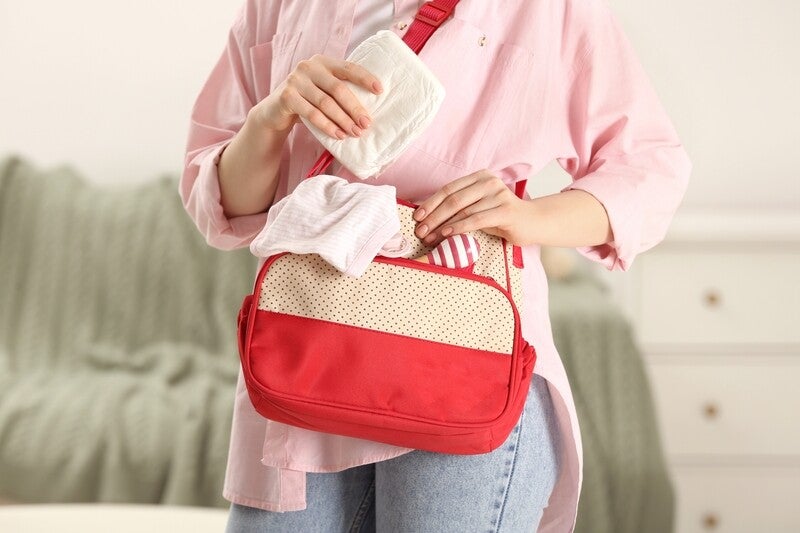
Pack diapers and a comfort toy in your carry-on for takeoff and landing.
Flying with a baby means checking a few things before you book, starting with your airline’s infant policy. Philippine Airlines, for example, lays out its own guidelines for traveling with infants. If you want a bassinet, ask as early as you can. Bassinets only attach to certain bulkhead seats, so they’re limited, and most airlines only offer them on flights of three hours or longer, which rules them out on many short domestic hops.
Pack your cabin diaper bag with:
- Diapers and wipes
- A change of clothes
- Any feeding essentials for the flight
- A comfort item, like a small toy or blanket
- A pacifier
The American Academy of Pediatrics (AAP) suggests nursing your baby during takeoff and landing, since the change in cabin pressure can hurt their ears. Another option? Offer a pacifier.
Your baby doesn’t need a passport to fly domestically. A PSA-issued birth certificate is the standard requirement airlines ask for at check-in, and some carriers, like Cebu Pacific, also accept a baby book. Requirements can vary slightly by airline, so always double-check with yours before you fly.
Documents to Bring When You Travel
Whatever way you’re traveling, keep yours and your baby’s documents in one folder so you’re not digging through your bag at the counter. Bring a photocopy of your baby’s birth certificate, your valid ID, and any booking confirmations. If your baby has an HMO or health card, pack that too, along with a note from your pediatrician if your baby takes any medication.
Frequently Asked Questions
Here are answers to some common questions about traveling with a baby.
When can my baby start traveling?
The AAP generally recommends waiting until your baby is 2 to 3 months old before flying, mainly to lower the risk of catching something in crowded airports and cabins.
Board-certified pediatrician Dr. Sandra Sharlene Lim Uy advises against bringing newborn babies to crowded places until they’ve finished that first round of vaccinations. Talk to your own pediatrician too, especially if your baby was born early or has a health condition.
Do I need a car seat even for a short drive?
Yes. RA 11229 doesn’t carve out an exemption for short trips, so your baby needs to be in an age- and size-appropriate car seat every time you’re in a private vehicle, whether you’re driving five minutes or five hours.
Do I need my baby's ID for domestic trips, even if I'm not flying?
It’s worth bringing a photocopy of your baby’s PSA birth certificate wherever you go, not just for flights. Some ferry operators and hotels ask for it too, especially if you’re checking in without your baby’s other parent along.
Do I need a DSWD travel clearance for domestic trips?
No. A DSWD travel clearance is only required for minors traveling abroad alone or with someone who isn’t a parent or legal guardian. If you’re traveling with your baby domestically, you don’t need one.
One Last Tip Before You Go
Every trip you take with your baby teaches you something for the next one. Pack with purpose, plan around your mode of transport, and give yourself extra time so nothing feels rushed. The night before you leave, lay everything from your checklist out on the bed and do one final walk-through instead of packing at the last minute. Traveling with a baby gets easier with every trip, and a little prep now makes the trip a lot smoother.
Got a packing hack or a travel story worth sharing? Talk to other parents who’ve been there in the ParenTeam Moms and Dads Facebook group, and find real advice from families who travel with babies and toddlers all the time.
References
Centers for Disease Control and Prevention. "Preventing Child Passenger Injury." CDC Child Passenger Safety. Accessed August 28, 2026. https://www.cdc.gov/child-passenger-safety/prevention/index.html
Cebu Pacific. "Traveling with Infants or Minors." Accessed August 28, 2026. https://help.cebupacificair.com/article/traveling-with-infants-or-minors-124189
Department of Social Welfare and Development. "Travel Clearance for Minors." Accessed August 28, 2026. https://transparency.dswd.gov.ph/faqs/travel-clearance-for-minors/
Firk, Christine, and Nora Großheinrich. "Infant Carrying: Associations with Parental Reflective Functioning, Parental Bonding and Parental Responses to Infant Crying." Infant Mental Health Journal 45, no. 3 (2024): 263–275. Accessed August 28, 2026. https://onlinelibrary.wiley.com/doi/abs/10.1002/imhj.22106
Maritime Industry Authority. MARINA Circular No. 2009-25, "Rules and Procedures on the Approval of Lifejackets and Lifebuoys for Ships Engaged in Domestic Shipping." Supreme Court E-Library. Accessed August 28, 2026. https://elibrary.judiciary.gov.ph/thebookshelf/showdocs/11/49927
Philippine Airlines. "Traveling with Infants." Accessed August 28, 2026. https://www.philippineairlines.com/ph/en/before-you-fly/special-needs-and-request/travelling-with-infants.html
Republic of the Philippines. Republic Act No. 11229, "An Act Providing for the Special Protection of Child Passengers in Motor Vehicles and Appropriating Funds Therefor." February 22, 2019. Accessed August 28, 2026. https://elibrary.judiciary.gov.ph/thebookshelf/showdocs/2/95785
Shu, Jennifer, and Claire McCarthy. "Flying With Baby: Parent FAQs & Tips for Safer, Easier Air Travel." HealthyChildren.org. American Academy of Pediatrics Council on Injury, Violence & Poison Prevention. Last modified March 3, 2026. Accessed August 28, 2026. https://www.healthychildren.org/English/safety-prevention/on-the-go/Pages/Flying-with-Baby.aspx
Related articles

How to Take a Clear Baby Picture for Visas and Passports
Getting a proper baby picture is tricky. Here's how to set up your background, time the session, and finally nail that open-eyed shot at home.
8 mins to read

5 Requirements for Your Child's Philippine Passport Application
Starting your child's Philippine passport application? This guide outlines all the necessary requirements, from documentation to photo tips for a stress-free process.
7 mins to read

Do You Need a Pacifier for Your Baby? What to Know Before Deciding
Here’s what a pediatrician wants you to know about using a pacifier.
9 mins to read

Iba ang Pambata: Why Age-Appropriate Milk Matters
You wouldn’t let your youngest child wear ate or kuya’s shoes—so why give them milk that isn’t made for their age? Milk is not one-size-fits-all.
5 mins to read

Wais Pag Sakto sa Edad: Why Age-Appropriate Milk Matters
Milk comes in many forms, but not all milk is made equal. Learn why kids need age-appropriate nutrition during their most critical years of growth.
6 mins to read

15 Filipino Parenting Myths: What to Keep or Let Go, According to Stage
Cravings and pwera usog? Filipino myths are part and parcel of parenting. Here’s what’s sentimental, what’s outdated, and what modern medicine actually says.
14 mins to read

Baby Toothpaste Guide: What to Use from First Tooth to Toddler Years
Baby toothpaste matters more than you’d think. Know how to pick the right one, use the right amount, and the right time to start, from that very first tooth.
7 mins to read

A Doctor Explains How to Use a Nasal Aspirator on Your Baby
A nasal aspirator can help your congested baby breathe easier, sleep better, and feed without a fight. Here’s how to use one safely, according to a pediatrician.
8 mins to read

PhilHealth Contribution for Self-Employed Parents: Requirements and Rates
How much is the PhilHealth contribution for self-employed parents? It depends on your declared income. Learn the rates, the requirements, and how to pay it correctly.
4 mins to read

5 Signs You Need to Switch Your Baby’s Laundry Detergent
Does your little one have a rash that won’t go away? It could be caused by your baby laundry detergent. Here’s how to spot the signs and know what to do next.
4 mins to read

What Is Stunted Growth? A Pediatrician’s Guide for Parents
Worried people think your child is bansot or pandak, Mommy? Behind that teasing is a real concern: stunted growth. Here’s how pediatricians check for it.
4 mins to read

Newborn Essentials: A Real-Parent Guide for the First 90 Days
Overwhelmed by baby shopping? Check out this no-hype guide for Filipino parents that break down the true newborn essentials—plus which items to skip or splurge on.
7 mins to read

Baptism and Christening Costs in the Philippines: What to Expect
Baptism and christening costs in the Philippines add up fast. See where the money goes, and where you can spend less without losing the meaning.
8 mins to read

How to Claim 14 Days of Paternity Leave: A Dad’s HR Filing Guide
Paternity leave gives you seven paid days to support your wife and bond with your baby. Learn how to qualify, file with HR, and claim up to 14 days total.
7 mins to read

A Parent’s Guide to Caring for Cradle Cap in Babies
Cradle cap in babies is common, harmless, and easy to manage with the right daily routine. Here’s what actually works, according to a pediatrician.
6 mins to read

15 Time-Saving Mother's Day Gift Ideas New and Toddler Moms
These useful gifts for new moms will make them feel supported, loved, and more like themselves again.
6 mins to read

How to Spot and Manage Your Baby’s Eczema at Home
Spotting baby eczema early helps you treat it fast. Learn to tell it apart from typical dry skin and explore easy routines to soothe their skin.
6 mins to read

6 DIY Montessori Toys You Can Make for Every Development Stage
Montessori toys built from household scraps? You can do it, too, Mom! Discover six DIY ideas that sharpen your child’s skills without the hefty price tag.
9 mins to read

Hooked on K-Dramas? 9 Korean Boy Names Inspired by Beloved Characters
These Korean boy names from popular K-dramas are perfect for your little one. Find a name with a beautiful meaning and strong character traits today.
9 mins to read


