


Baby Stroller Buying Guide: What to Check Before You Bring One Home
Choosing your first baby stroller can feel like a bigger decision than you expected when you see the price tags. You're in wide-eyed disbelief at how some models can cost as much as a small appliance or even a laptop!
Apart from the price, there are many designs, features, and styles to compare. You're already overwhelmed before you even begin. So, let's make it easier for you with this guide.
What to Consider When Buying a Baby Stroller
Choosing your baby's first stroller gets easier once you break down the options and focus on what fits your baby's stage and your daily routine.
1. Think of strollers as three types.
While there are many kinds available, most strollers generally fall into three main groups.
- Full-size strollers: These are sturdy, feature-packed, and designed to last from newborn to toddler years. This is an all-around option that most parents start with, although it is heavier.
- Travel systems: These include a car seat that attaches to the stroller frame, allowing for easy transfer of your baby from car to stroller. They're great for newborns and families with their own vehicles.
- Umbrella or lightweight strollers: These are ideal for quick trips and travel. They're easy to fold, carry, and store but are meant for babies who can already sit up on their own.
2. Match the stroller to your baby's age.
For the first few months, your baby can’t sit up yet on their own. They need a stroller that can recline flat to a horizontal position, or it comes with a compatible bassinet. As your baby grows and can sit up unassisted (around 6 months), you can switch to a stroller with a regular seat.
3. Test-drive the stroller.
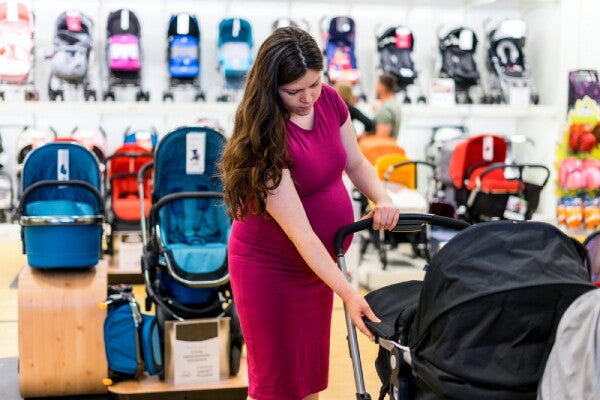
Ask a salesperson to show you different types of stroller so you can compare how it feels in your hands when you push, fold or lift it.
Check how smoothly the baby stroller steers, how easily it folds, and whether the brakes feel solid. See also if it fits in your car trunk or through your home's doorways. Put bags in the storage compartment underneath to see if the bottom doesn't sag to the floor.
Buying online? Read reviews that mention safety and everyday use, not just looks or features.
4. Check the stroller's size and weight.
The best stroller depends on how and where you plan to use it. Always test how easy it is to fold or carry before making a decision. Don't forget to lift the stroller when it's open and folded to check if you can manage the weight.
If you frequently use public transportation, a lightweight or compact stroller will make life easier, but it's ideal only when your baby can hold their head or sit up without help.
5. Look for extra features that meet your needs.
Aside from the basics, look for comfort and convenience details that fit your lifestyle, such as:
- Sunshade or canopy for UV protection
- Reclining seat for naps on the go
- Washable fabric for easy cleaning
- Smooth steering and suspension for ease of control
- Storage basket for diaper bags or groceries
Before deciding on a feature, design, color, or even stroller brand, make sure the one you're eyeing meets recognized safety standards. That's your best assurance that it's built to protect your little one from the very first day.
Baby Stroller Safety Features
Whether you are buying a baby stroller that's imported or manufactured here, they need to meet safety standards, such as:
- Wide, stable base that helps prevent tipping, even on uneven ground
- Reliable brakes that stay locked once engaged and can't be released by a child
- Secure locking and latching mechanisms that prevent accidental folding or collapsing
- A five-point or three-point harness that's permanently attached and adjustable to keep your baby in place
- Smooth edges and protective covers that prevent pinching or scratching
- Sturdy frame and wheels that stay intact after impact and load tests
- Clear warning labels and manufacturer information are printed or permanently marked on the stroller
Many local stores for baby gear and accessories will carry imported infant strollers that follow the safety standards of any of the following:
- Consumer Product Safety Commission (CPSC)
- European Committee for Standardization
- Canada Consumer Product Safety Act (CCPSA)
- Joint Australian/New Zealand Standard (AS/NZS)
These baby and toddler strollers may have certification labels or safety seals printed on the product, its packaging, or the instruction manual, such as:
- "Children's Product Certificate" for US models
- JPMA-Certified sticker (JPMA stands for US-based Juvenile Products Manufacturers Association)
- "AS/NZS 2088:2013" or "AS 2088:2022" for Australia and New Zealand-certified strollers
- "BS EN 1888-1:2018+A1:2022" for models manufactured or sold in Europe
However, the "best" infant stroller locally will have the Philippine Standard (PS) mark or the Import Commodity Clearance (ICC) sticker. These marks serve as proof that a product meets national safety and quality standards set by the Department of Trade and Industry (DTI).
Strollers manufactured abroad are required to have these PS and ICC stickers when they’re sold here even if they comply with international safety standards.
Check for safety seals or marks under "Product Details" or "Safety Information" when you shop online.
Planning to buy a pre-loved baby stroller? Visit the product recall pages of the CPSC or the Australian Competition and Consumer Commission to confirm that the model is not listed.
How to Use a Baby Stroller Safely
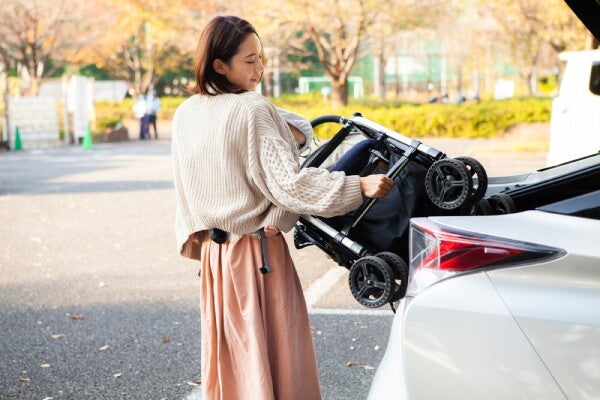
Check the stroller’s weight before buying. You'll often need to fold, unfold, and lift it while holding your baby.
Even if your stroller meets all the proper safety standards, how you use it every day matters just as much. These habits help keep your baby secure whether you're in the mall, walking around the village, or traveling.
Avoid leaving your baby unattended.
Even for a few seconds, never leave your baby alone in a stroller. It only takes a moment for it to move, tip, or for your baby to wriggle out of position.
Always use the harness.
Buckle your baby in every time, even for short stops or quick errands. It keeps them from slipping or climbing out when you least expect it.
Check the brakes before every use.
Get into the habit of testing the brakes before you start pushing. When you park the stroller, lock both wheels and make sure it doesn't roll even on slight slopes.
Don't hang heavy bags on the handle.
It's tempting to hook your diaper bag on the handle, but too much weight there can cause the stroller to tip backward. Use the under-seat basket instead to keep it balanced.
Watch the folding parts.
When folding or unfolding the stroller, make sure your baby is at a safe distance. Fingers can get caught between hinges or moving parts if you're not careful.
Use the tether strap.
If your stroller comes with a wrist strap, wear it, especially when going downhill or on busy sidewalks. It prevents the stroller from rolling away if you lose your grip.
Stay visible outdoors.
If you're out at dusk or early morning, use a stroller with reflective strips or attach a clip-on light so drivers and cyclists can see you easily.
Even if your stroller meets all the proper safety standards, how you use it every day matters as much. These habits help keep your baby secure whether you're in the mall, walking around your subdivision, or traveling.
One Last Thing to Keep in Mind
Prices for strollers can vary widely, and the most expensive option isn't always the most practical for your lifestyle. Set a budget that feels right for your family, then look for features that matter most to you.
Once you've checked that your baby stroller meets safety standards and learned how to use it correctly, you'll feel much more confident every time you head out with your baby.
References
“Baby Safety University - Stroller Safety.” Accessed November 16, 2025. https://www.babysafetyfoundation.org/stroller-safety
United States Consumer Product Safety Commission. “Carriages and Strollers.” Accessed November 16, 2025. https://www.cpsc.gov/FAQ/Carriages-and-Strollers
“Family Health Service - Safety Notes on Using Baby Carriers, Pushchairs, High Chairs and Car Seats.” Accessed November 16, 2025. https://www.fhs.gov.hk/english/health_info/child/12566.html
Health Canada. “Stroller and Carriage Safety.” Canada.ca, November 3, 2025. Accessed November 16, 2025. https://www.canada.ca/en/health-canada/services/infant-care/strollers-carriages.html
HealthyChildren.org. “How to Choose a Safe Baby Stroller,” n.d. https://www.healthychildren.org/English/safety-prevention/on-the-go/Pages/How-to-Buy-a-Safe-Stroller.aspx
Raising Children Network. “Prams and Strollers: Safety Guide,” November 20, 2024. Accessed November 16, 2025. https://raisingchildren.net.au/babies/safety/equipment-furniture/pram-stroller-safety
Reports, Consumer. “Buying Guide - Consumer Reports.” Consumer Reports, September 12, 2023. Accessed November 16, 2025. https://www.consumerreports.org/babies-kids/strollers/buying-guide/
Related articles

What Makes an Air Purifier a Smart Buy for New Parents
An air purifier can improve your home's air quality. Discover why this device is a smart investment for your baby’s health and well-being.
6 mins to read

When Can You Start Using a Baby Carrier? A Guide for First-Time Parents
Multitaskers love the idea of a baby carrier. But there's a lot to keep in mind, especially how to position the baby. Read this before you make a purchase!
6 mins to read

Is It Time for a High Chair? Here’s What You Need to Know
A high chair isn’t just for convenience. It helps your child make the mental connection between sitting and mealtimes. Here’s how to choose the right one.
7 mins to read

Quiz Time! How Well Do You Know the Car Seat Law in the Philippines?
Using a car seat is mandated by law, but do you know the right one for your child? Take this quick quiz to find out.
6 mins to read

Traveling with a Baby in the Philippines: Packing, Safety, and Prep Guide
Traveling with a baby doesn’t have to feel overwhelming. Get a packing checklist plus car, ferry, and flight prep made for Filipino families.
8 mins to read

Do You Need a Pacifier for Your Baby? What to Know Before Deciding
Here’s what a pediatrician wants you to know about using a pacifier.
9 mins to read

Iba ang Pambata: Why Age-Appropriate Milk Matters
You wouldn’t let your youngest child wear ate or kuya’s shoes—so why give them milk that isn’t made for their age? Milk is not one-size-fits-all.
5 mins to read

Wais Pag Sakto sa Edad: Why Age-Appropriate Milk Matters
Milk comes in many forms, but not all milk is made equal. Learn why kids need age-appropriate nutrition during their most critical years of growth.
6 mins to read

15 Filipino Parenting Myths: What to Keep or Let Go, According to Stage
Cravings and pwera usog? Filipino myths are part and parcel of parenting. Here’s what’s sentimental, what’s outdated, and what modern medicine actually says.
14 mins to read

Baby Toothpaste Guide: What to Use from First Tooth to Toddler Years
Baby toothpaste matters more than you’d think. Know how to pick the right one, use the right amount, and the right time to start, from that very first tooth.
7 mins to read

A Doctor Explains How to Use a Nasal Aspirator on Your Baby
A nasal aspirator can help your congested baby breathe easier, sleep better, and feed without a fight. Here’s how to use one safely, according to a pediatrician.
8 mins to read

PhilHealth Contribution for Self-Employed Parents: Requirements and Rates
How much is the PhilHealth contribution for self-employed parents? It depends on your declared income. Learn the rates, the requirements, and how to pay it correctly.
4 mins to read

5 Signs You Need to Switch Your Baby’s Laundry Detergent
Does your little one have a rash that won’t go away? It could be caused by your baby laundry detergent. Here’s how to spot the signs and know what to do next.
4 mins to read

What Is Stunted Growth? A Pediatrician’s Guide for Parents
Worried people think your child is bansot or pandak, Mommy? Behind that teasing is a real concern: stunted growth. Here’s how pediatricians check for it.
4 mins to read

Newborn Essentials: A Real-Parent Guide for the First 90 Days
Overwhelmed by baby shopping? Check out this no-hype guide for Filipino parents that break down the true newborn essentials—plus which items to skip or splurge on.
7 mins to read

Baptism and Christening Costs in the Philippines: What to Expect
Baptism and christening costs in the Philippines add up fast. See where the money goes, and where you can spend less without losing the meaning.
8 mins to read

How to Claim 14 Days of Paternity Leave: A Dad’s HR Filing Guide
Paternity leave gives you seven paid days to support your wife and bond with your baby. Learn how to qualify, file with HR, and claim up to 14 days total.
7 mins to read

A Parent’s Guide to Caring for Cradle Cap in Babies
Cradle cap in babies is common, harmless, and easy to manage with the right daily routine. Here’s what actually works, according to a pediatrician.
6 mins to read

15 Time-Saving Mother's Day Gift Ideas New and Toddler Moms
These useful gifts for new moms will make them feel supported, loved, and more like themselves again.
6 mins to read


