


You're browsing the toy aisle for a gift for your inaanak, and it’s overwhelming. You're looking for educational toys that are fun, engaging, and help kids learn new skills while playing—a great way to support children’s developmental stages.
But how do you pick the right one for their age? Whether you’re shopping for a baby’s baptism, a toddler’s birthday, or a preschooler’s Christmas present, this guide helps you pick toys that encourage learning and growth.
What Makes a Toy "Educational"?
The best educational toys are often the simplest ones. They actively engage your godchild's cognitive abilities and motor skills, helping them build key skills like problem-solving and creativity.
Before buying, check the age label and safety instructions on the packaging. Toys with small parts, strings, or detachable pieces can pose a choking hazard for younger kids.
When you're in the toy aisle, keep these simple ideas in mind:
Look for open-ended play.
Open-ended toys are great because they can be used in different ways. Think of building blocks: they can become a castle, a bridge, or a garage. This is different from a closed-ended toy, like a car that only moves when you press a button. This type of creative play boosts imagination, creativity, and problem-solving skills.
Think about the skills the toy builds.
You can tell what a toy teaches by the action it requires. A 2017 review from The LEGO Foundation suggests that different types of play are associated with a variety of skills, as you'll see below:
- Construction play: Toys like puzzles and building blocks are linked to better problem-solving, spatial skills, and even future math abilities.
- Pretend play: A toy kitchen, puppets, or costumes fosters imagination. This type of play is also linked to social skills and self-regulation.
- Physical play: Toys that get the body moving, like balls or a climbing toy, are clearly linked to motor development and social skills.
- Language play: Picture books and even simple nursery rhymes are strongly linked to language development and the skills needed for reading.
Look for toys they can explore on their own.
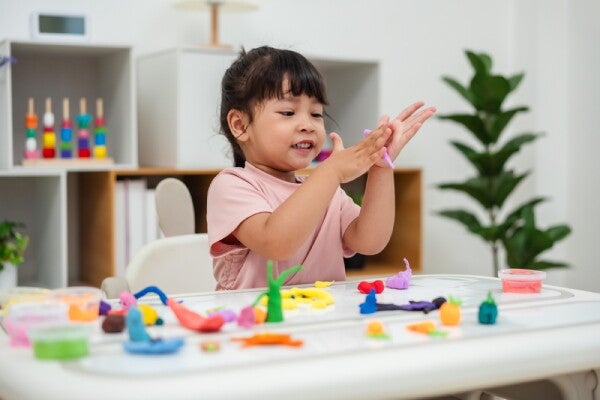
When your godchild can figure out educational toys on their own, they build creativity and confidence.
Educational toys promote exploration and trial-and-error, instead of just following a specific set of rules.
If a toy is too complicated or forces kids to follow just one path, it's not truly child-led. The American Academy of Pediatrics (AAP) even points out that when an adult directly instructs a child on exactly how a toy works, the child is less likely to discover new, creative ways to use it on their own.
The goal is to find something your godchild can figure out for themselves, such as building blocks, modeling clay, magnetic tiles, and nesting cups, building their confidence and creativity.
The Godparent's Guide to Educational Toys by Age
Picking the right toy is all about a child’s developmental stage. This guide is based on the official milestones from the AAP and CDC (US Centers for Disease Control and Prevention) to show you why certain gifts are a great fit. Here’s what to look for.
For young babies (0 to 6 months): It’s all about the senses
At this stage, babies are just figuring out their bodies. They're working on key skills like holding their head steady, following things with their eyes, and discovering their own hands.
What they're learning: Visual tracking, cause and effect (e.g., "Kick and it jiggles!"), and basic motor skills
Gift ideas:
- High-contrast (black and white) flashcards or soft books
- An activity mat or play gym
- Lightweight rattles and textured teether toys
- A baby-safe, non-breakable mirror securely attached to the crib or mat
For older babies (7 to 12 months): Exploring and moving
Your godchild is likely learning to sit up on their own, rake small objects toward them, and maybe even pull themselves up to stand. They now understand "object permanence" (knowing a toy is still there even when you hide it).
What they're learning: Object permanence, hand-eye coordination (like pinching), and movement skills (sitting, crawling, pulling up)
Gift ideas:
- Stacking rings or large, soft blocks
- Sensory balls with different textures
- "Peek-a-boo" or "lift-the-flap" soft books
- A simple push-toy (for babies close to walking)
For toddlers (1 to 3 years): Building independence
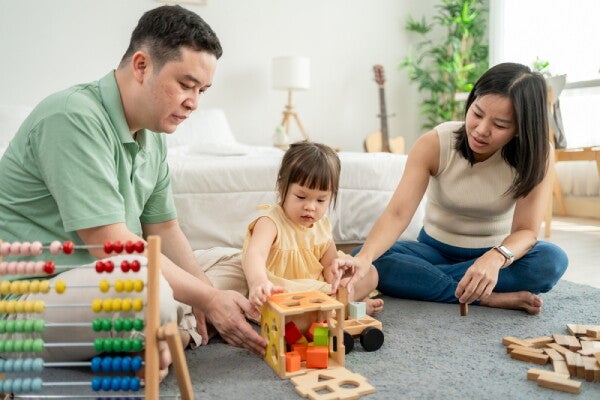
As kids grow, their play evolves from sensory exploration to stacking blocks and sorting shapes.
This is the ‘I can do it myself!’ stage, where toddlers master big new skills—stacking blocks, kicking balls, and starting to draw. The ideal educational toys for toddlers help them explore, build, and make sense of their world.
What they're learning: Hand and body coordination (stacking, scribbling, walking, running), spatial reasoning, language, and early problem-solving
Gift ideas:
- Stacking rings and large building blocks
- Simple puzzles (like large knob or 3 to 4 piece puzzles)
- Shape sorters (great for problem-solving)
- Push-or-pull toys to help with coordination
- Washable crayons and paper for scribbling
- Pretend-play sets, like kitchens or toolsets—great educational toys for 3-year-olds
For preschoolers (4 to 5 years): Exploring big ideas
Preschoolers have booming imaginations. Their play becomes more complex, social, and creative as they learn to tell stories, draw people, and play games with rules. They love to ask "Why?" about everything.
What they're learning: Social skills (sharing, taking turns), advanced creativity, basic logic, pre-reading, and pre-math concepts
Gift ideas:
- Complex building sets (like LEGOs or magnetic tiles)
- Simple board games or card games (milestone-approved!)
- Craft and art supplies (crayons, safety scissors, modeling clay)
- Costumes and "prop boxes" for imaginative storytelling
- Montessori educational toys, like lacing cards or dressing frames
For school-aged kids (6+ years): Solving complex problems
Once they're in grade school, a child's world expands. They’re becoming more independent, developing real friendships, and learning to navigate rules and teamwork. Their thinking is also more logical—they can understand simple math, tell time, and read on their own.
What they're learning: Logic, following rules, strategy, social negotiation (teamwork, fairness), and more complex problem-solving
Gift ideas:
- Strategy board games the whole family can play
- Beginner STEM kits, like a crystal-growing set or a simple robotics toy
- More complex construction sets
- Logic puzzles
- A read-aloud chapter book based on their interests
A Final Tip: When in Doubt, Ask!
If you’re ever unsure about what gift to give, just send a quick message to your godchild's parents. Remember, being a ninong or ninang isn't about buying the most expensive present; it's about showing up. Choosing the right educational toys is a simple, meaningful way to show your love and support as your inaanak learns and grows.
Connect with other amazing parents and godparents on the ParentTeam Moms and Dads Facebook group and share your own favorite educational toys and gift ideas!
References
Jensen, Hanne, Angela Pyle, Betül Alaca, and Ellen Fesseha. "Playing with a Goal in Mind: Exploring the Enactment of Guided Play in Canadian and South African Early Years Classrooms." Early Years 41, no. 5 (2019): 491–505. Accessed November 10, 2025. https://doi.org/10.1080/09575146.2019.1619670
Montessori Generation. "Does Montessori Use Open-Ended Toys?" Montessori Generation (blog). n.d. Accessed November 10, 2025. https://montessorigeneration.com/blogs/montessori/open-ended-toys
Schley, Courtney, and Burt Helm. "Learning Toys and STEM Toys We Love." The New York Times, Wirecutter, updated November 6, 2025. Accessed November 10, 2025. https://www.nytimes.com/wirecutter/reviews/learning-toys-and-stem-toys-we-love/
Weisberg, Deena, Kathy Hirsh-Pasek, and Roberta Golinkoff. "Guided Play: Where Curricular Goals Meet a Playful Pedagogy." Mind, Brain, and Education 7 (2013). Accessed November 10, 2025. https://doi.org/10.1111/mbe.12015
Related articles

Do You Need a Pacifier for Your Baby? What to Know Before Deciding
Here’s what a pediatrician wants you to know about using a pacifier.
9 mins to read

Baby Toothpaste Guide: What to Use from First Tooth to Toddler Years
Baby toothpaste matters more than you’d think. Know how to pick the right one, use the right amount, and the right time to start, from that very first tooth.
7 mins to read

A Doctor Explains How to Use a Nasal Aspirator on Your Baby
A nasal aspirator can help your congested baby breathe easier, sleep better, and feed without a fight. Here’s how to use one safely, according to a pediatrician.
8 mins to read

Newborn Essentials: A Real-Parent Guide for the First 90 Days
Overwhelmed by baby shopping? Check out this no-hype guide for Filipino parents that break down the true newborn essentials—plus which items to skip or splurge on.
7 mins to read

Bakit Nagugulat si Baby? A Doctor Explains the Moro Reflex in Newborns
The Moro reflex makes your baby suddenly throw their arms out. Learn what triggers this typical infant reaction and discover simple ways to soothe your startled newborn.
6 mins to read

Bringing Your Premature Baby Home: A Doctor’s Practical Care Guide
Your premature baby needs special care at home. Discover how to create a safe space, stick to feeding plans, and manage your emotions with this guide.
9 mins to read

Bakit Umuungol Si Baby? Understanding Newborn Grunting Noises
Hearing newborn grunting can worry any parent. Find out why your little one makes these noises and learn exactly when you should call your pediatrician.
5 mins to read

5 Key Baby Milestones and Health Terms to Know (Plus, a Fun Game!)
Understanding baby milestones gives you peace of mind as your little one grows. Explore five key health and development terms, and check your knowledge with a fun, stress-free game at the end!
5 mins to read

9 Ways to Turn Baby Talk into Your Little One's First Words
Excited to hear your baby talk? Learn tried and tested strategies to get them speaking their first words.
5 mins to read

First-Time Parents, 8 Ways to Make the Christmas Season Extra Special
Make your first Christmas season as parents unforgettable. Here are simple tips for creating cozy new traditions and making memories that will last a lifetime.
6 mins to read

Have Your Camera Ready! A List of Your 1-Year-Old Baby's Milestones
Your 1-year-old baby may start to stand up on their own and take their first steps! Check out all the developmental milestones to expect in this guide.
6 mins to read

9 Free Family Bonding Moments Your Kids Will Treasure Forever
Discover zero-cost family bonding moments you can do at home. From forts to mini cook-offs, these ideas will create memories your kids will carry for life.
7 mins to read

Not Just Photos! 8 Meaningful Baby Monthly Milestone Ideas
These baby monthly milestone ideas capture every adorable phase and make those memories stick for good.
6 mins to read

5 Ways to Prepare Your Blended Family for a New Baby
Worried about telling your stepkids you're pregnant? Discover tips to prepare your blended family, manage jealousy, and build excitement.
6 mins to read

Traveling with a Baby in the Philippines: Packing, Safety, and Prep Guide
Traveling with a baby doesn’t have to feel overwhelming. Get a packing checklist plus car, ferry, and flight prep made for Filipino families.
8 mins to read

Iba ang Pambata: Why Age-Appropriate Milk Matters
You wouldn’t let your youngest child wear ate or kuya’s shoes—so why give them milk that isn’t made for their age? Milk is not one-size-fits-all.
5 mins to read

Wais Pag Sakto sa Edad: Why Age-Appropriate Milk Matters
Milk comes in many forms, but not all milk is made equal. Learn why kids need age-appropriate nutrition during their most critical years of growth.
6 mins to read

15 Filipino Parenting Myths: What to Keep or Let Go, According to Stage
Cravings and pwera usog? Filipino myths are part and parcel of parenting. Here’s what’s sentimental, what’s outdated, and what modern medicine actually says.
14 mins to read

PhilHealth Contribution for Self-Employed Parents: Requirements and Rates
How much is the PhilHealth contribution for self-employed parents? It depends on your declared income. Learn the rates, the requirements, and how to pay it correctly.
4 mins to read


