


Do You Need a Pacifier for Your Baby? What to Know Before Deciding
It’s late at night, you’re tired, and your little one’s crying. Nakaka-stress talaga minsan, di ba? Every parent knows that moment, and it’s okay to want something that works fast. You’re thinking of getting a pacifier to help, but also wondering if it’s the right choice for your baby. Every baby soothes differently, so there’s no single right answer. Board-certified pediatrician Dr. Sandra Sharlene Lim Uy walks you through the benefits, the drawbacks, and what to know as your child grows.
How a Pacifier Can Help
Some parents find pacifier benefits worth considering, and here are two:
It can soothe your baby.
A pacifier can help calm some babies and support better sleep, though every baby responds differently. Dr. Lim Uy notes that rocking or cuddling works just as well for many babies, and that sometimes that’s really all it takes to settle them down. Thinking of a pacifier as one option among several, rather than the go-to, gives you room to notice what works for your baby.
And if your baby isn’t interested in it, Dr. Lim Uy advises against forcing it. Some babies simply prefer other ways to settle, and that’s just as valid.
It may protect against SIDS.
Offering a pacifier at nap time and bedtime is one of the American Academy of Pediatrics’ (AAP) safe sleep recommendations, associated with a lower risk of Sudden Infant Death Syndrome (SIDS), though researchers don’t fully know why this works. No one has run the kind of study that would prove pacifiers directly cause this lower risk, according to a 2017 review of the evidence. What exists is a consistent pattern seen across many studies that simply observed babies over time, which the AAP considers strong enough to include in its guidance.
Dr. Lim Uy points to this as the most important reason some parents choose to offer a pacifier, especially for babies between 0 and 6 months, when SIDS risk is highest. And even if the pacifier falls out once your baby’s asleep, that link to lower risk still holds, so there’s no need to get up and put it back.
A pacifier is one part of keeping your baby’s sleep safe, not a replacement for the basics: your baby should still sleep on their back, alone, on a firm, flat surface.
When Can Your Baby Use a Pacifier?
So, is there a right time to introduce a pacifier? When you’re breastfeeding, timing makes a real difference when it comes to using a pacifier for a newborn. Dr. Lim Uy shares that many pediatricians suggest waiting until your baby is about a month old, once breastfeeding feels more settled and your baby’s had time to get comfortable latching. This lines up with guidance from the CDC, which also advises waiting until breastfeeding is going well and your baby is gaining weight.
If you’re not breastfeeding, you have more flexibility here. Check with your pediatrician on what makes sense for your baby specifically.
How to Use a Pacifier Safely
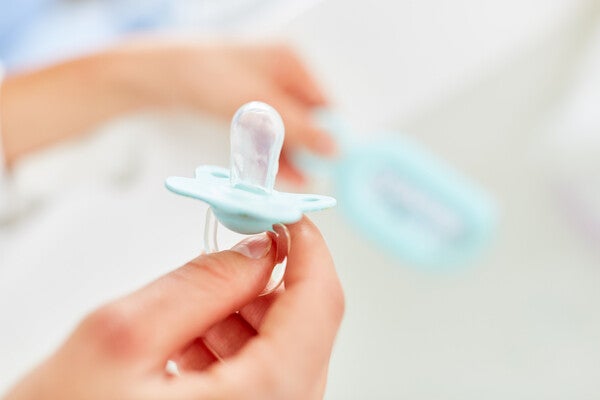
A pacifier used by a baby under 6 months needs sterilizing in boiling water or a dishwasher, not just rinsing.
If you’ve weighed the pacifier pros and cons and decided it’s right for your baby, pacifier safety comes down to a handful of habits, says Dr. Lim Uy.
Avoid two-piece pacifiers.
“It’s better to use one-piece pacifiers,” Dr. Lim Uy says, since two-piece ones can break apart and put a baby at risk for choking. One-piece designs are also generally easier to clean thoroughly, since there’s no seam or joint where milk residue or germs can build up.
Skip the string or clip during sleep.
Avoid attaching a pacifier to a string or hanging it around your baby’s neck, since a forgotten string poses a strangulation risk.
The same risk also applies to a pacifier with a clip. Unclip it once your baby’s down for a nap or for the night. It’s fine to use one while you’re actively watching your baby, like in the stroller, but removing any cords or attachments in your baby’s sleep space keeps them safe overnight.
Clean it based on your little one’s age.
Not sure how to clean pacifiers correctly? It changes as your baby gets older. For babies under 6 months, sterilize it in boiling water or a dishwasher, since your baby’s immune system is still developing and needs that extra layer of protection.
Once your baby passes 6 months, washing with soap and water is enough. Either way, “do not wash them in the mouth of the parent or other adults,” Dr. Lim Uy cautions, since that just passes your own germs on to your baby. If the pacifier drops, clean it before handing it back.
Skip anything sweet on the pacifier.
It might be tempting to coat the pacifier in something sugary or syrupy to help your baby take to it faster, but as Dr. Lim Uy cautions, “no dipping or putting something sweet on them, as these may cause cavities.”
Replace it as your baby grows.
Match the pacifier size to your baby’s age and swap it out once it looks worn or your baby has outgrown it. A pacifier that’s the right fit and in good shape is safer.
What Long-Term Pacifier Use May Mean for Your Child
Using a pacifier for a few months looks a lot different from using one for years, so it’s worth knowing what research has found.
Ear infections after 6 months
According to Dr. Lim Uy, continued pacifier use past 6 months may raise your baby’s risk of ear infections (otitis media). Some dental sources, including the American Academy of Pediatric Dentistry (AAPD), place this risk increase slightly later, closer to 12 months. Either way, keeping an eye on how often your baby uses the pacifier as they get older is one simple way to stay ahead of this.
So why does this happen? Researchers have a couple of ideas, though neither is confirmed. One is that the sucking motion may pull fluid or bacteria from the back of the throat up toward the middle ear. Another is that repeated sucking might press up against the roof of the mouth in a way that affects a small passage called the eustachian tube, which normally helps drain fluid from the middle ear.
A 2025 review of 36 studies found children who used a pacifier were somewhat more likely to develop ear infections than those who didn’t, though the researchers rated the strength of this evidence as low, and were upfront that no one has proven pacifiers actually cause this, only that the two tend to show up together.
Either way, keeping an eye on how often your baby uses the pacifier as they get older is one simple way to stay ahead of this.
Changes in dental development
The AAPD guidance also notes that pacifier use beyond 18 months can start to affect how your child’s mouth and bite develop, including issues like an open bite or crossbite. Basically, the shape of the roof of your child’s mouth and how their teeth line up can shift the longer a pacifier stays in daily use, though this varies quite a bit from child to child.
“Studies have also shown that dental harm occurs with continued use at 2 years old,” Dr. Lim Uy notes, which is why some pediatricians suggest phasing out pacifier use around that age.
You might see an orthodontic pacifier, which is marketed as gentler on your baby’s palate because of its flatter shape. If you’re deciding between shapes, ask your pediatrician which one fits your baby best.
A link to speech delay
Dr. Lim Uy points out that continued pacifier use may also play a role in speech delays. A 2024 review in Frontiers in Psychology looked into this and found that children with heavier, all-day pacifier use tended to have smaller vocabularies at ages 1 and 2. When it comes to speech specifically, the findings are less clear: one study cited found that using a pacifier during the day was linked to a few unusual speech errors, but otherwise, their speech wasn’t clearly affected either way.
In short: A pacifier that stays in your baby’s mouth most of the day leaves fewer chances to babble, copy sounds, and practice talking—the small building blocks of early speech. But the science here isn’t settled, and plenty of children who use pacifiers show no speech differences at all. Ear infections from prolonged use may add to this, too, since even temporary hearing trouble can make it harder for your child to pick up on speech sounds clearly.
So what does this mean? Cutting back on pacifier use is one option some parents choose, alongside plenty of talking, singing, and reading together, which support language development either way.
Signs Your Child May Be Ready to Move On
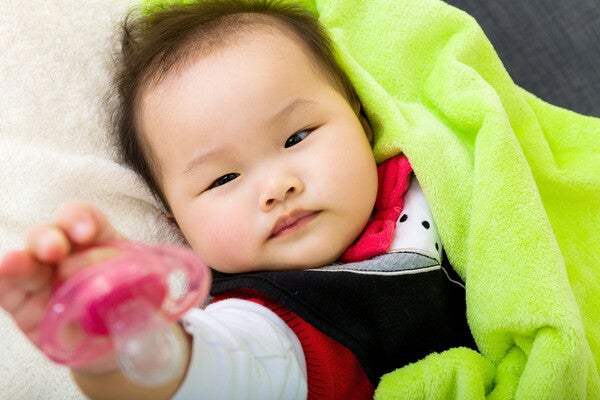
Most children transition off the pacifier by 12 to 18 months, but your child’s pediatrician is still the best judge.
You may also notice when your child’s ready to let go of the pacifier. Dr. Lim Uy generally sees this happen somewhere between 6 and 18 months, though every child’s timeline looks a little different. Some dental guidelines, like the AAPD’s, allow even more time, up to age 3. Your child’s pediatrician is still the best judge of what fits them specifically.
According to Dr. Lim Uy, you’ll likely notice a few signs your child is ready:
- Losing interest in the pacifier in favor of playing, talking, or singing
- Chewing or biting it instead of sucking on it
- Reaching for it out of habit, not because they’re upset
These signs tend to show up alongside your child’s other developmental milestones, so if your toddler’s hitting new ones, that’s a good moment to notice if they’re ready to move on from the pacifier, too.
According to Dr. Lim Uy, pacifier habits are generally easier to break than thumb-sucking. Some kids do get attached though, so there’s no need to rush it. Praise your child when they go without it, rather than taking it away abruptly. This kind of positive reinforcement works better than forcing the habit to stop cold.
Every Baby’s Journey Is Different
Whether you’re still deciding if a pacifier is right for your little one, working through how to keep it clean, or noticing your child moving away from it naturally, the right choice at each stage depends on your baby and your family. Your pediatrician’s advice, tailored to your child specifically, matters more than any general rule in this guide.
Got questions about your baby’s pacifier use? Trade notes with other parents who’ve been there in the ParenTeam Moms and Dads Facebook group.
About Dr. Sandra Sharlene Lim Uy
Dr. Sandra Sharlene Lim Uy is a board-certified pediatrician with a deep commitment to newborn and premature infant care. For the past five to six years, she has served as a dedicated pediatrician in the Neonatal Intensive Care Unit (NICU) at Taguig Pateros District Hospital, guiding countless families through the critical early days of their premature babies' lives.
Disclaimer: This article is for general information only and isn’t a substitute for personalized medical advice. Always check with your child’s pediatrician about what’s right for your baby’s pacifier use. The views and opinions expressed by the medical professional featured in this article are their own and don’t necessarily reflect the views of ParenTeam.
References
American Academy of Pediatric Dentistry. "Policy on Pacifiers." The Reference Manual of Pediatric Dentistry. Chicago: American Academy of Pediatric Dentistry, 2024. Accessed September 21, 2026. https://www.aapd.org/globalassets/media/policies_guidelines/p_on-pacifiers.pdf
Centers for Disease Control and Prevention. "Providing Care for Babies to Sleep Safely." Last reviewed September 17, 2024. Accessed September 21, 2026. https://www.cdc.gov/sudden-infant-death/sleep-safely/index.html
Kanellopoulos, Alexandros K., and Sarah E. Costello. "The Effects of Prolonged Pacifier Use on Language Development in Infants and Toddlers." Frontiers in Psychology 15 (2024): 1349323. Accessed September 21, 2026. https://pmc.ncbi.nlm.nih.gov/articles/PMC10912588/
Moon, Rachel Y., Rebecca F. Carlin, Ivan Hand, et al. "Sleep-Related Infant Deaths: Updated 2022 Recommendations for Reducing Infant Deaths in the Sleep Environment." Pediatrics 150, no. 1 (2022): e2022057990. Accessed September 21, 2026. https://publications.aap.org/pediatrics/article/150/1/e2022057990/188304/
Psaila, Kim, Jann P. Foster, Neil Pulbrook, and Heather E. Jeffery. "Infant Pacifiers for Reduction in Risk of Sudden Infant Death Syndrome." Cochrane Database of Systematic Reviews 2017, no. 4 (2017): CD011147. Accessed September 21, 2026. https://pmc.ncbi.nlm.nih.gov/articles/PMC6478106/
Related articles

Baby Toothpaste Guide: What to Use from First Tooth to Toddler Years
Baby toothpaste matters more than you’d think. Know how to pick the right one, use the right amount, and the right time to start, from that very first tooth.
7 mins to read

A Doctor Explains How to Use a Nasal Aspirator on Your Baby
A nasal aspirator can help your congested baby breathe easier, sleep better, and feed without a fight. Here’s how to use one safely, according to a pediatrician.
8 mins to read

Newborn Essentials: A Real-Parent Guide for the First 90 Days
Overwhelmed by baby shopping? Check out this no-hype guide for Filipino parents that break down the true newborn essentials—plus which items to skip or splurge on.
7 mins to read

Bakit Nagugulat si Baby? A Doctor Explains the Moro Reflex in Newborns
The Moro reflex makes your baby suddenly throw their arms out. Learn what triggers this typical infant reaction and discover simple ways to soothe your startled newborn.
6 mins to read

Bringing Your Premature Baby Home: A Doctor’s Practical Care Guide
Your premature baby needs special care at home. Discover how to create a safe space, stick to feeding plans, and manage your emotions with this guide.
9 mins to read

Bakit Umuungol Si Baby? Understanding Newborn Grunting Noises
Hearing newborn grunting can worry any parent. Find out why your little one makes these noises and learn exactly when you should call your pediatrician.
5 mins to read

5 Key Baby Milestones and Health Terms to Know (Plus, a Fun Game!)
Understanding baby milestones gives you peace of mind as your little one grows. Explore five key health and development terms, and check your knowledge with a fun, stress-free game at the end!
5 mins to read

9 Ways to Turn Baby Talk into Your Little One's First Words
Excited to hear your baby talk? Learn tried and tested strategies to get them speaking their first words.
5 mins to read

First-Time Parents, 8 Ways to Make the Christmas Season Extra Special
Make your first Christmas season as parents unforgettable. Here are simple tips for creating cozy new traditions and making memories that will last a lifetime.
6 mins to read

A Ninang and Ninong's Guide to Gifting Educational Toys
Looking for great educational toys? Find the perfect present for your inaanak, from sensory items for toddlers to STEM kits for big kids.
6 mins to read

Have Your Camera Ready! A List of Your 1-Year-Old Baby's Milestones
Your 1-year-old baby may start to stand up on their own and take their first steps! Check out all the developmental milestones to expect in this guide.
6 mins to read

9 Free Family Bonding Moments Your Kids Will Treasure Forever
Discover zero-cost family bonding moments you can do at home. From forts to mini cook-offs, these ideas will create memories your kids will carry for life.
7 mins to read

Not Just Photos! 8 Meaningful Baby Monthly Milestone Ideas
These baby monthly milestone ideas capture every adorable phase and make those memories stick for good.
6 mins to read

5 Ways to Prepare Your Blended Family for a New Baby
Worried about telling your stepkids you're pregnant? Discover tips to prepare your blended family, manage jealousy, and build excitement.
6 mins to read

Iba ang Pambata: Why Age-Appropriate Milk Matters
You wouldn’t let your youngest child wear ate or kuya’s shoes—so why give them milk that isn’t made for their age? Milk is not one-size-fits-all.
5 mins to read

Wais Pag Sakto sa Edad: Why Age-Appropriate Milk Matters
Milk comes in many forms, but not all milk is made equal. Learn why kids need age-appropriate nutrition during their most critical years of growth.
6 mins to read

15 Filipino Parenting Myths: What to Keep or Let Go, According to Stage
Cravings and pwera usog? Filipino myths are part and parcel of parenting. Here’s what’s sentimental, what’s outdated, and what modern medicine actually says.
14 mins to read

PhilHealth Contribution for Self-Employed Parents: Requirements and Rates
How much is the PhilHealth contribution for self-employed parents? It depends on your declared income. Learn the rates, the requirements, and how to pay it correctly.
4 mins to read

5 Signs You Need to Switch Your Baby’s Laundry Detergent
Does your little one have a rash that won’t go away? It could be caused by your baby laundry detergent. Here’s how to spot the signs and know what to do next.
4 mins to read


