


5 Key Baby Milestones and Health Terms to Know (Plus, a Fun Game!)
Your little one is hitting amazing baby milestones, but the medical terms used to describe them aren’t always easy to understand. Words like Moro reflex, object permanence, and Apgar score are actual clinical terms your pediatrician uses to check your baby's health and development.
Here are five key milestones to watch for in your baby’s first year, helping you stay on top of your child's growth without the confusion. You’ll also get a link to a Hangman-style game at the end to test what you’ve learned.
1. The Apgar Score: Your Baby's First Health Check
The very first of the newborn milestones happens just seconds after your baby enters the world. The Apgar score is a quick test done right after birth to check your baby’s breathing, pulse, and skin color.
In fact, trusted medical groups like the American College of Obstetricians and Gynecologists (ACOG) and the American Academy of Pediatrics (AAP) use this as the standard tool to report on your newborn's overall status and how well they are adjusting to life outside the womb.
The name is actually an easy way to remember what they check:
- Appearance (skin color)
- Pulse (heart rate)
- Grimace (reflexes)
- Activity (muscle tone)
- Respiration (breathing)
Doctors check these signs at one minute and again at five minutes after birth simply to see how well your baby is warming up to their new environment.
2. The Moro Reflex: Understanding the "Startle" Reaction

The Moro reflex is a normal startle reaction to loud sounds. Swaddling keeps your baby calm until it fades around 2 months.
Have you ever seen your baby suddenly jerk after hearing a loud door slam or feeling a quick movement? It may look like fear, but it’s actually a normal part of baby development. The AAP calls this the Moro reflex, or the startle reflex. When startled by a loud sound or sudden movement, your baby will extend their arms, legs, and neck, then quickly bring their arms back in. They might even cry loudly when this happens.
Reflexes like this show that your baby’s brain and nervous system are working properly. According to the AAP, this reflex usually peaks during your baby's first month. As your child hits more baby milestones by month, their nervous system matures, and you’ll notice this startle reaction starting to disappear after about two months.
If the Moro reflex frequently wakes your baby up from a nap, try using a gentle swaddle. Keeping their arms tucked close to their body prevents that falling sensation, helping them stay calm and restful.
3. The Social Smile: Connecting Through Joy
There is nothing quite like the first time your baby looks at you and gives you a big, gummy grin. According to the Centers for Disease Control and Prevention (CDC) and the AAP, babies start to smile when you talk to or grin at them at around two months of age.
A social smile shows that your baby is becoming more aware of their environment and learning to respond to you. By four months, this develops further, with your baby smiling on their own to get your attention.
4. Babbling: The Journey Toward First Words
Have you noticed your baby responding with sounds when you speak? A major leap in baby milestones happens around six months when your baby starts taking turns making sounds with you. By nine months, this turns into babbling, with repetitive sounds like “ba-ba-ba” or “ma-ma-ma.”
While it may sound like nonsense, your baby is practicing how to move their lips and tongue to copy what they hear. Even if they don’t know what words mean yet, they’re building the muscle memory for speech.
You can boost this stage of growth by keeping the conversation going. When your baby makes sounds at you, repeat them back with a smile. For more tips on encouraging these sounds, read about how to talk to your baby to support their vocabulary skills early on.
5. Object Permanence: The Logic Behind Peek-a-Boo
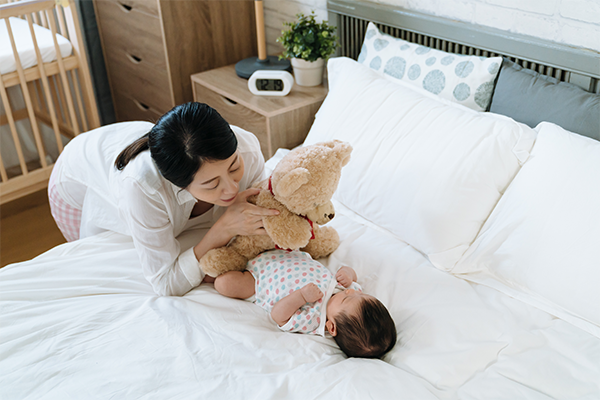
Playing peek-a-boo helps your baby understand that you still exist even when they cannot see your face.
Have you ever hidden a toy, only for your baby to forget about it? This happens because they haven’t learned object permanence yet. However, between nine and 12 months, your little one will realize that things—and people—still exist even when out of sight.
At nine months, you might notice your baby looking for a toy that falls off their highchair. By 12 months, they’ll actively look for things they see you hide under a blanket. They begin to understand that the toy didn’t disappear
Playing peek-a-boo is the perfect way to practice this skill. When you hide your face and then reappear, you are teaching your baby that you will always come back. This builds trust and helps reduce separation anxiety later on.
You can find more fun ways to play with your baby to help them master these important life skills.
Tracking Baby Milestones with Confidence
By breaking down clinical words like the Apgar score or object permanence into simple, everyday actions, you can confidently track baby milestones and see your little one's amazing progress. If you want to see how these moments fit into your child's first few years, this early childhood stage cheat sheet is a great place to start.
Keep learning and see how many more child development terms you can decode, by playing a quick game of ParenTerms! It's a fun, stress-free way to stay sharp while relaxing at home.
Your love and attention are all your baby really needs to succeed at their own pace. Connect with other parents on the ParenTeam Moms and Dads Facebook group to swap stories, ask questions, and share your child's baby milestones.
References
Altus, Celeste. "When Will My Baby Smile?" Healthline. Last modified October 30, 2019. Accessed April 6, 2026. https://www.healthline.com/health/baby/when-will-my-baby-smile#takeaway
"Apgar Score." MedlinePlus. Last modified October 20, 2024. Accessed April 6, 2026. https://medlineplus.gov/ency/article/003402.htm
Centers for Disease Control and Prevention. "Positive Parenting Tips: Infants (0–1 Years)." Last modified February 20, 2026. Accessed April 6, 2026. https://www.cdc.gov/child-development/positive-parenting-tips/infants.html
Pattnaik, P., and Y. Al Khalili. "Moro Reflex." In StatPearls. Treasure Island, FL: StatPearls Publishing. Last modified August 2, 2025. Accessed April 6, 2026. https://www.ncbi.nlm.nih.gov/books/NBK542173/
Related articles

Do You Need a Pacifier for Your Baby? What to Know Before Deciding
Here’s what a pediatrician wants you to know about using a pacifier.
9 mins to read

Baby Toothpaste Guide: What to Use from First Tooth to Toddler Years
Baby toothpaste matters more than you’d think. Know how to pick the right one, use the right amount, and the right time to start, from that very first tooth.
7 mins to read

A Doctor Explains How to Use a Nasal Aspirator on Your Baby
A nasal aspirator can help your congested baby breathe easier, sleep better, and feed without a fight. Here’s how to use one safely, according to a pediatrician.
8 mins to read

Newborn Essentials: A Real-Parent Guide for the First 90 Days
Overwhelmed by baby shopping? Check out this no-hype guide for Filipino parents that break down the true newborn essentials—plus which items to skip or splurge on.
7 mins to read

Bakit Nagugulat si Baby? A Doctor Explains the Moro Reflex in Newborns
The Moro reflex makes your baby suddenly throw their arms out. Learn what triggers this typical infant reaction and discover simple ways to soothe your startled newborn.
6 mins to read

Bringing Your Premature Baby Home: A Doctor’s Practical Care Guide
Your premature baby needs special care at home. Discover how to create a safe space, stick to feeding plans, and manage your emotions with this guide.
9 mins to read

Bakit Umuungol Si Baby? Understanding Newborn Grunting Noises
Hearing newborn grunting can worry any parent. Find out why your little one makes these noises and learn exactly when you should call your pediatrician.
5 mins to read

9 Ways to Turn Baby Talk into Your Little One's First Words
Excited to hear your baby talk? Learn tried and tested strategies to get them speaking their first words.
5 mins to read

First-Time Parents, 8 Ways to Make the Christmas Season Extra Special
Make your first Christmas season as parents unforgettable. Here are simple tips for creating cozy new traditions and making memories that will last a lifetime.
6 mins to read

A Ninang and Ninong's Guide to Gifting Educational Toys
Looking for great educational toys? Find the perfect present for your inaanak, from sensory items for toddlers to STEM kits for big kids.
6 mins to read

Have Your Camera Ready! A List of Your 1-Year-Old Baby's Milestones
Your 1-year-old baby may start to stand up on their own and take their first steps! Check out all the developmental milestones to expect in this guide.
6 mins to read

9 Free Family Bonding Moments Your Kids Will Treasure Forever
Discover zero-cost family bonding moments you can do at home. From forts to mini cook-offs, these ideas will create memories your kids will carry for life.
7 mins to read

Not Just Photos! 8 Meaningful Baby Monthly Milestone Ideas
These baby monthly milestone ideas capture every adorable phase and make those memories stick for good.
6 mins to read

5 Ways to Prepare Your Blended Family for a New Baby
Worried about telling your stepkids you're pregnant? Discover tips to prepare your blended family, manage jealousy, and build excitement.
6 mins to read

Traveling with a Baby in the Philippines: Packing, Safety, and Prep Guide
Traveling with a baby doesn’t have to feel overwhelming. Get a packing checklist plus car, ferry, and flight prep made for Filipino families.
8 mins to read

Iba ang Pambata: Why Age-Appropriate Milk Matters
You wouldn’t let your youngest child wear ate or kuya’s shoes—so why give them milk that isn’t made for their age? Milk is not one-size-fits-all.
5 mins to read

Wais Pag Sakto sa Edad: Why Age-Appropriate Milk Matters
Milk comes in many forms, but not all milk is made equal. Learn why kids need age-appropriate nutrition during their most critical years of growth.
6 mins to read

15 Filipino Parenting Myths: What to Keep or Let Go, According to Stage
Cravings and pwera usog? Filipino myths are part and parcel of parenting. Here’s what’s sentimental, what’s outdated, and what modern medicine actually says.
14 mins to read

PhilHealth Contribution for Self-Employed Parents: Requirements and Rates
How much is the PhilHealth contribution for self-employed parents? It depends on your declared income. Learn the rates, the requirements, and how to pay it correctly.
4 mins to read


