


Toys for a 1-Year-Old to Help Motor, Brain, and Language Development
Your toddler's movement, coordination, early thinking, and first words grow side by side. They're more curious and eager to explore, which is why toys for 1-year-olds become helpful tools at home.
Research published in Pediatrics shows that developmentally appropriate play with you and other kids provides your child a massive opportunity to help build social-emotional, cognitive, language, and motor skills.
Here's a bonus: Play helps kids build solid, caring relationships, which they need to really thrive and feel safe.
Before You Choose Toys
Below are the four key areas in the early childhood stage, along with the types of play and developmental toys for a 1-year-old that strengthen each one. Keep in mind, though, that you don't need a separate toy for each area—a toy can build more than one skill.
A set of blocks can strengthen fine motor skills, spark imagination, and encourage social skills when another child joins in. A household item like a plastic container can be just as engaging as a store-bought toy when your child is focused and curious.
Use the sections below to get a sense of what kind of play helps with developmental milestones. Then, pick out stuff you already own or grab one that matches it and have fun playing! (Calling all ninongs and ninangs, these toys are also excellent gift ideas for a first birthday.)
Boost Your Child's Cognitive Abilities
Cognitive function refers to how your child thinks, explores, and solves simple problems. Self-directed play allows your child 1 year old to understand cause and effect, remember where things go, copy familiar actions, and look for hidden objects.
Encourage self-directed play
Your child leads in self-directed play, sometimes called free play. There are no step-by-step instructions, and there is no specific "right" way to use the toy. The goal is to let them experiment.
In this UNICEF article, experts note that when toddlers perform independent play, they use their imagination more freely and start building early independence. Self-directed play also supports problem-solving because they get the chance to figure things out on their own.
Toy ideas for self-directed play
- Blocks for arranging, stacking, and experimenting with balance
- Puzzles that encourage trial and error
- Sorting toys by shapes, colors, or sizes
- Art materials like crayons and paper for creating patterns and lines
- Loose parts such as cups, lids, and wooden rings that can be moved, grouped, or combined in open-ended ways
You can also check these Montessori toys for a 1-year-old to help with motor development.
Parent tip: As tempting as it might be, hold off on jumping in to show your little one how to use a toy right away. Instead, stay close but let them play around with it on their own.
Strengthen Your Child's Motor Skills
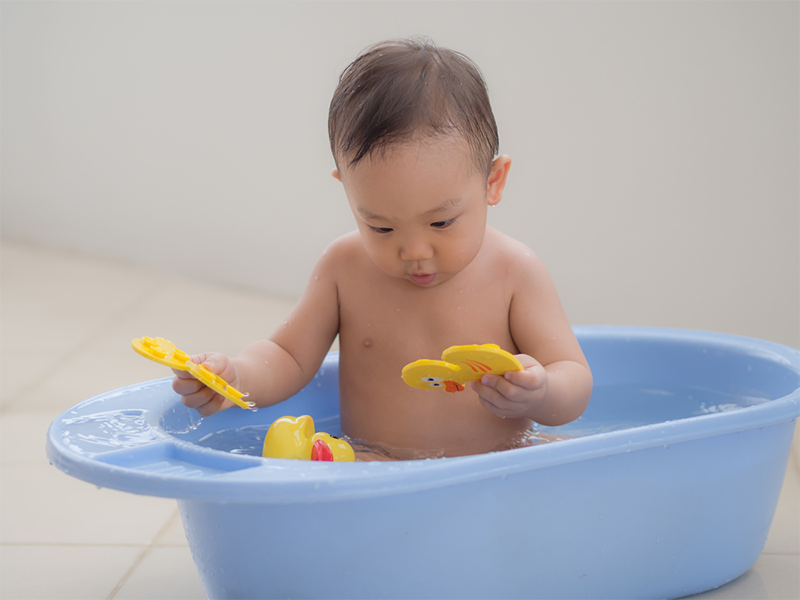
Bath toys let your toddler practice their fine motor skills.
Motor skills cover the movements your child makes using their big and small muscles. (See all the milestones in this motor skill guide to your child's first five years.) Active play is the most natural way for a 1-year-old to practice their gross and fine motor skills.
Schedule regular active play
Active play, which can occur indoors or outdoors, involves spontaneous, self-directed movement in which a child uses their whole body and expends energy. Any physical activity at this stage helps a 1-year-old test their strength, balance, and coordination.
AAP mentions in the Pediatrics clinical report that active play helps kids build the physical and social skills they'll need for school and beyond. Plus, they get better at thinking creatively and multitasking when they regularly engage in active play.
Toy ideas for active play
- Ride-on toys for 1-year-olds for leg strength and coordination
- Balls for throwing, catching, and kicking
- Push-and-pull toys for toddlers to keep their bodies moving
- Climbers or soft play blocks that allow safe climbing and sliding
- Stacking toys for hand control and coordination
Parent tip: Offer activities that match their energy level. Some days they may want to crawl, climb, or push. On other days, they may prefer slower movements. Get ideas for indoor and outdoor family activities in this guide.
Guide Your Child's Social and Emotional Growth
A 1-year-old baby's social-emotional development centers on mimicking actions, interacting with their parents or caregivers, and being curious about other kids. You can help prepare them by taking the next step after solitary play.
Practice parallel play
As a baby, your child is typically engaged in solitary play. They're focused on their own toy or activity, even when other kids are nearby. Soon, they can engage in parallel play, which means they'll play beside other children, but it's still solitary play (they won't interact with the other kids).
This stage of play is crucial because it allows your child to become comfortable being around kids and to learn what it's like to play in shared spaces. It's their first baby step toward socializing!
Toy ideas for parallel play
Many of the toys mentioned above are great for parallel play, so the key is to set up the ideal environment for playtime with other children. You want these toddlers to be near each other and learn by observation without forcing them to do so.
Two children playing with blocks side by side is the classic example of parallel play. Here are other ideas:
- Sand and water play tools while in the sandbox with other children
- Individual art supplies, but you provide them with a shared set of crayons or washable markers
- Play-dough or clay that allows them to make their own shapes and forms right next to each other
Parent tip: Model phrases to use when your child plays with others, like "I'm Miro," "Can I play?", "My turn?", and "Thanks." Don't forget: Toddlers need to hear these words repeatedly so they can pick them up and use them.
Encourage Your Child's Language and Communication Skills
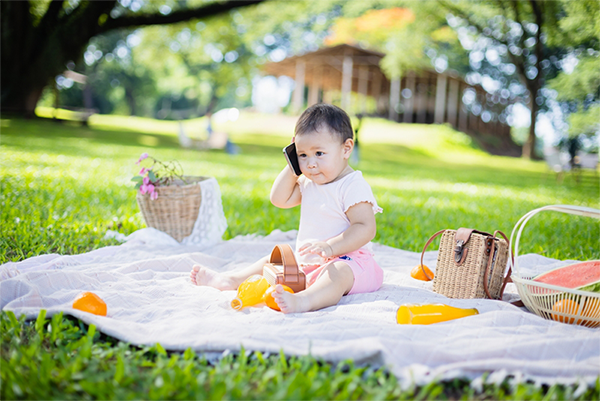
When your child imitates you, they're learning gestures, then sounds, and eventually words and sentences.
Your 1-year-old is not saying many words yet, but they're discovering that the words they do know, plus sounds and gestures, get your attention. Pretend play gives them plenty of opportunities to improve their language and communication skills.
Let your child play pretend
Role-play or pretend play gives your child opportunities to practice back-and-forth conversations, express their emotions, and name familiar things. They learn about tone, gestures, and storytelling.
As AAP notes, pretend play helps toddlers learn to control their emotions and actions. It improves their ability to think about different situations and possibilities.
Toy ideas for pretend play
- Toy phones for simple back-and-forth exchanges
- Board books where your child can point to pictures or copy simple actions.
- Dolls and action figures for building storylines
- Toy vehicles matched with sound effects and narration
- Play kitchens for naming objects, describing steps, and role-playing routines
These brain games for kids include toys that motivate you to talk and respond to your little one, an activity that's crucial for your child's cognitive function as well.
Parent tip: Try to read with your child every day, even for a few minutes. Let them point to pictures, turn pages, or make sounds with you. The back-and-forth helps them link words to objects and builds early listening skills. Here are 12 Filipino children’s books you may want to try.
Your child learns through every interaction, and choosing the right toys for a 1-year-old supports all the abilities they're building day by day. Keep play materials simple, give your toddler plenty of time and space to explore, and watch them flourish!
What toys for a 1-year-old do you love for your toddler's playtime? Share them on ParenTeam's Moms and Dads Facebook group!
References
Bahri, Nurul Fitriana, and Alvian Fajar Setiawan. “Open-Ended Toys to Stimulate Cognitive Development Children Aged 1-3 Years Old in the Pandemic Era.” Journal of Industrial Product Design Research and Studies 1, no. 2 (February 8, 2023): 45–58. https://doi.org/10.17509/jipdrs.v1i2.46620
Donovan, Lauren. “Stages of Play From 12–24 Months: Young Toddlers Are Problem Solvers | ZERO TO THREE.” ZERO TO THREE, June 22, 2023. Accessed November 29, 2025. https://www.zerotothree.org/resource/stages-of-play-from-12-24-months-young-toddlers-are-problem-solvers/
NAEYC. “Good Toys for Young Children by Age and Stage.” Accessed November 29, 2025. https://www.naeyc.org/resources/topics/play/toys
Guyton, Gabriel. “Using Toys to Support Infant-Toddler Learning and Development.” Bank Street College. Accessed November 28, 2025. https://educate.bankstreet.edu/cgi/viewcontent.cgi?article=1006&context=faculty-staff
“Pathways.org | How Kids Learn to Play: 6 Stages of Play Development.” Accessed November 29, 2025. https://pathways.org/kids-learn-play-6-stages-play-development
Nemours KidsHealth. “Smart Toys for Every Age.” Accessed November 29, 2025. https://kidshealth.org/en/parents/smart-toys.html
Toy Association. “6 Benefits of Play & Young Kids - Physical, Emotional, Social, More.” thegeniusofplay.org. Accessed November 29, 2025. https://www.thegeniusofplay.org/tgop/genius/benefits-of-play/benefits-of-play-home.aspx
UNICEF. “Your Toddler’s Developmental Milestones at 1 Year.” Accessed November 29, 2025. https://www.unicef.org/parenting/child-development/your-toddlers-developmental-milestones-1-year
HealthyChildren.org. “Use Shared Play to Build Communication Skills.” Accessed November 29, 2025. https://www.healthychildren.org/English/family-life/power-of-play/Pages/how-shared-play-can-build-communication-skills.aspx
Related articles

25 Filipino Nursery Rhymes and Lullabies to Sing to Your Child
Explore this list of 25 Filipino nursery rhymes and lullabies. You can sing these songs to help your child learn, grow, and have fun!
9 mins to read

GROWING TOGETHER: The Importance of Tracking Developmental Milestones in the First 2000 days. -2nd
The first 2,000 days are critical in shaping a child’s future—discover why every developmental milestone matters in these early years of growth and learning.
2 mins to read
GROWING TOGETHER: The Importance of Tracking Developmental Milestones in the First 2000 days.
The first 2,000 days are critical in shaping a child’s future—discover why every developmental milestone matters in these early years of growth and learning.
2 mins to read

How to Survive Toddler Haircuts Without the Tears
Say goodbye to the struggles of toddler haircuts. Here are practical ways to make salon visits fun, tear-free, and comfortable for your child.
6 mins to read

15 Brain Games to Help Your Babies and Toddlers Learn!
No pricey toys required. These brain games need just one important thing: Mom or Dad. Get ready to have fun with your little one!
8 mins to read

How to Discipline a Child Without Hitting or Yelling
Disciplining your child without yelling or hitting? It’s possible with these effective tips that build better behavior.
4 mins to read

7 Teacher-Recommended Reading Strategies to Use at Home
Get your little one to build their reading skills with these expert tips and strategies from a teacher.
4 mins to read

How to Control Emotions: 9 Ways to Help Toddlers Who Feel Too Much
Toddlers feel big emotions but are still learning to manage them. Discover science-backed, mom-approved tips to guide meltdowns into calm without losing your cool.
6 mins to read

10 Fun Activities to Keep Toddlers Entertained in the Heat
You can keep your toddler cool and engaged even on the hottest days while making the most of play-based learning!
6 mins to read

How to Handle Short-Tempered Kids (Is It More Than a Phase?)
When your toddler becomes short-tempered, they can throw a fit like there's no tomorrow. Here's how to calm things down.
6 mins to read

Gentle Parenting Through Toddler Tantrums: What Works (and What Doesn’t)
The latest research shows gentle parenting isn't always easy. But it may be worth it, especially when dealing with toddler tantrums. Here's what it takes.
6 mins to read

Age-Appropriate Household Chores for Kids to Teach Life Skills
Getting kids to help doesn’t have to be a battle. Learn the best age-appropriate household chores for kids to build confidence, independence, and real-life skills.
6 mins to read

How a Daily Routine Can Support Your Child’s Emotional Health
Did you know that a simple daily routine can do wonders for easing tension at home? Learn how to start one now!
7 mins to read

Taming Tantrums: How to Teach Your Toddler Emotional Regulation
Struggling with meltdowns? Emotional regulation is the key to calm. Discover how to teach your toddler to manage big feelings with love.
6 mins to read

Real Moms Share What Works When Setting Boundaries With Lolos and Lolas
Setting boundaries with family takes patience, practice, and teamwork with your spouse. Here are seven ways to approach it with calm.
6 mins to read

How to Use the 5 Kinds of Love Language to Connect with Your Toddler
Knowing the different kinds of love language allows you to parent better! Here's how to talk to your toddler to meet their emotional needs.
5 mins to read

Sharing Is Caring: How to Teach Toddlers to Share Toys
The idea of "sharing is caring" works better when you begin with realistic expectations. Here's a realistic guide to raising a cooperative child.
6 mins to read

3 Ways Dads Build Self-Confidence in Kids
Want to build self-confidence in kids? Find out why Dad's kulitan and harutan are actually good for their future success.
4 mins to read

10 Montessori Toys to Help Your Child Develop Problem-Solving Skills
Discover how Montessori toys help kids think independently, solve problems, and grow through play—no flashing lights, batteries, or hovering needed.
4 mins to read


