


Preparing your kids for the unexpected doesn’t have to be a scary conversation. You’ve likely thought about how to keep your home safe from typhoons, fires, and earthquakes. Taking those thoughts and transforming them into a solid emergency plan is one of the most important steps in emergency preparedness.
Instead of overwhelming your little ones with worry, you can turn these safety skills into fun role-playing games and playtime missions. Simple games help your toddlers, preschoolers, and older kids know exactly what to do quickly and safely without panicking. Ready to turn your next emergency drill into an exciting family activity? Here are four easy games to get you started.
1. The Evacuation Race
In a real disaster, like a fire, every second counts. Speed up your evacuation by turning it into a race. To make it feel like a game, set up checkpoints and a grand prize at the finish line.
Level 1: Choose your player missions.
Give everyone a role so they know exactly what to do when the timer starts. Keep their mission simple, so they keep moving without feeling overwhelmed. However, in real emergencies, safety always comes first—teach your kids to head straight out if there’s danger and skip any items if time is critical.
- Go-bag captain (preschoolers and older kids): Their mission is to run and check the emergency kit or go-bag by the door.
- Toy guard (toddlers): Their special task is to quickly grab their shoes and one favorite stuffed toy.
- Switch master (adults): Your job is to secure the house by "tagging" (closing) the LPG valve and the main electrical switch.
Level 2: Hit your checkpoints and sprint to the finish line.
Start a timer on your phone. As your kids complete their missions, let them watch you secure the switches in the kitchen. This makes it part of your routine and shows them that adults are securing the house. Once everyone meets at the front door, head to the final level of the game—your designated safe zone.
Practice walking quickly to the local barangay covered court or an open park nearby. Put your toddler in a sturdy stroller and ask your preschoolers to lead the way by spotting familiar landmarks. When you reach the safe zone, stop the timer and celebrate with a special sticker or a quick cheer at the finish line.
2. The Great Brownout Scavenger Hunt
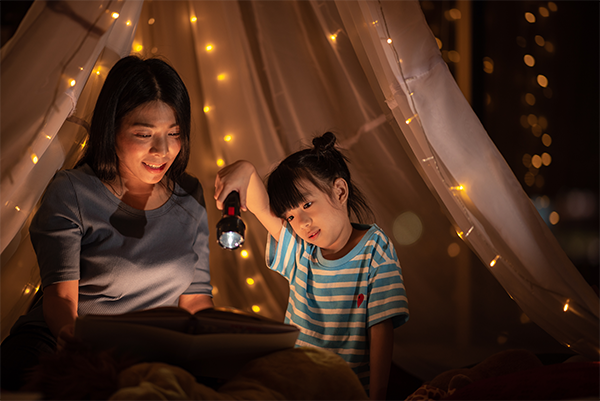
Once you find the glowing flashlight, reward your kid's bravery by reading a favorite book together inside a cozy dark tent.
Typhoons often lead to sudden power outages, and if this happens at night, the dark can scare your children. You can make the dark feel less scary by practicing a brownout drill while the weather is still calm
Level 1: Master the "owl eyes" challenge.
Turn off all the lights at night to simulate a power outage. Tell your kids they need to unlock their night vision to pass level one.
- Sit with your toddlers and practice slow, steady breaths together.
- Challenge your preschoolers and older kids to sit completely still, use their "owl eyes" (since owls can see better at night) to adjust to the dark, and listen closely to their surroundings.
Level 2: Hunt for the glowing treasure.
Level two is all about finding the tools you need! Place glow-in-the-dark stickers on emergency lights or the handles of your go-bags before the drill.
- Show toddlers how the stickers glow and let them find the flashlight with you or their older siblings.
- Ask preschoolers to race against a timer to search for the glowing stickers on their own.
- Older kids can be in charge of helping and guiding your little ones.
Once they find the treasure and turn the flashlights on, end the drill with a cozy reward, like reading under a blanket fort or stringing up fairy lights in their room.
3. The Earthquake "Turtle" Game
In sudden emergency scenarios like earthquakes, your kids need to react instantly. Use a simple ‘turtle’ cue to teach the drop, cover, and hold technique. This ensures they know exactly what to do when the ground shakes.
Level 1: Practice the drop, cover, and hold.
Use a whistle to signal a fake rumble and shout, "Turtle!" Show toddlers how to crawl quickly under a sturdy wooden table and tuck their heads. For preschoolers, challenge them to lock down their shell by grabbing the table leg firmly so their shield stays right over them, even if it shifts.
Level 2: Beat the clock until the all-clear.
Earthquakes can feel like they last a long time, and kids might want to run out too soon. Make the waiting period a simple time challenge. Teach preschoolers and toddlers to stay put and stay focused by singing a song or nursery rhyme together to keep them anchored.
Once you declare the all-clear, reward them by letting them choose the next family game or outing.
4. Emergency Phone Number Karaoke

Use a song to help your kids remember your 11-digit mobile number in case you ever get separated in an emergency situation.
Memorizing an 11-digit mobile number may be too complex for younger kids, but children aged six and up are ready for the challenge. You can give your grade-schoolers the important job of being the family communications officer, while younger kids practice recognizing their names and who to ask for help.
Even if all your contacts are on your cellphones, your child still needs to know your number by heart. If they ever get separated from you, they should be able to recite your number to a security guard or teacher. Use a song or rhythm to make this memory task easier to remember.
Level 1: Sing your contact info to unlock the next level.
Pick a song or rhyme like "Twinkle, Twinkle, Little Star" or "If You're Happy and You Know It." Since local mobile numbers have 11 digits, break them down into smaller chunks to fit the beat. For example, for Twinkle Little Star, sing it to the beat: 0-9-1-7-1 (pause) 2-3-4 (pause) 5-6-7.
Practice this chant with your older kids while in the car or doing chores. Make it a game by challenging them to sing your number the fastest to unlock the final part of your emergency plan.
Level 2: Roleplay finding a safe stranger for the grand prize.
Since your kids won’t have a phone of their own, teach them how to ask an adult for help. Turn your living room into a practice scenario and pretend to be a security guard or a store clerk. Challenge your older child to walk up to you and confidently recite their 11-digit song so you can call their parents. When they successfully give the right number, celebrate their win with a big high-five and let them choose the family movie for the night.
Level Up Your Safety: A Quick Home Sweep
Before you begin, make sure to follow these home safety rules from the American Academy of Pediatrics (AAP) to ensure a safe environment for your drills:
- Test your buzzers: Ensure you have working smoke and carbon monoxide detectors on every level of your home. Your kids need to know what the alarm sounds like, so they know when the race begins.
- Clear the paths: Get down on your child's level and check the floors for small objects or clutter. Keeping pathways clear ensures no one trips during a fast evacuation or a sudden brownout.
- Anchor your heavy items: Children can be seriously hurt by tipping furniture. Make sure bookcases, dressers, and TVs are firmly anchored to the wall, so your kids have safe zones during a real earthquake drill.
Why Regular Practice Matters
Practicing these steps once is a good start, but repetition builds real readiness. While you might be used to typhoons or occasional brownouts, these events can still be terrifying for young children. When you introduce your emergency plan as fun activities, you help your kids stay calm and confident during emergencies.
Recent safety guidelines from UNICEF show that children who engage in active disaster role-play have significantly lower anxiety levels when a real event occurs. Preschoolers and toddlers learn through play, and active participation can help boost confidence, resilience, and coping skills, especially when conquering their fears.
By assigning evacuation roles, staying calm in the dark, mastering the turtle drop, and memorizing your contact details, you cover all the important bases. When you turn your emergency plan into a regular game you play often, your kids will know exactly what to do, and you’ll have the peace of mind knowing they’re ready.
Think of your emergency plan as simple hero training—every family member plays an important role. Connect with other parents on the ParenTeam Moms and Dads Facebook group and share your creative games.
References
UNICEF. "Disaster Risk Reduction and Recovery." Accessed March 27, 2026. https://www.unicef.org/disaster-risk-reduction-and-recovery.
UNICEF. "Education in Emergencies." Accessed March 27, 2026. https://www.unicef.org/eap/education-emergencies.
World Health Organization. 2019. "Health Emergency and Disaster Risk Management Framework." July 30, 2019. Accessed March 27, 2026. https://www.who.int/publications/i/item/health-emergency-and-disaster-risk-management-framework.
Related articles

Pedia Shares 3 Major Signs You May Have a Child With Special Needs
Here's what pedias want you to know if you suspect you have a child with special needs.
8 mins to read

How to Protect Your Active Toddler from Extreme Heat in the Philippines
Parenting in a hot climate can add to your stress levels! But your kids rely on you even more during these warmer days. Here's the TLC they need.
6 mins to read

Milk Teeth: What Are They and When Do Kids Lose Them?
Your child's milk teeth are crucial for their health and development. Learn when they appear, fall out, and how to care for them every step of the way.
6 mins to read

Doodling and Talking? Here Are Your 18-Month-Old Baby's Milestones
Your 18-month-old-baby is more active and curious than ever! Learn the key milestones to expect and how to support your toddler's growth every day.
5 mins to read

A Child Psychologist's Guide to Building Emotional Stability in Kids
Emotional stability is really shaped by the small, consistent moments you share with your child every day. Here's how to strengthen those moments.
6 mins to read

7 Simple Ways to Boost Brain Development in Growing Kids
Jumpstart your toddler's brain development by turning simple activities, fun games, and daily routines into learning opportunities. Build focus, memory, and confidence!
6 mins to read

Tooth Decay in Kids: Your Guide to Causes, Symptoms, and Prevention
Tooth decay in kids is common, but you can prevent it. Learn to spot the signs, understand the causes, and protect your child's smile for good.
6 mins to read

8 Cute and Practical Kids’ Hairstyle Ideas for Boys and Girls
Looking for no-fuss kids’ hairstyles? Discover easy ideas, from French braids to a textured crop, that that you can do easily before school or playdates.
5 mins to read

Choking First Aid: A Step-by-Step Guide to Help Your Child Fast
Know what to do! This choking first aid guide gives you life-saving steps for infants (back blows) and children (Heimlich). Equip yourself with this crucial skill.
8 mins to read

25 Filipino Nursery Rhymes and Lullabies to Sing to Your Child
Explore this list of 25 Filipino nursery rhymes and lullabies. You can sing these songs to help your child learn, grow, and have fun!
9 mins to read

8 Simple Ways to Inspire Healthy Eating Habits in the Whole Family
From trying new dishes to setting an example at the dinner table, here’s how parents can instill healthy eating habits for the entire household.
6 mins to read

Where to Book a Christmas Photoshoot for Your Family
Your family's Christmas photoshoot deserves the perfect spot. Discover pro and self-shoot studios in and around Manila, plus tips on what to wear.
7 mins to read

15 Brain Games to Help Your Babies and Toddlers Learn!
No pricey toys required. These brain games need just one important thing: Mom or Dad. Get ready to have fun with your little one!
8 mins to read

How to Discipline a Child Without Hitting or Yelling
Disciplining your child without yelling or hitting? It’s possible with these effective tips that build better behavior.
4 mins to read

7 Teacher-Recommended Reading Strategies to Use at Home
Get your little one to build their reading skills with these expert tips and strategies from a teacher.
4 mins to read

How to Control Emotions: 9 Ways to Help Toddlers Who Feel Too Much
Toddlers feel big emotions but are still learning to manage them. Discover science-backed, mom-approved tips to guide meltdowns into calm without losing your cool.
6 mins to read

10 Fun Activities to Keep Toddlers Entertained in the Heat
You can keep your toddler cool and engaged even on the hottest days while making the most of play-based learning!
6 mins to read

Encouraging Your Child to Eat Right
It’s no secret – nutrition is definitely key to children’s health! But how can you help your little one develop healthy eating habits? Read these tried-and-tested parenting tips to find out!
3 mins to read

Curious and Exploring! A 2-Year-Old Baby's Milestone Checklist
Your 2-year-old is eager to explore, touch, and try everything. These are some milestones you'll enjoy watching.
5 mins to read


