


One minute, your toddler is quietly stacking cups, and the next, they're playing with all the plastic containers in your kitchen. Messy, yes—but these everyday moments can actually jumpstart your toddler’s brain development. Discover how simple things—like hands-on play, engaging conversations, and a good night’s sleep—give your toddler a strong foundation for their growing brain.
How Your Child’s Brain Develops
In the first few years, your little one’s brain develops faster than it ever will again. In fact, they’ll produce far more connections (called synapses) than they will ever need.
According to a 2024 review in the Delaware Journal of Public Health, early brain growth follows a simple use-it-or-lose-it principle. Every time you play, talk, or laugh together, those specific connections get stronger, while unused connections fade.
So, if you're wondering how to support your toddler’s growing brain, focus on everyday interactions and consistent habits. Even simple routines can have a big impact.
Simple Ways to Support Your Kid's Brain Development
Ready to put that use-it-or-lose-it science into action? Here are a few fun and easy things you can try at home today.
1. Build their focus by stacking blocks.
Grab a few simple stacking blocks or clean plastic cups to start a fun building game. Show them how to stack one item on top of another, then let them try. Give them plenty of time to figure out balance and coordination. If the tower falls, laugh and encourage them to build it again.
Brain benefit: Based on the 2022 clinical report in Pediatrics, by 15 months, most toddlers can stack at least two small objects—a clear sign of healthy cognitive development. Stacking helps improve focus and spatial awareness as they figure out how things fit together.
2. Play hide and seek for memory challenges.
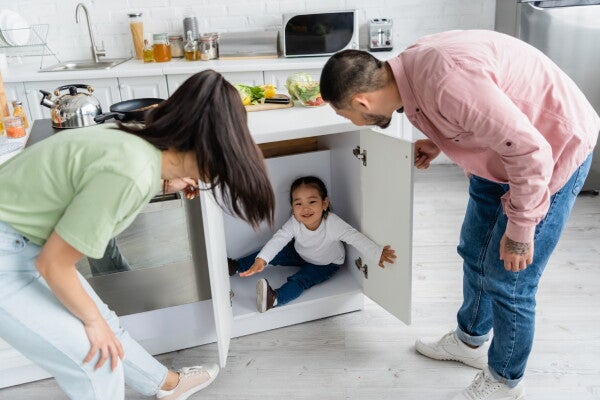
A simple game of hide-and-seek builds your toddler’s memory and teaches them that hidden objects still exist.
You can turn any afternoon with your toddler into a fun game just by grabbing a towel or blanket. Start with a game of peek-a-boo, then progress into hiding a favorite stuffed toy under the blanket and asking your kid to find it. As they get older, you can play a game of hide and seek, hiding safely behind a sofa or a door.
Brain benefit: By their first birthday, most babies begin searching for hidden objects—a major cognitive milestone. When they master hide and seek, it shows they understand that objects still exist even when out of sight.
3. Let them solve puzzles with household items.
Puzzles don’t always have to come from a store. You can easily use clean household items to create a fun problem-solving game. Take a few plastic food containers and their matching lids, mix them up on the floor, and let your kid figure out how to put them together. Help them try different sizes until they find the perfect match.
Brain benefit: Around age two (24 months), toddlers typically learn to hold a container in one hand while removing the lid with the other. Watching them use trial and error to match these everyday objects is a great sign of early logical reasoning and problem-solving skills.
4. Use serve-and-return to build their brain.
Talking and listening back and forth is called serve-and-return. When your kid points at a dog and babbles, you return the serve by saying, "Yes, that is a brown dog!" Even if they’re not speaking in full sentences yet, responding to their sounds shows them that their voice matters.
Brain benefit: These back-and-forth exchanges strengthen the neural pathways your child uses to think and communicate. Most toddlers can follow simple one-step directions by around 18 months, like picking up a toy or placing it in a basket.
5. Make sure they get enough sleep to recharge.
During sleep, your child’s brain organizes and stores what they learned that day. Set a regular bedtime routine with a warm bath and a quiet story to help them wind down.
The American Academy of Sleep Medicine recommends that toddlers between 1 and 2 years old get 11 to 14 hours of total sleep on a regular basis, which includes their afternoon naps.
Brain benefit: Getting the recommended amount of rest is directly linked to better learning, memory, and emotional regulation. Without enough sleep, toddlers are more likely to struggle with hyperactivity and more intense tantrums during the day.
6. Provide emotional safety to support growth.

Emotional safety is key to brain development. Kisses and hugs calm their stress so they can confidently learn and explore.
Your kid learns best when they feel safe and loved. You can build this security through simple actions, like sticking to a predictable daily routine or offering a warm hug when they’re frustrated with a difficult toy.
Acknowledging their big feelings and showing physical affection reassures them that they’re cared for. A loving environment is one of the most powerful tools for your child’s brain growth.
Brain benefit: Experts refer to this as "felt safety"—meaning your child feels secure on the inside even if things are uncertain on the outside. That sense of security gives your toddler the confidence to explore, learn, and grow.
7. Encourage social play with others.
Playing with cousins, neighbors, or siblings teaches your kid how the world works. Taking turns and sharing toys can be tough at first, but these moments teach patience.
You can guide them by playing interactive games together, like a very simple version of Simon Says, to practice listening and following directions. These early social experiences shape how your child understands cooperation and empathy. (You can read more about building social skills to see how group play deeply impacts your child’s brain development.)
Brain benefit: By about 15 months, many toddlers begin copying other children during play. By 18 months, most can follow simple one-step directions without gestures. Encouraging these interactive games directly supports the neural pathways they need for cooperation, active listening, and patience.
A Gentle Reminder for Moms and Dads
Every child grows at their own unique pace. Try not to compare your toddler to other kids in the neighborhood or online. However, if you ever feel like they’re taking a little longer to hit milestones according to their age, trust your instincts and bring it up with your pediatrician.
“In the meantime, keep talking, playing, and showing up for them every day. Small, consistent moments—stacking cups, sharing laughs, reading before bed—add up to boost brain development over time.
Connect with other parents on the ParenTeam Moms and Dads Facebook group and share your favorite tips for early brain development.
References
American Academy of Pediatrics. "Healthy Sleep Habits: How Many Hours Does Your Child Need?" HealthyChildren.org. Last modified November 16, 2020. Accessed February 20, 2026. https://www.healthychildren.org/English/healthy-living/sleep/Pages/healthy-sleep-habits-how-many-hours-does-your-child-need.aspx
Jeong, Joshua, Emily Franchett, Clariana Ramos de Oliveira, Kimberly Rehfeld, and Aisha K. Yousafzai."Parenting Interventions to Promote Early Childhood Development in the First Three Years of Life: A Global Systematic Review and Meta-analysis." PLoS Medicine 18, no. 5 (May 10, 2021). Accessed February 20, 2026. https://doi.org/10.1371/journal.pmed.1003602
Malik, F., and R. Marwaha. "Developmental Stages of Social Emotional Development in Children." In StatPearls. Treasure Island, FL: StatPearls Publishing, 2025. Last modified September 18, 2022. Accessed February 20, 2026. https://www.ncbi.nlm.nih.gov/books/NBK534819/
Related articles

Teach Kids Safety: 4 Ways to Gamify Your Family Emergency Plan
Practice your emergency plan with fun games that teach kids safety roles. You’ll help them stay calm, learn important contacts, and prepare for any disaster.
7 mins to read

Pedia Shares 3 Major Signs You May Have a Child With Special Needs
Here's what pedias want you to know if you suspect you have a child with special needs.
8 mins to read

How to Protect Your Active Toddler from Extreme Heat in the Philippines
Parenting in a hot climate can add to your stress levels! But your kids rely on you even more during these warmer days. Here's the TLC they need.
6 mins to read

Milk Teeth: What Are They and When Do Kids Lose Them?
Your child's milk teeth are crucial for their health and development. Learn when they appear, fall out, and how to care for them every step of the way.
6 mins to read

Doodling and Talking? Here Are Your 18-Month-Old Baby's Milestones
Your 18-month-old-baby is more active and curious than ever! Learn the key milestones to expect and how to support your toddler's growth every day.
5 mins to read

A Child Psychologist's Guide to Building Emotional Stability in Kids
Emotional stability is really shaped by the small, consistent moments you share with your child every day. Here's how to strengthen those moments.
6 mins to read

Tooth Decay in Kids: Your Guide to Causes, Symptoms, and Prevention
Tooth decay in kids is common, but you can prevent it. Learn to spot the signs, understand the causes, and protect your child's smile for good.
6 mins to read

8 Cute and Practical Kids’ Hairstyle Ideas for Boys and Girls
Looking for no-fuss kids’ hairstyles? Discover easy ideas, from French braids to a textured crop, that that you can do easily before school or playdates.
5 mins to read

Choking First Aid: A Step-by-Step Guide to Help Your Child Fast
Know what to do! This choking first aid guide gives you life-saving steps for infants (back blows) and children (Heimlich). Equip yourself with this crucial skill.
8 mins to read

25 Filipino Nursery Rhymes and Lullabies to Sing to Your Child
Explore this list of 25 Filipino nursery rhymes and lullabies. You can sing these songs to help your child learn, grow, and have fun!
9 mins to read

GROWING TOGETHER: The Importance of Tracking Developmental Milestones in the First 2000 days. -2nd
The first 2,000 days are critical in shaping a child’s future—discover why every developmental milestone matters in these early years of growth and learning.
2 mins to read
GROWING TOGETHER: The Importance of Tracking Developmental Milestones in the First 2000 days.
The first 2,000 days are critical in shaping a child’s future—discover why every developmental milestone matters in these early years of growth and learning.
2 mins to read

How to Survive Toddler Haircuts Without the Tears
Say goodbye to the struggles of toddler haircuts. Here are practical ways to make salon visits fun, tear-free, and comfortable for your child.
6 mins to read

Easy Pinoy Dinner Ideas Dads and Kids Can Cook for Mother’s Day
Need easy Pinoy dinner ideas? Surprise mom with a budget-friendly meal that dads and kids can quickly prep, cook, and enjoy together for a fun celebration at home.
6 mins to read

8 Simple Ways to Inspire Healthy Eating Habits in the Whole Family
From trying new dishes to setting an example at the dinner table, here’s how parents can instill healthy eating habits for the entire household.
6 mins to read

Where to Book a Christmas Photoshoot for Your Family
Your family's Christmas photoshoot deserves the perfect spot. Discover pro and self-shoot studios in and around Manila, plus tips on what to wear.
7 mins to read

15 Brain Games to Help Your Babies and Toddlers Learn!
No pricey toys required. These brain games need just one important thing: Mom or Dad. Get ready to have fun with your little one!
8 mins to read

How to Discipline a Child Without Hitting or Yelling
Disciplining your child without yelling or hitting? It’s possible with these effective tips that build better behavior.
4 mins to read

7 Teacher-Recommended Reading Strategies to Use at Home
Get your little one to build their reading skills with these expert tips and strategies from a teacher.
4 mins to read


