

Welcome to NIDO® 3+'s Probiotics Protection Corner!
Meet Rhamy!
Our Probiotics Protector

Here to guide you on how probiotics like Lactobacillus rhamnosus, the strain that inspired his name, can support your child's health journey!
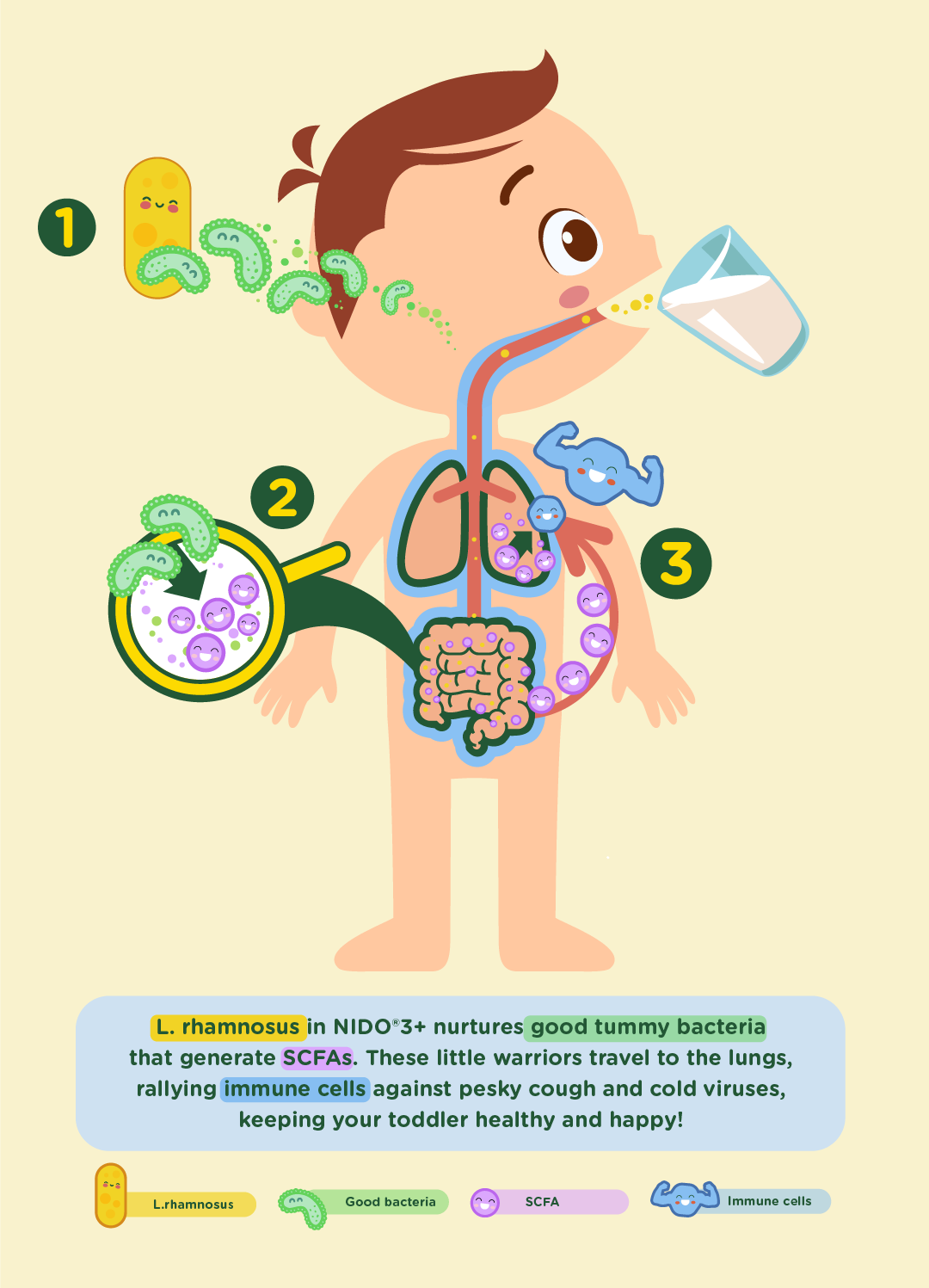
Known for its incredible benefits, L. rhamnosus not only aids digestion but also plays a vital role in strengthening your toddler’s immune system and protecting respiratory health.
Choosing NIDO® 3+’s 1 Billion Probiotic Protection, which features L. rhamnosus, is a loving step toward supporting your toddler’s overall well-being and resilience. Continue reading to find out how NIDO® 3+ can help your toddler stay protected as he socializes, learns and explores!
See Rhamy in action—tap the power‑up below to start playing!
See Rhamy in action—tap the power‑up below to start playing!
How It Works

FAQs
What are probiotics?
Probiotics are beneficial bacteria that help support your child’s health from the inside. In NIDO® 3+, probiotics like L. rhamnosus can help support digestion and your toddler’s immune system as they grow and explore.
Kumpu M., et al. European Journal of Clinical Nutrition, 2012
Liu Y., et al., Frontiers in Nutrition, 2025
Are probiotics only for the gut?

No. While probiotics help support digestion, certain probiotics like L. rhamnosus also help support your child’s immune and respiratory health, providing protection beyond the gut.
Hatakka K., et al., BMJ, 2001
Hojsak I., et al., Pediatrics, 2010
How do probiotics help reduce respiratory infections?

Probiotics help support immune function, with studies showing 19% less antibiotic use for respiratory infections vs control.
Hatakka K., et al., BMJ, 2001
Can probiotics help reduce illness-related school absences?

Yes! Probiotics help support overall health, resulting in 40% fewer illness-related school absences vs control.
Hojsak I., et al., Pediatrics, 2010
Can probiotics help prevent gastrointestinal infections?

Yes! Probiotics support beneficial gut bacteria, which helps prevent against gastrointestinal infections.
Hojsak I., et al., Pediatrics, 2010
Can probiotics help improve sleep quality?
Yes! By supporting gut health, probiotics may also help improve sleep quality.
Liu Y., et al., Frontiers in Nutrition, 2025
Why Choose NIDO®3+?
NIDO®3+ stands out as the only milk fortified with 1 billion probiotics, specifically L. rhamnosus, to support your child’s growing needs. NIDO®3+ not only aids digestion but also strengthens the immune system, offering enhanced protection for your toddler’s respiratory health. With NIDO®3+, your Act of Love is choosing a unique blend that nourishes and protects, keeping your toddler strong and healthy.

Articles

Supporting Your Child’s Respiratory Health, One Loving Choice at a Time
Every day, children are exposed to countless germs, especially when they start socializing more in playgrounds, pre-schools, or big school.
4 mins to read

The One Nutrition Secret to Help Protect your Child
Being a first time mom is a challenging experience. With all the new things you have to learn, it can get overwhelming. The first few years are the most difficult.
3 mins to read

Choose NIDO® 3+’s 1 Billion Probiotic Protection


Sources


