


10 Sleepy Time Activities for Kids: Bedtime Stories, Lullabies, and More
It’s 8 p.m. Dinner’s done, the TV’s still on, and your toddler is bouncing on the bed like it’s the middle of the afternoon. “Anak, tulog na!” you say for the third time. Sound familiar, Mommy? If sleepy time in your home feels more like a tug-of-war than a wind-down, a few quiet, cozy activities can help tell your child’s body that the day is ending.
Here are 10 you can try tonight with your toddler or preschooler, from quiet play and bedtime stories to lullabies, gentle stretches, and cuddly moments. You don’t need special toys or a strict schedule, just a few minutes and use things you already have at home.
Why Sleepy Time Activities Help Your Child Settle Down
When you do the same quiet activities in the same order each night, your child starts to expect what comes next. Ligo, libro, yakap, tulog (bath, book, hug, sleep): the same four steps each night tell your child’s body it’s time to rest.
That predictability pays off. Kids with a regular bedtime routine tend to go to bed earlier, fall asleep faster, wake up less at night, and sleep longer, according to a review of bedtime routine studies by sleep researchers Jodi Mindell and Ariel Williamson.
And it doesn’t take much. In one study the review cites, moms of babies and toddlers who had trouble sleeping tried a simple 30-minute routine: a bath, a gentle massage or lotion rub, then cuddling or reading. After three weeks, the moms said their kids fell asleep faster and woke up less at night. In short, a few calm minutes each night can mean fewer “not yet, Mommy” pleas at lights out.
The review also links a regular bedtime routine at age 3 to better control over feelings and behavior, even in homes under stress. Here’s how a daily routine can support your child’s emotional health, too.
Quiet Play That Slows Busy Hands
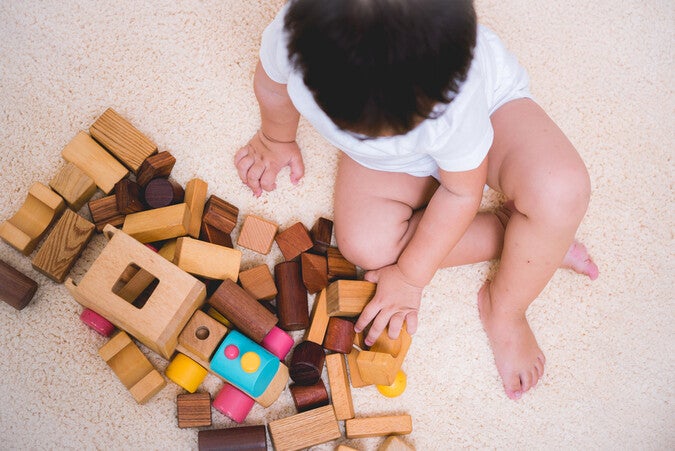
Stacking blocks or coloring after dinner keeps little hands busy, since active play right before bed may make kids too wired.
After dinner, it’s tempting to let your little one burn off energy with a round of habulan or kilitian with Papa or Kuya. But the American Academy of Pediatrics (AAP) notes that active play right before bed may make your child too excited to sleep. Quiet play keeps those hands busy, so your child is ready to rest by the time it’s lights out.
1. Build with blocks or finish an easy puzzle.
Stacking blocks or finishing a puzzle with a few big pieces lets your toddler focus on one small task while their energy winds down. Pick a set they already know, so they feel proud instead of frustrated. When the last piece clicks into place, say “Tapos na. Ligpit na,” and pack up together. That clear ending tells your child playtime is over.
2. Draw, color, or squish some clay.
Coloring or squishing clay gives your child something calm and creative to do with their hands. Playdough or clay works since slow rolling and squishing keeps little hands busy while their body settles.
A UK NHS children’s health service lists coloring and building blocks among the quiet, offline activities to encourage in the hour before bed. A few crayons and the back of an old calendar or the blank pages of Ate’s old notebook will do. Ask your child to draw their favorite stuffed toy getting ready for bed, so they start thinking about their own bedtime, too.
3. Tuck their favorite toys into bed.
Once the drawing is done, let your child put one or two toys to sleep. They can tuck them under a hanky or an old lampin, whisper “Tulog na, Teddy,” and switch off a pretend light. This little ritual lets your child practice the steps they’re about to take, so going to bed feels like their own idea.
Gentle Moves to Relax Little Bodies
Malikot pa rin? Some kids still have the wiggles after quiet play. These three activities help your child let go of that leftover energy before you settle into bed.
4. Take a warm, unhurried bath.
You don’t need a bathtub for this. Let your child sit in a batya and pour warm water from a tabo while they wash a rubber toy. That quiet water play turns an ordinary wash into a few tranquil minutes with you.
Mindell and Williamson suggest that the warmth of a bath, then the cool-down after, may make it easier to drift off. Keep the water warm, not hot, and stay within arm’s reach. Afterward, brush their teeth. The AAP even sums up a child’s nighttime routine in three words: “Brush, Book, Bed.”
5. Try belly breathing with a pretend flower.
Turn deep breathing into a game. Ask your child to smell a pretend flower slowly through their nose, then gently blow out a pretend birthday candle. Do this a few times, breathing along with them.
In a practice brief for the US Administration for Children and Families, child development researchers call this co-regulation and suggest that parents model calming habits like taking a deep breath. Basically, you lend your child your calm until they can find it on their own.
6. Stretch like sleepy animals.
If your child still can’t sit still, slow stretches let them move without getting excited all over again. Your child can arch like a sleepy cat, curl up like a turtle, or reach up tall like a giraffe before flopping down like a tired puppy. End with everyone lying flat on the bed, so the game finishes right where sleep begins.
Bedtime Stories and Lullabies for a Softer Evening
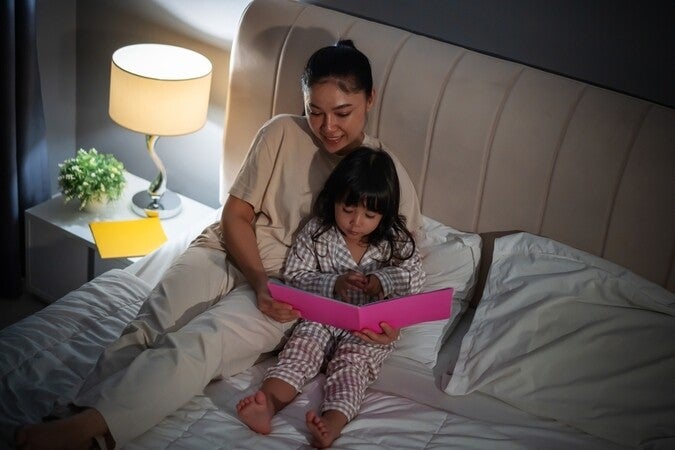
Reading two or three picture books in bed gives your toddler a calm, screen-free way to settle in at sleepy time every night.
Now that your child is lying down, it’s their turn to get cozy. All you need for this part of the night is a soft tone and a few quiet minutes in bed.
7. Read two or three picture books in bed.
Storytime is another way to help your child slow down. Any short story works: a Bible story, a Tagalog storybook, or your own kuwento about the fat orange street cat that patrols the streets at night.
The AAP says reading aloud together, even for just 15 minutes a day, can help improve your child’s language and social-emotional skills. In other words, every bedtime story helps your child pick up new words while you both enjoy some close, quiet time.
8. Sing a lullaby or play soft music.
Lullabies have long been part of Filipino bedtime, from “Sa Ugoy ng Duyan” to the Visayan favorite “Ili-Ili Tulog Anay.” You’ll find both in this list of Filipino nursery rhymes and lullabies.
Sing the same songs each night, and your child can start to hear them as a gentle signal that sleep is coming. A little sintunado, Mommy? Soft instrumental music works, too.
Screen-Free Bonding Moments Before Lights Out
Once your child is tucked in and the lights are low, these last few minutes are all about connecting. Leave your phone in another room so your child gets all of your attention.
9. Give a slow back rub or hand massage.
Rub small circles on your child’s back, stroke their hair, or play pizza massage: knead the “dough” on their back, spread the “sauce,” then sprinkle the “toppings” with your fingertips.
In a small study cited in the bedtime routine review, babies and toddlers who had trouble sleeping got a 15-minute massage from a parent at the end of their routine. After a month, they fought bedtime less and fell asleep faster than kids whose routine ended with a story, and their moms felt less anxious about bedtime. Put plainly, a back rub after your story may make lights out easier for both of you.
10. Talk about the best part of the day.
Lie down beside your child and ask, “What was the best part of your day?” Share your answer, too. If something upset them, help them name it: “You felt sad when your tower fell, didn’t you?” That same brief on co-regulation suggests helping toddlers put names to their emotions as they learn to handle big feelings. Simply put, these small chats let your child practice saying what they feel, and they give you a peek into what matters to them.
Making Sleepy Time Work in a Busy Household
You don’t need all 10 activities every night. Remember the 30-minute bath, massage, and cuddle routine? Just three steps helped those kids fall asleep faster, so pick two or three that fit your evening.
- Start winding down about an hour or so before lights out, so no step feels rushed.
- Keep your chosen activities in the same order every night.
- If lolo, lola, or a tito or tita lives with you, let them take a turn with the story or lullaby.
- Dim the lights and lower the TV volume in the whole house.
- Keep phones and tablets away during wind-down time. The World Health Organization (WHO) advises no screen time for 1-year-olds and no more than an hour a day for kids aged 2 to 4.
- Kids sharing a room? Wind them down together with one story and one song.
If you work late or on a night shift, a shorter routine may work better, so even one story and a back rub count. And if an activity winds your child up instead of down, swap it out. If bedtime still ends in tears most nights, these toddler sleep solutions can help with bigger struggles like night wakings.
A Cozy Sleepy Time Starts With a Few Small Steps
With a few of these activities in your nightly lineup, you may not need that third “Anak, tulog na!” Quiet play calms busy hands, gentle moves settle little bodies, stories and songs soften the mood, and a back rub or bedtime chat helps your child drift off feeling close to you.
Start tonight with just three, Mommy: one quiet activity, one story or song, and one cuddly moment. Keep them in the same order for a few weeks, and watch sleepy time get a little easier for both of you. Good rest matters for growing kids in many ways, so read up on the benefits of sleep for kids, too.
Got a lullaby or wind-down trick that works in your home? Share it with fellow parents in the ParenTeam Moms and Dads Facebook group, and pick up fresh sleepy time ideas for your little one along the way.
References
American Academy of Pediatrics. “Brush, Book, Bed: How to Structure Your Child’s Nighttime Routine.” HealthyChildren.org. Last updated February 2, 2024. Accessed September 24, 2026. https://www.healthychildren.org/English/healthy-living/oral-health/Pages/Brush-Book-Bed.aspx
American Academy of Pediatrics. “Toddler Bedtime Trouble: 7 Tips for Parents.” HealthyChildren.org. Last updated August 25, 2022. Accessed September 24, 2026. https://www.healthychildren.org/English/healthy-living/sleep/Pages/Bedtime-Trouble.aspx
East of England Community Health and Care NHS Trust. “Sleep Routines for Toddlers and Children.” Bedfordshire and Luton Children’s Health. Last reviewed November 1, 2024. Accessed September 25, 2026.
Mindell, Jodi A., and Ariel A. Williamson. “Benefits of a Bedtime Routine in Young Children: Sleep, Development, and Beyond.” Sleep Medicine Reviews 40 (2018): 93–108. Accessed September 24, 2026. https://pmc.ncbi.nlm.nih.gov/articles/PMC6587181/
Rosanbalm, K. D., and D. W. Murray. Co-Regulation From Birth Through Young Adulthood: A Practice Brief. OPRE Brief #2017-80. Washington, DC: Office of Planning, Research, and Evaluation, Administration for Children and Families, US Department of Health and Human Services, 2017. Accessed September 24, 2026. https://acf.gov/opre/report/co-regulation-birth-through-young-adulthood-practice-brief
World Health Organization. Guidelines on Physical Activity, Sedentary Behaviour and Sleep for Children under 5 Years of Age. Geneva: World Health Organization, 2019. Accessed September 24, 2026. https://www.who.int/publications/i/item/9789241550536
Related articles

12 Storybooks in Tagalog to Help Your Toddler Learn the Language
Looking for a storybook in Tagalog that your toddler will love? These picks build vocabulary, spark curiosity, and deepen your bond.
7 mins to read

Easy Pinoy Dinner Ideas Dads and Kids Can Cook for Mother’s Day
Need easy Pinoy dinner ideas? Surprise mom with a budget-friendly meal that dads and kids can quickly prep, cook, and enjoy together for a fun celebration at home.
6 mins to read

Where to Book a Christmas Photoshoot for Your Family
Your family's Christmas photoshoot deserves the perfect spot. Discover pro and self-shoot studios in and around Manila, plus tips on what to wear.
7 mins to read

How to Find a Green Flag Yaya for Your Toddler
Finding a green flag yaya starts with the right questions. Learn how to screen candidates, check backgrounds, and run a trial period for your peace of mind.
9 mins to read

6 Filipino Traditions to Teach Your Kids This Holy Week
Share these Filipino traditions with your kids this Lenten season. Guide them through Holy Week with these simple and meaningful family activities.
6 mins to read

GROWING TOGETHER: The Importance of Tracking Developmental Milestones in the First 2000 days. -2nd
The first 2,000 days are critical in shaping a child’s future—discover why every developmental milestone matters in these early years of growth and learning.
2 mins to read
GROWING TOGETHER: The Importance of Tracking Developmental Milestones in the First 2000 days.
The first 2,000 days are critical in shaping a child’s future—discover why every developmental milestone matters in these early years of growth and learning.
2 mins to read

Math for Kids: How to Instill a Love for Numbers Early
Math for kids doesn’t need worksheets. It needs stacked cups, sorted socks, and the games you’re already playing.
8 mins to read

25 Filipino Nursery Rhymes and Lullabies to Sing to Your Child
Explore this list of 25 Filipino nursery rhymes and lullabies. You can sing these songs to help your child learn, grow, and have fun!
9 mins to read

How to Survive Toddler Haircuts Without the Tears
Say goodbye to the struggles of toddler haircuts. Here are practical ways to make salon visits fun, tear-free, and comfortable for your child.
6 mins to read

Teach Kids Safety: 4 Ways to Gamify Your Family Emergency Plan
Practice your emergency plan with fun games that teach kids safety roles. You’ll help them stay calm, learn important contacts, and prepare for any disaster.
7 mins to read

8 Simple Ways to Inspire Healthy Eating Habits in the Whole Family
From trying new dishes to setting an example at the dinner table, here’s how parents can instill healthy eating habits for the entire household.
6 mins to read

Pedia Shares 3 Major Signs You May Have a Child With Special Needs
Here's what pedias want you to know if you suspect you have a child with special needs.
8 mins to read

How to Protect Your Active Toddler from Extreme Heat in the Philippines
Parenting in a hot climate can add to your stress levels! But your kids rely on you even more during these warmer days. Here's the TLC they need.
6 mins to read

15 Brain Games to Help Your Babies and Toddlers Learn!
No pricey toys required. These brain games need just one important thing: Mom or Dad. Get ready to have fun with your little one!
8 mins to read

How to Discipline a Child Without Hitting or Yelling
Disciplining your child without yelling or hitting? It’s possible with these effective tips that build better behavior.
4 mins to read

7 Teacher-Recommended Reading Strategies to Use at Home
Get your little one to build their reading skills with these expert tips and strategies from a teacher.
4 mins to read

How to Control Emotions: 9 Ways to Help Toddlers Who Feel Too Much
Toddlers feel big emotions but are still learning to manage them. Discover science-backed, mom-approved tips to guide meltdowns into calm without losing your cool.
6 mins to read

10 Fun Activities to Keep Toddlers Entertained in the Heat
You can keep your toddler cool and engaged even on the hottest days while making the most of play-based learning!
6 mins to read


