


You’ve been noticing it for a while now, Mommy: a rash around your little one’s wrists, ankles, or collar, and it just won’t fully go away no matter how many baths you give or how gently you towel them dry. Nakaka-stress talaga kapag ‘di mo alam kung bakit. You’ve wondered if it’s the weather, checked if it’s just heat rash, and maybe even switched their lotion. But there’s one common cause that’s easy to overlook: your baby laundry detergent.
So how do you know for sure? Board-certified dermatologist Dr. Hazel Hao-Dy shares the five signs to watch for that mean it’s time to make the switch.
Why Your Baby’s Skin Reacts to Detergent
Your baby’s skin is more sensitive than yours, Mommy, which is why even detergent for baby clothes can easily affect them.
A 2025 review in Allergy, Asthma & Immunology Research found that a baby’s skin barrier is thinner and holds more water than an adult’s, making it far more permeable to outside irritants like detergents and surfactants. This just means that ingredients that wouldn't bother your skin can easily trigger a reaction on theirs, especially detergent residue.
That’s why choosing the right laundry detergent for baby, especially a newborn laundry detergent, matters so much from the start. Get it right, and you’ll save your little one from a lot of discomfort and itching.
5 Signs You Need to Switch Your Baby’s Laundry Detergent
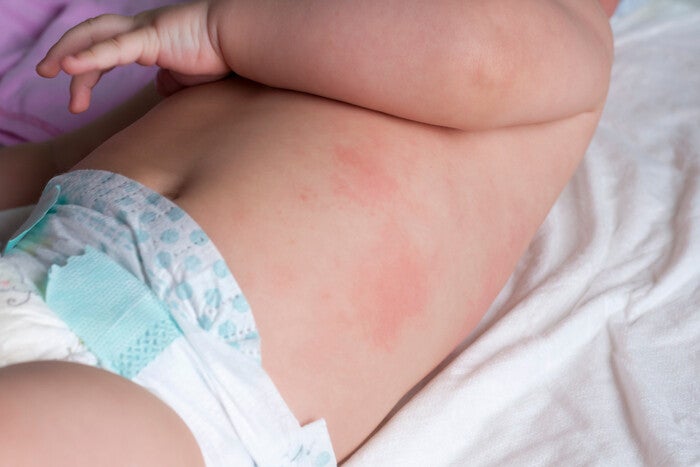
Bright red patches where clothing rubs are often the first sign of detergent-related irritation.
Since your baby’s skin reacts more easily, knowing the early signs helps you act before the rash gets worse. Here’s what Dr. Hao-Dy wants you to watch for.
1. The rash shows up exactly where clothing rubs your baby's skin.
The rash location is the clearest sign to catch. “The pattern appears exactly where clothing rubs tightly,” she explains. Check your baby’s waistband elastics, wrist cuffs, sock lines, and collar first, since these are the spots where fabric presses hardest. If the rash lines up with these areas, your baby detergent is likely the reason.
2. The diaper area stays smooth and clear.
Here’s another clue: while the rest of the skin reacts, the area under a diaper usually stays protected. That’s because the diaper acts as a barrier against the fabric that triggers irritation. If your baby’s diaper area looks fine while other spots don’t, that’s another sign it might be the detergent.
3. Bright red patches or small pink bumps show up.
According to Dr. Hao-Dy, this is usually one of the first things you’ll notice: bright red patches or small pink bumps in a specific spot or area rather than a rash spread across your baby’s body.
4. The skin feels dry, rough, or slightly scaly.
It’s not just about how the skin looks. Run your fingers gently over the area, and you may notice it feels rough or scaly, too. This texture change often shows up alongside the redness, so always make sure to check how the rash feels.
5. It shows up 24 to 72 hours after a switch.
Dr. Hao-Dy points out that symptoms typically flare up one to three days after you introduce a new detergent brand, so think back to any recent changes in your laundry routine. If the timeline matches, you know what’s up.
How to Tell It Apart from Heat Rash and Eczema
Not every baby rash points to your detergent. Heat rash and eczema are the two conditions most commonly mistaken for detergent irritation, since all three can show up as red, bumpy, or irritated skin. Dr. Hao-Dy points out how to tell them apart.
Heat rash
You’ll usually find this as tiny, clear or pink bumps clustered in areas where your baby sweats most, like the neck, armpits, and groin. The good news is it clears up fast; cool your baby down, and you’ll often see it fade within the day.
If your baby’s rash lines up with fabric edges instead of sweaty folds, and stays for more than a day or two, detergent is more likely the cause.
Eczema
Eczema runs in the family and tends to stick around, so it’s helpful to know if it’s something your baby may be prone to.
It often starts on the cheeks in the early months, then moves to the creases of the elbows and knees as your baby grows. It also tends to flare up and calm down on its own over time, not something that clears up simply by changing one product.
If your baby’s rash follows tight clothing lines and eases up once you switch detergents, that’s a sign it’s not eczema. If you’re still not sure which one it is, don’t hesitate to call your doctor. It’s always okay to ask for help figuring it out.
What to Do Next If You Suspect Your Baby Laundry Detergent
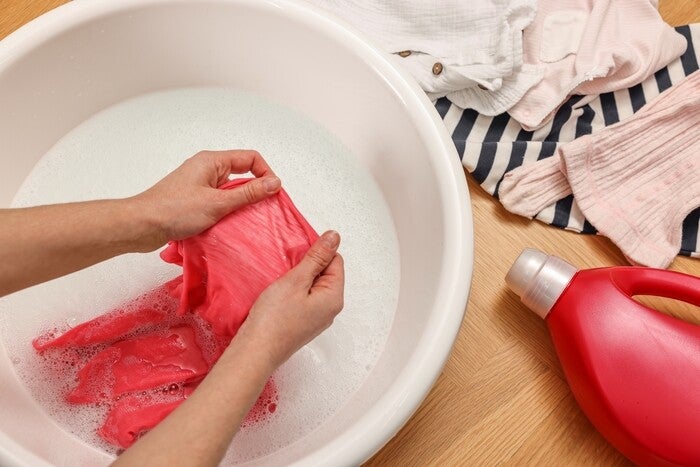
Rewashing recently worn clothes in a new detergent helps flush out trapped residue from fabric fibers.
Once you’ve spotted the pattern, Dr. Hao-Dy suggests taking these steps.
Switch to a baby-safe detergent.
Discontinue your current baby laundry soap or detergent and choose one that’s fragrance-free, dye-free, and hypoallergenic. There’s no single best detergent for baby clothes, but the safest formulas share those three qualities.
“Look for formulations explicitly labeled fragrance-free rather than unscented, as unscented products may still contain masking chemicals,” she adds. This means unscented products can still hide a scent instead of removing it, which may still trigger a reaction.
Rewash everything your baby has recently worn.
Now that you’ve made the switch, rewash your baby’s clothes, bedding, and bath towels in the new formula. If you’re wondering how to wash baby clothes properly, Dr. Hao-Dy recommends adding an extra rinse cycle to help flush out any leftover surfactants (the ingredients that let detergent lift dirt and oil) and optical brighteners (additives that make fabric look whiter) that may still be trapped in the fibers.
Know when it's time to see a doctor.
If your baby’s rash is mild and they’re otherwise acting like themselves, it’s usually fine to try the new detergent first and watch how their skin responds over the next few days, says Dr. Hao-Dy.
But if the skin starts oozing, crusting, or bleeding, or your baby seems unusually fussy from the itching, or the rash simply isn’t improving after a week, that’s your cue to get a dermatologist or pediatrician to take a look rather than continuing to guess on your own.
Trust What Your Baby's Skin Is Telling You
Your baby’s skin is still developing, making it more sensitive and reactive than yours, Mommy. But that sensitivity is just its way of telling you when something’s off. If you notice the rash is following fabric lines instead of all over the body—and it doesn’t match a heat rash or eczema—then you know it’s due to your baby’s laundry detergent. Make the switch for your precious one’s comfort and skin health.
Every baby’s skin reacts differently, and figuring out the right baby laundry detergent takes some trial and error. If you want to hear how other parents handled a similar rash mystery, swap notes with the community in the ParenTeam Moms and Dads Facebook group.
About Dr. Hazel Hao-Dy
Dr. Hazel Hao-Dy is a board-certified dermatologist dedicated to helping patients safely manage their skin health. She is an active member of the Philippine Dermatological Society and the Philippine Academy of Dermatologic Surgery Foundation, Inc. Backed by extensive local and international training in clinical and laser surgery, Dr. Hao-Dy currently practices and holds clinic hours at dermHQ and Yssabelle Aesthetics and Wellness.
Disclaimer: This article is for general informational purposes only and is not a substitute for professional medical advice, diagnosis, or treatment. Always consult your child's pediatrician or dermatologist regarding any skin condition. The views and opinions expressed by the medical professional featured in this article are their own and don't necessarily reflect the views of ParenTeam.
References
Choi, Eung Ho. "Skin Barrier Function in Neonates and Infants." Allergy, Asthma & Immunology Research 17, no. 1 (2025): 32–46. Accessed August 10, 2026. https://pmc.ncbi.nlm.nih.gov/articles/PMC11791375/
American Academy of Dermatology. "How Can I Find Eczema-Friendly Products?" Accessed August 10, 2026. https://www.aad.org/public/diseases/eczema/childhood/triggers/friendly-products
Jana, Laura A., and Jennifer Shu. "Cleaning Baby Clothes." HealthyChildren.org. American Academy of Pediatrics. Last updated November 2, 2009. Accessed August 10, 2026. https://www.healthychildren.org/English/ages-stages/baby/diapers-clothing/Pages/Cleaning-Baby-Clothes.aspx
American Academy of Dermatology. "How Can I Find Eczema Triggers on My Child's Body?" Accessed August 10, 2026. https://www.aad.org/public/diseases/eczema/childhood/triggers/body
Cleveland Clinic. "Are You Allergic to Your Laundry Detergent?" Last modified August 8, 2025. Accessed August 10, 2026. https://health.clevelandclinic.org/laundry-detergent-allergy
Related articles

What Is Stunted Growth? A Pediatrician’s Guide for Parents
Worried people think your child is bansot or pandak, Mommy? Behind that teasing is a real concern: stunted growth. Here’s how pediatricians check for it.
4 mins to read

A Parent’s Guide to Caring for Cradle Cap in Babies
Cradle cap in babies is common, harmless, and easy to manage with the right daily routine. Here’s what actually works, according to a pediatrician.
6 mins to read

How to Spot and Manage Your Baby’s Eczema at Home
Spotting baby eczema early helps you treat it fast. Learn to tell it apart from typical dry skin and explore easy routines to soothe their skin.
6 mins to read

Newborn Baby Baths Made Simple
Master newborn baby bath time! Learn when and how often to bathe your baby, along with step-by-step techniques and safety advice for a happy baby!
5 mins to read

Babbling to Full Sentences! Your Language Development Checklist by Age
Learn the language development milestones your child needs to hit from baby to preschool stage.
7 mins to read

30 Must-Know Terms to Guide You Through the Early Childhood Stage
Welcome to your early childhood stage cheat sheet, so you feel more prepared and less frazzled for parenting!
11 mins to read

How to Give a Baby Massage With Confidence
Love getting a good massage? Your baby probably does, too! Learn the essential baby massage techniques to help with sleep, constipation, and more.
8 mins to read

Sinisinok si Baby? 5 Easy Ways to Soothe Newborn Hiccups
Newborn hiccups are a natural reflex as your baby’s nervous system matures. Learn how to keep your little one comfortable with these expert-backed soothing techniques.
5 mins to read

Why Health Experts Recommend "Unang Yakap" After Birth
Unang Yakap is more than just a picture-worthy moment! Discover the so-good benefits that first embrace has in store for your baby—and you!
6 mins to read

Sitting and Teething! Welcome to Your 6-Month-Old Baby's Milestones
Your 6-month-old baby is discovering the world! This guide covers key developments, sleep patterns, and growth charts to help you on this journey.
6 mins to read

Why Babies Cry: 11 Reasons to Know So You Can Worry Less
Wondering why baKnowing why babies cry helps you understand their needs. From hunger to discomfort, learn the common reasons for tears and find ways to soothe your little one.bies cry?
7 mins to read

A Parent's Guide to Better Baby Sleep
Wondering how to help your baby sleep through the night? Learn to create a bedtime routine and find solutions to common sleep issues for more restful nights.
8 mins to read

Child Development Stages: A Guide from Birth to 5 Years
Understanding child development stages helps you celebrate every milestone. Discover what to expect, from newborn reflexes to preschooler chatter.
6 mins to read

Can Your Child Do This? Key Motor Skills From 0 to 5 Years
Motor skills play a crucial role in your child's growth and learning. Here's a complete checklist to their motor milestones!
7 mins to read

Your Guide to Your Baby’s First Tooth: Signs and Soothing Tips
Wondering about your baby’s first tooth? This guide covers the typical timeline, common symptoms, and simple remedies for teething discomfort.
5 mins to read

Newborn Screening 101: What First-Time Parents Need to Know
Newborn screening is a crucial first step to protect your baby's health as soon as they're born.
7 mins to read

Baby Sleeping Position Basics: What's Safe, What's Not, and Why
Worried about the safest baby sleeping position? Learn why experts recommend placing babies on their backs and master tips for creating a safe sleep environment.
8 mins to read

From Milia to Baby Acne: A Guide to Your Newborn's Rash on the Face
Seeing your newborn’s rash on the face is common in the first weeks. Find out how to handle tiny bumps easily, and know exactly when to visit your pediatrician.
6 mins to read

How to Burp a Newborn for Nervous First-Time Parents
This step-by-step guide on how to burp a newborn can help ease your worries about the right positions, burp frequency, and more.
5 mins to read


