

PhilHealth Contribution for Self-Employed Parents: Requirements and Rates
If you’ve moved from a 9-to-5 job to freelancing, running your own business, or working gigs on your own terms, that’s a big shift. It means figuring out things like the PhilHealth contribution for self-employed parents on your own, too.
The good news is that it’s simpler than it sounds: you declare your income, pay your premium directly, and keep your records up to date so you and your child stay protected. Here’s everything you need to know, from how much to pay and what to prepare to how to register or update your membership.
Note that PhilHealth requirements and procedures for registering or updating membership are subject to change. Always check PhilHealth’s Facebook and website for the latest updates.
Quick Answer: How Much Is PhilHealth Contribution for Self-Employed Parents?
The PhilHealth contribution rate for 2026 is 5% of your declared monthly income. This means that your minimum monthly premium is ₱500, and your maximum is ₱5,000, no matter how much you earn. Since you don’t have an employer to split this with, you cover the full amount yourself. Confirm the current rate with PhilHealth before you pay, since it can change.
Who Counts as Self-Employed or Self-Earning for PhilHealth?
PhilHealth calls the self-employed or self-earning group the informal economy. Basically, if no employer is deducting your premium from a payroll, you’re in this category, whether you’re a freelancer, consultant, business owner, online seller, artist, performer, or trainer. Knowing this matters because it determines which PhilHealth form you fill out and how you register.
PhilHealth Requirements for Self-Employed Parents
Gather these before your PhilHealth visit: one trip, no missing documents, no delay in your family’s coverage.
- PhilHealth PMRF: Fill out two copies of the PhilHealth Member Registration Form (PMRF). Check “self-earning individual” under member type, and write your declared monthly income.
- Valid ID and PhilHealth number: Bring a government-issued ID with your photo and name. If you’re already a member, have your PhilHealth Identification Number (PIN) ready. You’ll use this same number for life.
- Proof of income or profession (if requested): Some offices ask for a business permit, receipts, or a certificate of employment history. Bring what you have.
- Your child’s PSA-issued birth certificate: This is needed if you’re adding your child as a dependent, whether you’re newly registering or updating an existing record.
How to Register or Update PhilHealth as a Self-Employed Parent
Your steps depend on whether this is your first registration or an update from employed status. Either way, this is what gets your child’s coverage active.
If you’re registering for the first time
If this is your first time dealing with PhilHealth and you’ve never had a PIN, you’ll register as a freelancer or self-employed professional, based on PhilHealth’s registration procedures.
- Visit your nearest PhilHealth Local Health Insurance Office (LHIO) or PhilHealth Express outlet.
- Submit your PMRF (2 copies) and valid ID.
- Wait for your Member Data Record (MDR), which carries your new PhilHealth ID number (PIN).
You can also start this online through PhilHealth’s registration portal.
If you’re changing from employed to self-employed
If you already have a PIN from a previous job, you don’t need to start over. You keep that same PIN and just update your status.
- Fill out a new PMRF and tick the box marked “Updating / Amendment” under purpose.
- Write your existing PIN at the top of the form.
- Indicate your new status as a self-earning individual and your current declared income.
- Submit this in person at an LHIO, or check PhilHealth’s Member Portal for online options, since availability can vary.
- Once processed, you’ll get an updated MDR reflecting your new membership type. Keep it on hand, since hospitals and clinics may ask for it.
How to Compute PhilHealth Contribution for Self-Employed Members

Multiply your declared monthly income by 5% to get your PhilHealth contribution for self-employed members.
Say you’re a freelance graphic designer, a sari-sari store owner, or a home-based virtual assistant earning ₱25,000 a month. How much do you actually owe PhilHealth?
Your monthly contribution follows one formula: your declared income multiplied by 5%, with a floor and ceiling built in so you’re never charged less than ₱500 or more than ₱5,000, no matter how much you make. In short: you pay based on what you declare, no more, no less.
Below ₱10,000, you’re still charged the ₱500 floor. Above ₱100,000, your contribution stays capped at ₱5,000. Everything in between is a straight 5% of what you declare.
Use the PhilHealth contribution table below to check your exact amount:
| Declared Monthly Income | Contribution Rate | Estimated Monthly Contribution |
| ₱10,000 or below | 5% of ₱10,000 floor | ₱500 |
| ₱20,000 | 5% | ₱1,000 |
| ₱30,000 | 5% | ₱1,500 |
| ₱50,000 | 5% | ₱2,500 |
| ₱100,000 or above | 5% of ₱100,000 ceiling | ₱5,000 |
How to Pay PhilHealth Contributions as a Self-Employed Parent
Once you know your amount, the next step is payment. Here’s how often you can pay and where to send it.
How often can you pay?
Freelance and business income doesn’t always arrive on a fixed schedule, and PhilHealth works around that. If your income comes in steadily, pay monthly. If it arrives in bigger chunks, after a project wraps or a big sale comes in, you can pay quarterly, every six months, or once a year instead. You get to match your payment schedule to how your money actually comes in, not the other way around.
Where to pay
You can pay at any PhilHealth LHIO, accredited payment center, or its online Member Portal, whichever fits your day better.
Starting April 1, 2026, there’s one extra step: you’ll need a Statement of Premium Account (SPA) before your payment gets accepted. Get this ahead of time through PhilHealth’s SPA portal or by scanning the QR code on its website, so it’s ready in hand instead of something you’re scrambling for at the counter.
PhilHealth Checklist Before and After Your Baby Arrives
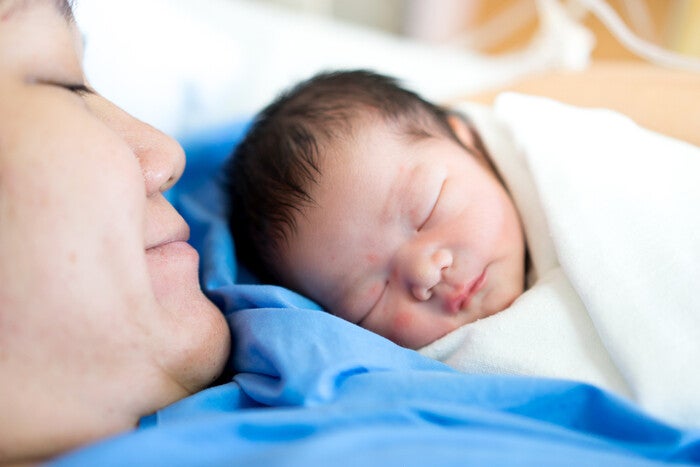
Once your baby arrives, update PhilHealth to add them as your dependent.
Here’s what to prepare before your baby arrives, and what to update once they’re born.
Before your baby arrives
- Confirm your PhilHealth Identification Number.
- Check that your membership type is updated to self-earning individual.
- Declare your current monthly income.
- Pay your contribution ahead of your due date and keep receipts.
- Prepare a valid ID and your PMRF.
After your baby arrives
- Bring your child's PSA-issued birth certificate and a PMRF marked "For Updating" to your PhilHealth office.
- Once processed, your child appears on your updated MDR, covered under your membership without a separate one.
FAQs About PhilHealth Contribution for Self-Employed Parents
Still have questions about PhilHealth contribution for self-employed parents? Here are quick answers to what most parents ask.
How much is PhilHealth contribution for self-employed members?
For 2026, you're charged 5% of what you declare, capped between ₱500 and ₱5,000 a month.
Do self-employed parents pay the full PhilHealth contribution?
Yes. As a self-employed member, the full premium is yours to shoulder; there’s no payroll deduction covering part of it for you.
How do I change my PhilHealth status from employed to self-employed?
Submit a new PMRF marked “Updating/Amendment” at your nearest LHIO, along with your existing PIN and current declared income.
How do I add my child as a PhilHealth dependent?
Bring your child’s PSA-issued birth certificate and an updated PMRF to a PhilHealth office so your MDR reflects them as a dependent.
What happens if I miss a PhilHealth contribution payment?
Your membership doesn’t get cancelled, and you can still use your benefits under the government’s “immediate eligibility” rule. But unpaid months still accumulate, along with interest, so it’s worth catching up when you can to avoid a bigger bill later.
Do I need to wait before I can use my PhilHealth benefits after registering?
No. Immediate eligibility means your coverage applies as soon as you’re a registered member, even before you’ve built up months of contributions.
Take Advantage of Your PhilHealth Benefits
Staying on top of your PhilHealth contribution for self-employed parents means fewer surprises when you need coverage most, from hospital stays to newborn care. Keep your rate current, your PMRF and MDR updated, and your payments on schedule, and the whole process becomes routine instead of a scramble. Set a recurring reminder before each due date, and generate your Statement of Premium Account ahead of time rather than at the counter. That small habit protects your coverage, and your child's, right when you need it most.
Before you go: if you’re also sorting through other parenting benefits, here’s more on paternity leave in the Philippines, expanded maternity leave law, and solo parent requirements.
Got questions? Join the ParenTeam Moms and Dads Facebook group and ask other members who are figuring out the same process for PhilHealth contributions for self-employed parents.
References
Philippine Health Insurance Corporation. "Registration Procedures for Informal Economy Members." Accessed August 6, 2026. https://www.philhealth.gov.ph/members/informal/registration.php
Philippine Health Insurance Corporation. "Data Amendment for Informal Economy Members." Accessed August 6, 2026. https://www.philhealth.gov.ph/members/informal/amendment.php
Philippine Health Insurance Corporation. "Continuing Coverage for Informal Economy Members." Accessed August 6, 2026. https://www.philhealth.gov.ph/members/informal/continuing.php
Philippine Health Insurance Corporation. PhilHealth Advisory No. 2025-0002: Premium Contribution for All Direct Contributors for CY 2025. Accessed August 6, 2026. https://www.philhealth.gov.ph/advisories/2025/PA2025-0002.pdf
Philippine Health Insurance Corporation. PhilHealth Advisory No. 2026-0016. Accessed August 6, 2026. https://www.philhealth.gov.ph/advisories/2026/PA2026-0016.pdf
Philippine Health Insurance Corporation. PhilHealth Advisory No. 2021-004: Immediate Eligibility. Accessed August 6, 2026. https://www.philhealth.gov.ph/advisories/2021/adv2021-004.pdf
Philippine Health Insurance Corporation. PhilHealth Member Registration Form (PMRF). Accessed August 6, 2026. https://www.philhealth.gov.ph/downloads/membership/pmrf_012020.pdf
Oblianda, Antonino S. "All Filipinos Are PhilHealth Members Entitled to Services." Philippine Information Agency, November 7, 2025. Accessed August 6, 2026. https://pia.gov.ph/news/all-filipinos-are-philhealth-members-entitled-to-services/
Related articles

How to Claim 14 Days of Paternity Leave: A Dad’s HR Filing Guide
Paternity leave gives you seven paid days to support your wife and bond with your baby. Learn how to qualify, file with HR, and claim up to 14 days total.
7 mins to read

How Much Do You Need to Save for Your Child’s College Tuition Fees
It's never too early to think and plan for college tuition fees, which increase yearly. Here's how much they cost now and how to calculate future costs.
5 mins to read

Do You Need a Pacifier for Your Baby? What to Know Before Deciding
Here’s what a pediatrician wants you to know about using a pacifier.
9 mins to read

Iba ang Pambata: Why Age-Appropriate Milk Matters
You wouldn’t let your youngest child wear ate or kuya’s shoes—so why give them milk that isn’t made for their age? Milk is not one-size-fits-all.
5 mins to read

Wais Pag Sakto sa Edad: Why Age-Appropriate Milk Matters
Milk comes in many forms, but not all milk is made equal. Learn why kids need age-appropriate nutrition during their most critical years of growth.
6 mins to read

15 Filipino Parenting Myths: What to Keep or Let Go, According to Stage
Cravings and pwera usog? Filipino myths are part and parcel of parenting. Here’s what’s sentimental, what’s outdated, and what modern medicine actually says.
14 mins to read

Baby Toothpaste Guide: What to Use from First Tooth to Toddler Years
Baby toothpaste matters more than you’d think. Know how to pick the right one, use the right amount, and the right time to start, from that very first tooth.
7 mins to read

A Doctor Explains How to Use a Nasal Aspirator on Your Baby
A nasal aspirator can help your congested baby breathe easier, sleep better, and feed without a fight. Here’s how to use one safely, according to a pediatrician.
8 mins to read

5 Signs You Need to Switch Your Baby’s Laundry Detergent
Does your little one have a rash that won’t go away? It could be caused by your baby laundry detergent. Here’s how to spot the signs and know what to do next.
4 mins to read

What Is Stunted Growth? A Pediatrician’s Guide for Parents
Worried people think your child is bansot or pandak, Mommy? Behind that teasing is a real concern: stunted growth. Here’s how pediatricians check for it.
4 mins to read

Newborn Essentials: A Real-Parent Guide for the First 90 Days
Overwhelmed by baby shopping? Check out this no-hype guide for Filipino parents that break down the true newborn essentials—plus which items to skip or splurge on.
7 mins to read

Baptism and Christening Costs in the Philippines: What to Expect
Baptism and christening costs in the Philippines add up fast. See where the money goes, and where you can spend less without losing the meaning.
8 mins to read

A Parent’s Guide to Caring for Cradle Cap in Babies
Cradle cap in babies is common, harmless, and easy to manage with the right daily routine. Here’s what actually works, according to a pediatrician.
6 mins to read

15 Time-Saving Mother's Day Gift Ideas New and Toddler Moms
These useful gifts for new moms will make them feel supported, loved, and more like themselves again.
6 mins to read

How to Spot and Manage Your Baby’s Eczema at Home
Spotting baby eczema early helps you treat it fast. Learn to tell it apart from typical dry skin and explore easy routines to soothe their skin.
6 mins to read

6 DIY Montessori Toys You Can Make for Every Development Stage
Montessori toys built from household scraps? You can do it, too, Mom! Discover six DIY ideas that sharpen your child’s skills without the hefty price tag.
9 mins to read

Hooked on K-Dramas? 9 Korean Boy Names Inspired by Beloved Characters
These Korean boy names from popular K-dramas are perfect for your little one. Find a name with a beautiful meaning and strong character traits today.
9 mins to read

Bakit Nagugulat si Baby? A Doctor Explains the Moro Reflex in Newborns
The Moro reflex makes your baby suddenly throw their arms out. Learn what triggers this typical infant reaction and discover simple ways to soothe your startled newborn.
6 mins to read

How to Take a Clear Baby Picture for Visas and Passports
Getting a proper baby picture is tricky. Here's how to set up your background, time the session, and finally nail that open-eyed shot at home.
8 mins to read


